

A Week in the Life of a Funded Trader
A realistic breakdown of how funded traders manage accounts day to day.

A funded trader’s routine isn’t about waking at 4:30 AM or trading the New York open. The routine depends on strategy and the markets they trade. A London session scalper operates nothing like an Asia session swing trader. What stays constant across all funded traders? The discipline framework! Preparation, execution, review, and risk management. This will reveal the daily story of a funded trader.
| SUMMARY BOX 1. Funded trader routines adapt to three variables: trading style (scalper, day trader, swing trader), market session (Asia, London, New York), and time zone, but most funded traders try to follow the same discipline structure of prep, execution, and review. 2. Regardless of style, funded traders separate preparation time from execution time, enforce pre-written trade criteria, and prioritize journaling, even when trading only 2–3 times per week. 3. The routine protects the account through continuous risk checks: daily drawdown monitoring for active traders, weekly position reviews for swing traders, and immediate rule-break documentation for most categories. |
Three Layered Framework That Work for Any Trading Style
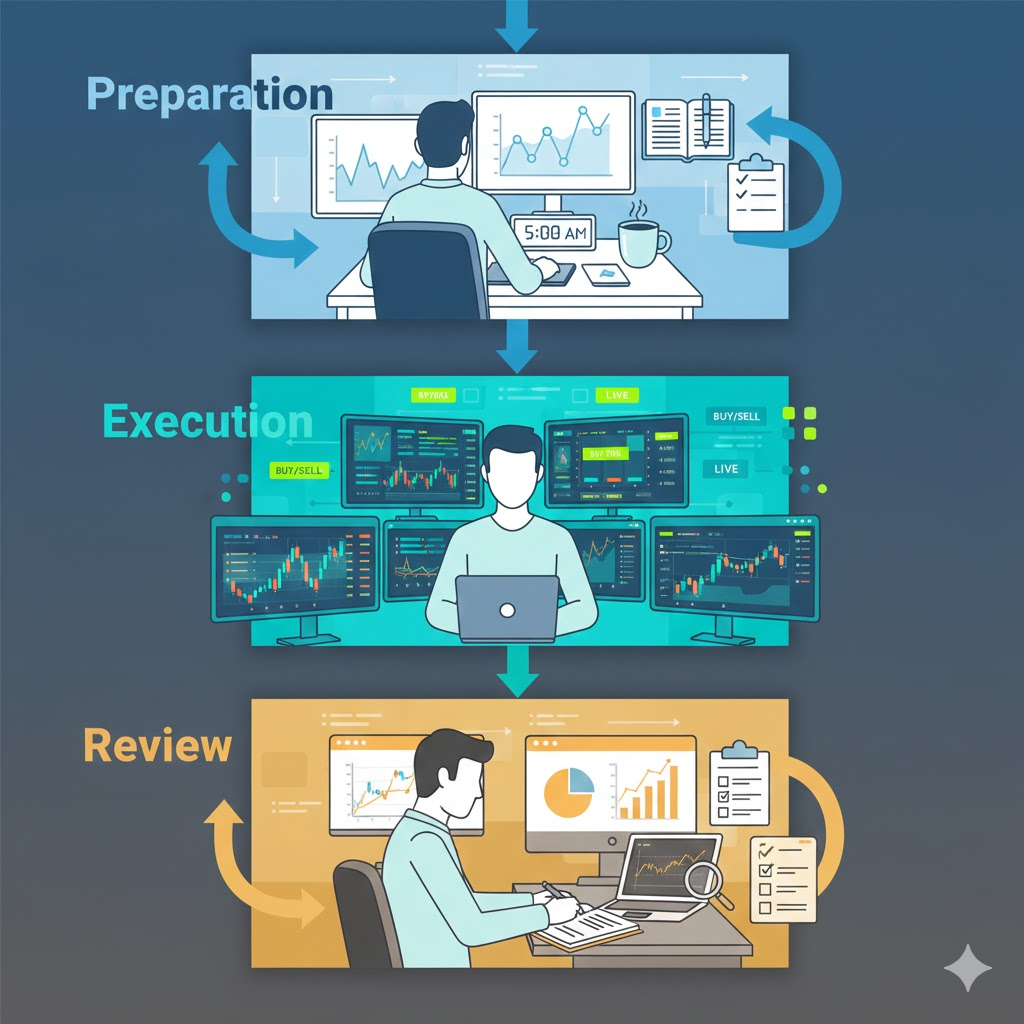
The routine isn’t about when you wake up. It’s about three layers that repeat:
Layer 1: Preparation (before markets)
Layer 2: Execution (during trading hours)
Layer 3: Review (after session close)
The strategy determines the timing. The structure stays the same.
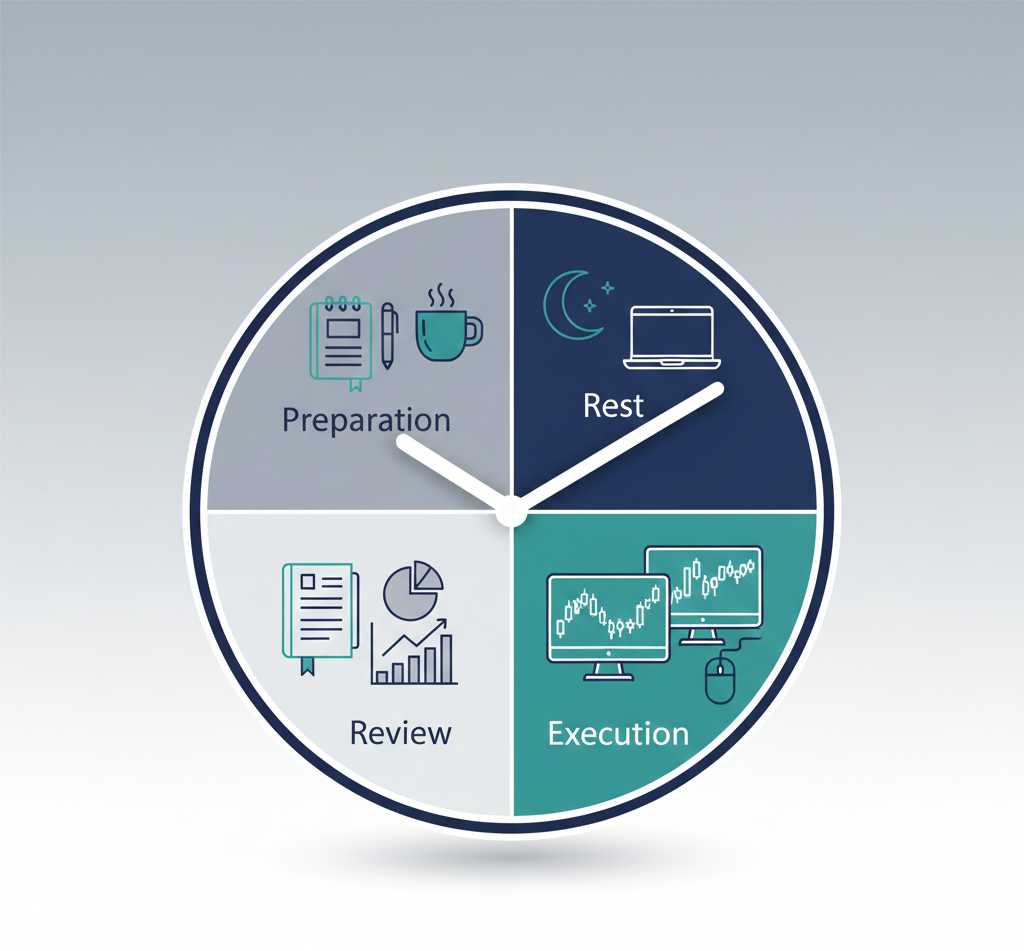
The Clock Depends on Your Markets
The Simple Truth About Timing
Traders don’t pick their schedule. Markets pick it for them.
The question isn’t “when should I wake up?” The question is: “When are MY markets actually moving?”
Trading London session from Europe? You prepare at 6 AM, trade 8 AM–12 PM, review by 1 PM. Afternoons are free.
Trading New York from Tokyo? You prepare at 8 PM, trade 10 PM–2 AM, review by 3 AM. You sleep normal hours, just shifted.
Trading overlap hours (London + New York)? You focus on the 4-hour window when both markets are open. That’s 8 AM–12 PM EST. Preparation happens before. Review happens after.
The pattern: funded traders build their day around market hours, not the other way around.
INSIGHT:
Your market picks your schedule. A funded trader in London trading EUR/USD and a funded trader in Singapore trading the same pair live completely different days, and both are doing it right.
Layer 1: Preparation (Before You See a Single Chart)
Funded traders separate preparation from execution. Charts stay closed during this time.
What Happens 1–2 Hours Before Markets Open
Step 1: Mental reset (20–30 minutes)
Cold shower, walk, stretch, coffee, whatever cleared yesterday. No phone, charts or news yet. The goal is a clear head, not information overload.
Step 2: Market context check (15–20 minutes)
- What happened overnight? (If trading a different session than you sleep)
- Any major news today? (Economic calendar check)
- Where did the price close yesterday?
- What’s the current market structure? (Trending, ranging, choppy)
This isn’t a prediction. It’s orientation.
Step 3: Plan review (15 minutes)
Funded traders write their game plan on Sunday. Most mornings, they re-read it. No new ideas get added 30 minutes before markets open. The plan was made when they were calm, not when price was moving.
Step 4: Risk rules lock-in (10 minutes)
- Maximum loss for today: written down (example: “1.5% max”)
- Position size per trade: calculated in advance
- Maximum trades allowed today: set clearly (example: “3 trades max”)
- Account status check: current drawdown, remaining risk budget
The rule: If it’s not written before the session, it doesn’t happen during the session.
Layer 2: Execution (When Markets Are Open)
This is where trading style changes everything.
Day Traders: Focused Windows
Session length: 3–6 hours
Trade frequency: 2–8 trades per day
Pattern: Trade mostly their pre-planned setups. Take mandatory breaks every 90–120 minutes. Close all positions before the session ends.
Example day:
- 8:00 AM: Markets open, first setup watch
- 9:15 AM: First trade taken (matched written criteria)
- 10:30 AM: 20-minute break (walk, water, no screens)
- 11:45 AM: Second trade opportunity assessed
- 1:00 PM: Session complete, all positions closed
Key discipline: Day traders check account drawdown after every 2–3 trades. If they hit 75% of their daily loss limit, they stop immediately, even if it’s only 10 AM.
Swing Traders: Lower Frequency, Longer Holds
Session length: 30–60 minutes active daily
Trade frequency: 1–5 trades per week
Pattern: Daily 15-minute position checks. Trade mostly when setup matches exact criteria. May go 5–7 days without placing a new trade.
Example day:
- 7:00 AM: 15-minute chart check (open positions status)
- Throughout day: No charts watched
- 6:00 PM: 15-minute evening check (any setup developing?)
- If no setup: Done for the day (most days look like this)
Key discipline: Swing traders succeed by NOT trading. Their discipline is patience, not activity. A week with one perfect trade beats a week with ten mediocre trades.
| The Pre-Trade Checklist (Every Funded Trader Uses This) Before any trade, funded traders verify: 1. Does this match my written setup? (Yes/No) 2. What’s my exact entry price? 3. Where’s my stop-loss? (Set before order) 4. Where’s my target? (Set before order) 5. What’s my position size? (Matches plan, not emotion) 6. Am I within today’s risk limit? (Yes/No) If any answer is “No” or unclear: they don’t trade. This checklist feels slow. It’s supposed to. It’s filtering out 80% of tempting trades that would have violated rules. |
The Mid-Session Reality Check
For active traders (scalpers, day traders):
Take an intentional break every 90–120 minutes. Ten minutes, no screens. Walk, water, bathroom, anything but charts. Fatigue creates mistakes. Breaks are risk management.
For all traders:
If you hit your daily loss limit, you stop. No “one more trade to make it back.” The limit exists to prevent exactly that thinking. Close the platform. Review happens later.
Layer 3: Review (Where Most Traders Skip, Where Funded Traders Win)
The session is over. Charts are closed. Now the real work starts.
Immediate Post-Session Journal (30–45 minutes)
Every trade gets logged:
- Entry price and reason (which setup criteria matched?)
- Exit price and reason (target hit, stop hit, manual close?)
- Position size used
- Emotional state (calm, anxious, rushed, confident?)
- Rule adherence: Did I follow my plan? (Yes/No)
- One-sentence lesson
Format doesn’t matter. Spreadsheet, notebook, app—pick one, stay consistent.
The funded trader mindset: This isn’t punishment for losing trades. It’s data collection for every trade. Winners and losers both get journaled identically.
FXIFY’s industry leading dashboard comes in handy here, you can have necessary information from there and use it in your journal to review.
Weekly Deep Dive (Saturday or Sunday, 2–3 Hours)
Once per week, funded traders compile everything:
Metrics calculated:
- Win rate percentage (trades won ÷ total trades)
- Average risk-to-reward ratio
- Maximum drawdown used this week
- Best trading time windows (when do I perform best?)
- Worst trading time windows (when do mistakes cluster?)
Discipline graded:
“Did I follow my written plan on 80%+ of trades?”
If yes: Continue the same plan next week.
If no: Identify why rules broke, add prevention steps, reduce position size 30% until discipline returns.
Mistake log updated:
List 2–3 execution errors from the week. Example: “Took trade #4 on Tuesday without a written setup” or “Increased size after two wins (emotion, not plan).”
Then ask: What process change prevents this next week?
Sunday Planning (1–2 Hours)
Before the new week starts, funded traders write:
- Next week’s game plan (specific setups, risk rules, session times)
- Process goals (not profit goals): “Follow plan 90% of trades, journal within 30 minutes every day, take breaks every 2 hours”
- Maximum trades for the week
- Any adjustments based on last week’s data
This plan gets re-read every morning. It’s the rulebook.
PERSPECTIVE SPLIT: Same Discipline, Different Execution
| Day Trader Week | Swing Trader Week |
| 20–25 trades across 5 days | 2–3 trades across 7 days |
| Daily 4-hour execution blocks | Daily 15-minute checks |
| Immediate post-session journaling | Trade-day journaling only |
| Friday often reduced or skipped | Friday identical to Monday |
| Success = consistent execution across sessions | Success = patience between setups |
What Stays the Same (Regardless of Style or Session
1. The Plan Comes Before the Trade
No funded trader “sees what happens” when markets open. They know their setups before charts move. Improvisation is what evaluation accounts filter out.
2. Risk Limits Are Hard Stops
Daily loss limits aren’t suggestions. Weekly drawdown caps aren’t guidelines. When hit, trading stops. This protects the funded account when emotions are loudest.
3. Journaling Isn’t Optional
Every trade gets documented. Not just losers. Winners too. The journal is the database that reveals patterns you can’t see in real-time.
4. Reviews Grade Process, Not Profit
A funded trader can lose money all week and call it a success, if they followed their plan perfectly. Process adherence matters more than P&L because process is what compounds over months.
5. Recovery Is Part of the Routine
Seven to eight hours of sleep minimum. Daily physical movement (walk, gym, anything). One non-trading hobby. These aren’t luxuries, they’re what keeps decision-making sharp.
INSIGHT:
The best trading week often follows the week you didn’t obsess about trading. Funded traders protect recovery time as seriously as they protect risk limits.
KEY TAKEAWAYS: The Weekly Rhythm
- Sunday preparation sets the entire week’s rules, no improvising during sessions
- Daily routines flex around market hours, but include preparation, execution, and review layers
- Weekly reviews grade discipline quality (sticking to plan) over profit results
- The hardest part isn’t trading, it’s not trading when setups don’t match your criteria