


Are AI and Bots Replacing Retail Traders?
Algorithms now execute between 60-75% of US equity trades. This article explains the difference between traditional algorithmic trading and AI-based trading, why bots fail during unpredictable market events, and what retail traders need to do to remain relevant in automated markets.
Summary: Algorithms now execute between 60-75% of US equity trades. This article explains the difference between traditional algorithmic trading and AI-based trading, why bots fail during unpredictable market events, and what retail traders need to do to remain relevant in automated markets.
Automated systems now dominate the execution side of financial markets. According to JPMorgan, between 60 and 75% of all US equity trading is carried out by algorithms. In forex markets, the figure is even higher. Finance Magnates estimates that 85% of forex trading volume is now algorithmic.
If you are a retail trader, these numbers matter. They change how the market moves, how liquidity behaves around news events, and why prices sometimes react in ways that feel disconnected from the underlying story.
But the claim that “bots are replacing retail traders” is not accurate, at least not as usually presented. To understand what is really happening, you need to understand what these systems actually are, what they can do, and where they consistently fail.
Algorithmic Trading and AI Trading Are Not the Same Thing
Most articles about “AI bots replacing traders” misuse the term “AI”. The majority of automated trading in markets today is not driven by artificial intelligence. Algorithmic trading systems drive it.
Algorithmic trading means a computer executes trades based on a fixed set of rules written by a human. The rules do not change unless a programmer changes them. If the price crosses a moving average, the system buys. If volatility reaches a certain level, the system exits. The machine follows the instructions. It does not learn, adapt, or decide.
AI-based trading differs from traditional algorithms because true AI systems, using machine learning and reinforcement learning, can adapt to new market conditions by detecting patterns that the programmer did not explicitly define. They update their behaviour as new data arrives, which can help traders understand how AI might respond differently during unpredictable events. According to EBC Financial Group, the key distinction is that AI can pick up patterns humans did not specify. Still, this flexibility introduces additional model risk and depends heavily on the quality of input data.
The distinction matters because the limitations of each type are different. A traditional algorithmic system fails when the market moves outside the rules it was written for, such as during sudden crises. An AI system can also fail when it encounters conditions that were not represented in the data it learned from, like during unprecedented market shocks. Both can fail, especially in extreme events, but they do so in different ways. Understanding these limitations helps traders prepare for unexpected market moves.
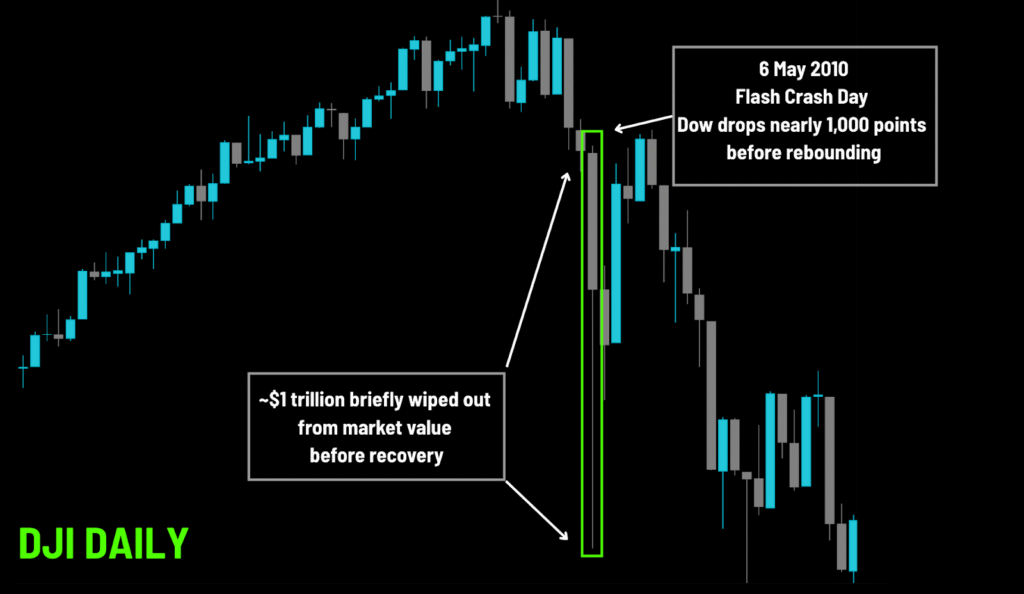
When the 2010 Flash Crash occurred on May 6, the event was driven by traditional high-frequency trading algorithms, not by AI. A large automated sell order from Waddell & Reed Financial, worth approximately $4.1 billion in E-Mini S&P futures contracts, triggered a cascade of algorithmic responses. High-frequency trading systems repeatedly bought and resold contracts among themselves, creating what the SEC described as a “hot potato” volume effect. In 14 seconds, those systems traded over 27,000 contracts, representing 49%of total volume at that time. The Dow Jones fell nearly 1,000 points before partially recovering. The SEC and CFTC later confirmed that high-frequency algorithms exacerbated the decline. Human intervention, including the manual suspension of E-Mini trading, helped halt the collapse.
How Much of the Market Is Now Automated and What That Means for Your Trades
Algorithmic trading has grown steadily since the early 2000s. According to QuantifiedStrategies.com, algos now account for approximately 60% to 75% of trading volume across US equity markets, European financial markets, and major Asian capital markets. In US forex markets, the proportion is higher still.
The global algorithmic trading market was valued at $21.06 billion in 2024 and is projected to reach $42.99 billion by 2030, according to Grand View Research. A separate report from the AI trading software market suggests that the segment alone could grow from $11.5 billion in 2024 to $75.5 billion by 2034.
For retail traders, what matters is not the market size figure. What matters is the practical effect on price behaviour.
Algorithms make markets more efficient during normal conditions. They narrow bid-ask spreads and provide liquidity. But they can also amplify price moves during abnormal conditions, because many systems react to the same data at the same time. The IMF cautioned in 2024 that widespread AI trading can increase volatility when multiple models respond identically to the same market event. The 2010 Flash Crash illustrated exactly this feedback dynamic.
Retail traders who do not understand this will misread price action. Recognising that algorithms cause short-term distortions can give traders a practical edge and boost their confidence in managing risks.
Where Algorithmic Systems Fail and Why Human Judgement Still Has Value
Algorithmic systems have three persistent failure modes that retail traders can understand and use.
Overfitting. A system trained on historical data will often perform well on that data but fail in live markets when conditions change. This is called overfitting. The algorithm learned the past too precisely and cannot adapt to a new regime. This is why many retail algo traders report strong backtests but poor live performance.
Regime blindness. Algorithms do not know when the rules have changed. Human traders can recognise regime shifts by monitoring macro developments or observing price reactions, which can make traders feel more capable and in control.
Feedback cascades. When many algorithms respond to the same signal, their effects can be self-reinforcing, causing sharp moves. Recognising this pattern can help traders avoid being caught in the whipsaw, fostering a sense of strategic control.
The Eurekahedge AI Hedge Fund Index, which tracks funds using AI-based strategies, returned approximately 9.8% annualised from December 2009 to July 2024, compared to 13.7% for the S&P 500 over the same period. This is not evidence that AI is worthless. It is evidence that AI is a tool, not a guaranteed edge. The best outcomes come from combining it with human judgment.
How Retail Traders Can Work Alongside Algorithmic Systems Rather Than Against Them
The practical question is not whether algorithms are replacing retail traders. The question is whether retail traders are adjusting their approach to account for algorithmic market behaviour.
Several adjustments are directly actionable.
Trade away from the noise window. Algorithms react fastest in the first minutes after a news release. Spreads widen, liquidity thins, and prices can move sharply in both directions before settling. Trading 5 to 15 minutes after a release, once algorithmic positioning has stabilised, often produces cleaner entries.
Recognise liquidity sweeps for what they are. Many short-term price spikes below support or above resistance are algorithmic stop hunts. The algorithm pushes price to a level where retail stop-loss orders are clustered, triggers those orders to generate liquidity, then reverses. Traders who understand this pattern can use the sweep as an entry signal rather than exiting at exactly the point the algorithm wants them to.
Use algorithmic tools for execution, not for decisions. Platforms such as MetaTrader 5, TradingView with alerts, and QuantConnect allow retail traders to automate strategy execution without requiring any coding beyond basic scripting. The decision of what to trade, when to trade, and what size remains with the human. The algorithm handles the mechanical part without hesitation or deviation from the rules.
According to a 2023 eToro Global Trading Study, 45% of retail traders already use some form of automated strategy. This figure will rise. The traders who remain relevant are those who use automation to execute disciplined strategies faster and more consistently, while keeping the macro and contextual judgment for themselves.
Human Trader vs Algorithmic System: A Direct Comparison
The competition is not zero-sum. The comparison below shows where each has a structural advantage.
| Human Trader Edge | Algorithmic System Edge |
| Reads market context during news events | Executes orders in milliseconds |
| Identifies regime changes before data confirms them | Runs 24 hours a day without fatigue |
| Adapts strategy when macro conditions shift | Processes thousands of instruments simultaneously |
| Overrides a position when logic no longer applies | Maintains consistent position sizing with no emotion |
| Recognises when a breakout is a trap, not a signal | Applies stop-loss rules with exact precision every time |
The most effective approach in current markets combines both columns. You provide the strategy and the contextual judgement. Automation provides consistent execution.
What This Means If You Are Trading with a Prop Firm
Proprietary trading firms evaluate traders on disciplined risk management and consistent performance, not on whether they trade manually or use automation. FXIFY’s evaluation programs permit automated trading strategies, provided they meet the programme rules.
Regardless of the programme you choose, the evaluation tests your ability to manage drawdown and protect capital. An algorithm that performs well in backtesting but breaches a daily loss limit in live conditions will still fail the evaluation. Human oversight of the automated system is not optional. Full programme details are available at fxify.com/how-it-works.
Frequently Asked Questions
No. Algorithmic trading uses fixed rules written by a programmer. The system follows those rules and does not change unless reprogrammed. AI-based trading uses machine learning to detect patterns without explicit instructions and to update its behaviour as new data arrives. Most automated trading in financial markets today is algorithmic, not AI.
According to JPMorgan, between 60% and 73% of US equity trading is algorithmic. In forex markets, Finance Magnates estimates the figure at approximately 85%. The exact number varies by market and time period.
The SEC and CFTC concluded that a large automated sell order of 75,000 E-Mini S&P futures contracts triggered a cascade of high-frequency trading activity. Algorithms began passing the contracts back and forth rapidly, draining liquidity. The Dow Jones fell nearly 1,000 points in under 30 minutes before recovering when E-Mini trading was manually suspended. High-frequency algorithms exacerbated the decline. Human intervention was required to stop it.
Yes. Platforms such as MetaTrader 5 and TradingView allow retail traders to automate strategy execution without advanced programming knowledge. The advantage is consistent execution without emotional deviation. The risk is that a poorly designed algorithm can breach risk parameters faster than a human trader who monitors positions manually. Human oversight remains necessary.
FXIFY permits automated and algorithmic trading strategies across its evaluation programmes, subject to programme rules. FXIFY also allows news trading without restriction. Full details of each programme are available at fxify.com/programs.
No. The Eurekahedge AI Hedge Fund Index returned approximately 9.8% annualised from 2009 to 2024, compared to 13.7% for the S&P 500 over the same period. Algorithms can outperform in specific conditions but fail during regime changes and unpredictable events. Performance depends on how the system is designed, how well it is monitored, and whether it is adjusted when market conditions change.