





How to Stay Disciplined in the Final Stretch of a Prop Firm Evaluation
Most traders fail their evaluation in the final stretch – not because of bad strategy, but bad psychology. Learn how to manage urgency, protect your progress, and pass consistently.

SUMMARY
- The final stretch of a trading evaluation is a psychological trap. Proximity to a reward triggers urgency, and urgency leads to rule-breaking.
- The most common mistakes (oversizing, forcing trades, cutting winners short) don’t feel like mistakes in the moment.
- Discipline isn’t about willpower. It’s about having rules written before the pressure starts, and following them without exception until the phase is done.
Why the Final Stretch Is the Most Dangerous Part of an Evaluation
You have done the hard work. Your account is close to the evaluation target. One or two more trades and you could be through.
This is exactly when things go wrong.
The final stage of a prop firm evaluation is not just a technical challenge. It is a psychological one. Understanding what happens in your head during this phase, and how to manage it, is what separates traders who pass from traders who keep repeating the same phase.
Note: Throughout this article, “evaluation target” refers to the overall profit goal you need to reach to pass the phase — not the take-profit on an individual trade.
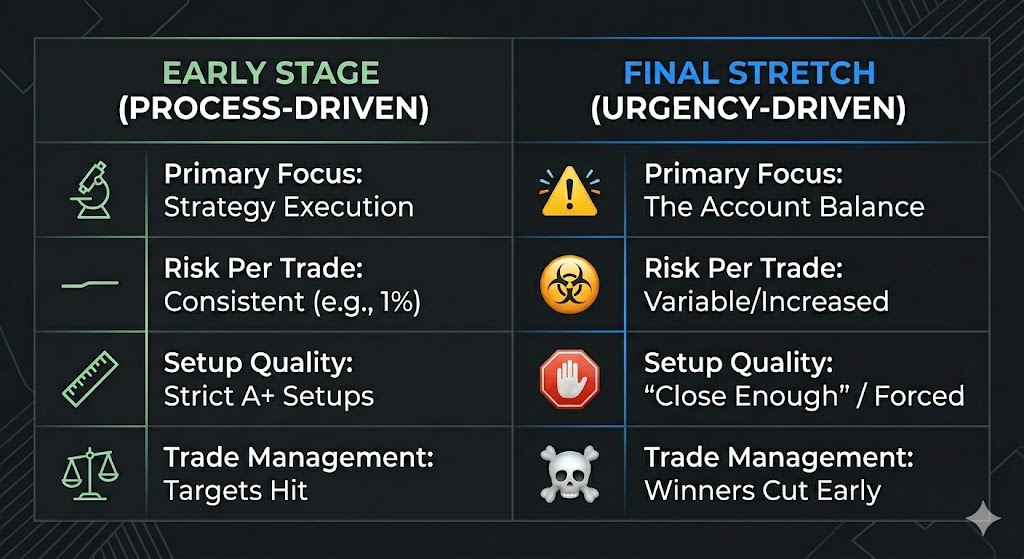
Why Discipline Breaks Near the Profit Target
The Shift in Focus
When your account balance is far from the target, you trade your strategy. You follow your rules because the result feels distant. There is no immediate pressure.
When you’re within 1–2% of the target, that changes. You stop thinking about trade quality and start thinking about the number. That’s a fundamental shift, and it quietly causes problems.
The Brain Responds to Proximity
The closer you are to a reward, the more urgency you feel. This is not a weakness. It’s how the brain processes incentives.
That urgency pushes you toward action. You want to close the gap. You feel that hesitation equals lost opportunity.
But in trading, urgency is a liability. Any decision made under pressure carries more risk than the same decision made in a calm, neutral state.
Behaviour Changes Without You Realising
The changes that happen near the target are often subtle. You don’t decide to break your rules. They just start feeling less important.
You rationalise a setup that doesn’t quite fit. You increase your size because ‘it’s just this one trade.’ You close a winner early because the profit looks good on the balance sheet.
Each of these feels reasonable in the moment. That’s what makes them dangerous.
What Actually Goes Wrong
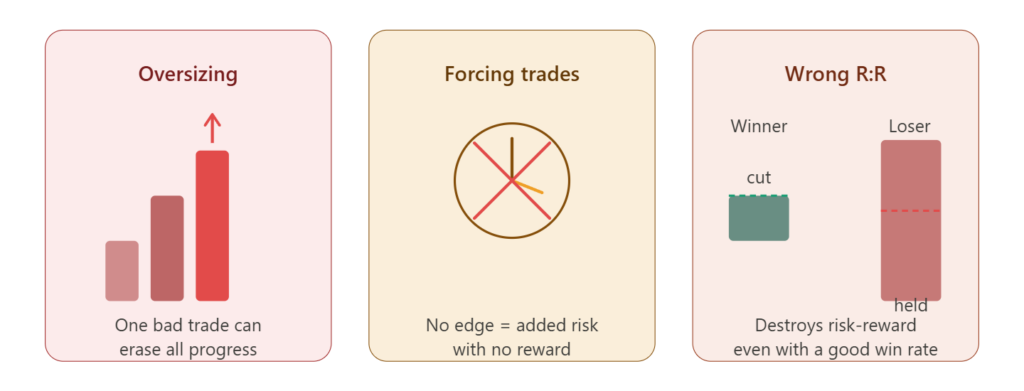
Increasing Position Size
This is the most destructive error traders make near the evaluation target.
The logic sounds reasonable: increase your lot size, reach the evaluation target faster. One trade does the work of three. What it ignores is the drawdown. A larger position on a losing trade doesn’t just cost more – it can push you into a drawdown that wipes out your progress entirely.
Prop firm evaluations have strict drawdown rules. One oversized losing trade can end a phase regardless of how well you traded before it.
Taking Low-Quality Trades
When you are waiting for the target, patience wears thin. Sessions pass without a clean setup. The temptation grows to force a trade.
A low-quality trade is any trade you wouldn’t have taken earlier in the evaluation. If the setup doesn’t meet your entry criteria, it doesn’t matter what the balance looks like — it’s still a bad trade.
Low-quality entries add risk without adding edge, and over time they quietly drag down your statistics.
Closing Winners Early and Holding Losers
Near the target, small gains feel more significant. A 0.5% profit looks meaningful because it visibly moves you closer to the goal.
This creates pressure to close winning trades before they reach their intended take-profit. You lock in the gain, the balance moves. It feels productive.
But the same trader will hold a losing trade longer than planned, waiting for it to come back.
This is the opposite of good trade management. Cutting winners short while extending losers destroys your risk-to-reward ratio — even a strong win rate can’t save a strategy run this way.
How to Stay Disciplined
Define Your Rules Before You Get Close
The right time to set your rules is not when you are near the target. It’s before the evaluation begins.
Write down the exact criteria for the following:
- Maximum risk per trade (as a fixed percentage of starting capital)
- Minimum criteria a setup must meet before you enter
- Maximum number of trades per session
- Daily loss limit that triggers an automatic stop
Rules written before the emotion kicks in act as a reference point. You’re not making decisions under stress — you’re following decisions that were already made.
Keep Risk Consistent Throughout
Your risk per trade should not change based on your account’s position relative to the target.
If you risk 1% per trade at the start of the evaluation, you risk 1% when you’re 0.5% from the finish. The number doesn’t move. This removes the temptation to accelerate, and it protects the account from one badly timed, oversized loss.
Apply the Same Entry Criteria
Your strategy has entry criteria. Apply them without exception.
A setup either meets the criteria, or it doesn’t. There is no category called ‘close enough.’ Once you start allowing setups that are almost there, you are no longer trading your strategy – you’re improvising.
Prop firm evaluations test consistency over time. Changing your entry criteria mid-phase introduces inconsistency into the data. That works against you even when individual trades happen to win.
Stop Watching the Account Balance During Sessions
The balance figure creates emotional responses. Watching it move up or down affects decision-making.
During a trading session, your job is to execute the strategy. The balance is an output of that process, not a tool you use while trading.
Close the tracker, focus on the chart, and review performance after the session — not during it.
A Practical Structure to Follow
The Pre-Session Checklist
Before every trading session:
- Confirm market conditions match your strategy requirements
- Set your maximum loss for the session in advance
- Confirm your lot size matches your standard risk percentage
- Identify the specific setup type you’re looking for
- Set a maximum number of trades for the session
Do not open a position until this checklist is complete.
Session Limits
A session limit is a rule that ends your trading activity for the day under defined conditions.
Examples of valid session limits:
- Stop trading after two losing trades in the same session
- Stop after four hours, regardless of the result
- Stop if the daily loss limit is reached
Session limits prevent overtrading and force you to stop when you are most at risk of making poor decisions.
Risk Limits Per Trade and Per Day
Set two numbers and don’t break them:
Per trade: The maximum percentage of starting capital you will risk on a single position.
Per day: The maximum percentage of starting capital you will risk across all positions in one session.
For example: 1% per trade, 2% per day. Once you hit the daily limit, you are done for the day, regardless of what the market is doing.
These numbers should match your normal parameters and should never be adjusted based on how close you are to the target.
When to Stop Trading for the Day
Stop trading when any of the following happen:
- You reach your daily loss limit
- You reach your daily profit target
- You hit your session trade count
- You catch yourself rationalising a setup that doesn’t meet your criteria
- You’ve had a profitable session and feel the urge to add more trades
That last one matters. Ending a profitable day at a reasonable point is discipline in itself. The goal isn’t to extract maximum profit from every session, but to complete the evaluation without breaking the rules.
Mistakes to Avoid
“Just One More Trade” Behaviour
The moment you think this, your decision-making has already broken down.
If your session limit is reached, the session is over. If your daily loss limit is hit, the day is over. These rules have no exceptions. “Just one more trade” bypasses everything you set up and replaces structured thinking with impulse. The outcome of that trade is irrelevant. The behaviour itself is the problem.
Changing Strategy Mid-Phase
Switching to a different setup type, timeframe, or entry method during an evaluation introduces a completely different risk profile.
You have no performance data on the new approach in these conditions. You are trading it without context, without historical results, and under emotional pressure.
If your strategy is not working, the right move is to stop trading and review, not to switch approaches in real time.
Trying to Rush the Finish
There’s no prize for completing an evaluation in the fewest possible days. Speed is irrelevant.
Rushing leads to overtrading, which leads to forcing setups, which leads to the exact behaviour that causes phases to fail at the end. A trader who takes three weeks to complete a phase with clean, consistent statistics is demonstrating far more skill than one who tries to finish in three days and fails.
Prop firms evaluate process, not pace.
Why Consistency Matters More Than Speed
What Prop Firms Actually Look For
When a prop firm reviews your evaluation, they are looking at more than whether you hit the evaluation target.
They assess drawdown behaviour, risk management consistency, and whether your performance is repeatable. A trader who passes with a low maximum drawdown and stable lot sizing looks fundamentally different from one who passed by taking aggressive risks in the final days.
This matters because funded accounts and the ability to scale your capital over time are tied to ongoing performance — not just passing a single phase.
Consistent Behaviour Builds a Reliable Track Record
A trading account that shows consistent risk per trade, consistent entry criteria, and disciplined session management tells a clear story. The performance is stable. The results are explainable.
That’s the kind of track record a prop firm wants to fund. It’s also the foundation that allows a trader to scale up over time. Passing with discipline means you’re building something repeatable. Passing by breaking your rules gives you a result, but not a foundation.
The Evaluation Is a Test of Process
The evaluation target is a threshold. It marks when the phase ends. It doesn’t tell you how to trade.
Treat the evaluation consistently from start to finish. Apply the same rules. Take the same quality setups. Risk the same amount per trade. When you do that, the target takes care of itself. You’re not chasing it, you’re executing a process that leads to it.
Ready to put this into practice?