

Is Prop Trading Taxable? (2026 Guide for Funded Traders)
Prop trading payouts are taxable. In virtually every major jurisdiction, money earned from trading a funded account is treated as income by tax authorities. The…
Prop trading payouts are taxable. In virtually every major jurisdiction, money earned from trading a funded account is treated as income by tax authorities. The exact classification – which determines what you report and how – depends on where you live. This guide explains how the IRS, HMRC, CRA, and ATO approach prop trading income, and what that means for you.
Proprietary trading firms provide traders with funded accounts. You trade the firm’s capital, not your own, within defined risk parameters. Before receiving a funded account, you complete an evaluation program by meeting profit targets while staying within drawdown limits. Firms such as FXIFY offer structured evaluation programs – see how it works for details.
Once funded, you receive a performance split – your share of the trading gains generated on the firm’s capital. Performance splits typically range from 50% to 90% of trading gains, depending on the firm and the program. The firm retains the remainder. Your portion is paid out. See FXIFY’spayout structure for specifics.
You earn money by performing a trading service for a firm. That is the distinction tax authorities focus on. It shapes how your income is classified.
Key Terms: Performance split – your share of trading gains from firm capital. Keeping detailed records of these terms can help you feel more secure and prepared when reporting your income.
Is Prop Trading Taxable?
Quick answer: Yes, prop trading payouts are taxable in most countries, but how you report and classify this income varies. Clarify whether your jurisdiction treats it as self-employment, business, or contractor income to help you understand your specific reporting obligations.
The central question is not just whether prop trading income is taxable, but how it is classified. A clear understanding of this can make you feel more empowered to handle your tax reporting correctly.
Classification varies by country, by the nature of your trading arrangement, and by your individual circumstances. Provide specific examples of tax treatment in different countries to address potential confusion about jurisdiction-specific rules and help traders identify their obligations accurately.
How Tax Authorities Determine Trading Classification
Tax authorities do not automatically classify all trading income the same way. They look at specific factors to decide whether your activity is a business, a profession, or something else.
The most common factors examined include:
• Frequency – how often you trade and receive payouts
• Organisation – whether you operate in a systematic, commercial way
• Profit motive – whether you carry out the activity with the intention of making a profit
• Dependence – whether trading is your primary or a significant secondary source of income
• Continuity – whether you trade regularly over time, not just occasionally
Consider a funded trader based in Manchester who receives monthly payouts from a US-based prop firm. Under HMRC’s framework, that trader trades frequently, operates commercially through a funded account program, and earns income from it regularly. HMRC would likely treat those payouts as self-employment income. The trader would need to report via Self Assessment.
Failure to report trading income can result in tax assessments, interest on underpaid tax, and financial penalties. In serious cases, tax authorities may open a formal investigation. The obligation to report applies regardless of whether your prop firm sends you a tax document.
How Prop Trading Is Taxed in Major Countries
United States

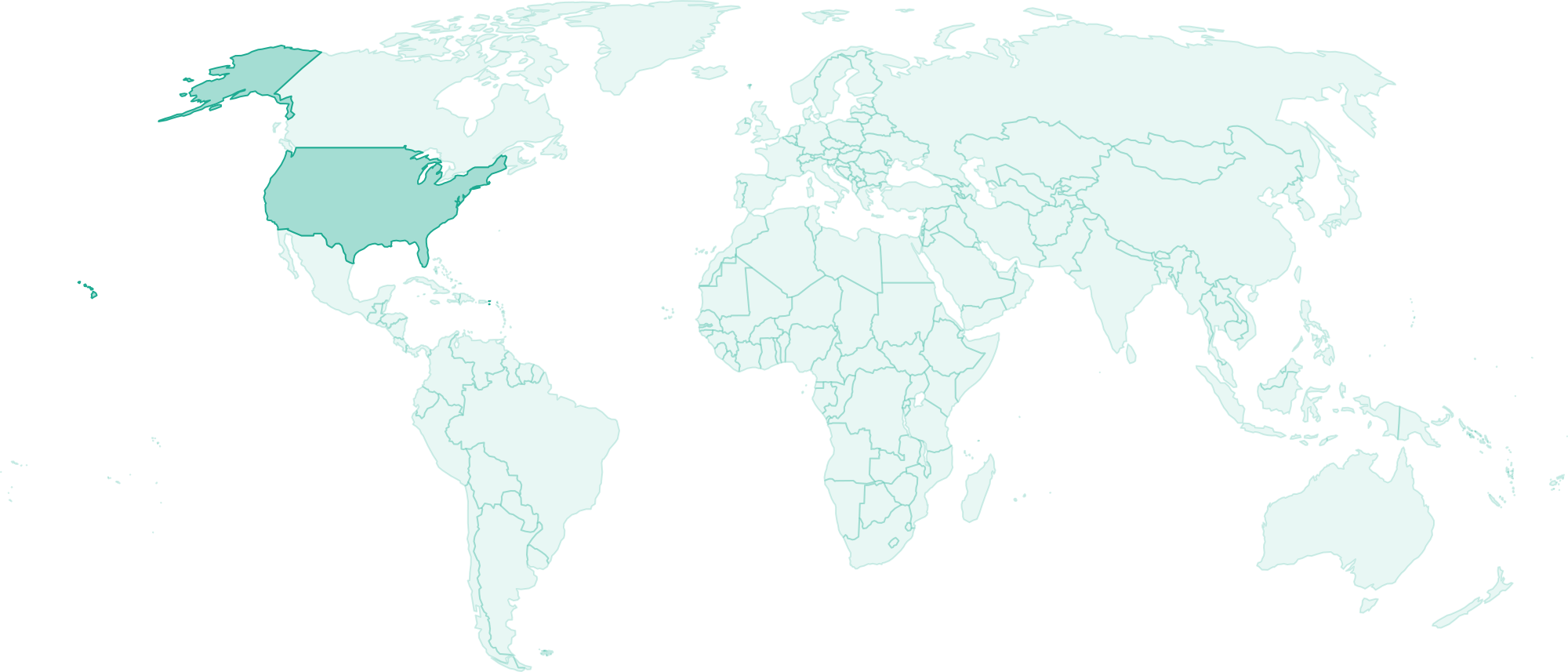
The Internal Revenue Service (IRS) treats income from trading activity as ordinary income. See IRS Topic 429 for its guidance on traders in securities. Prop trading payouts do not qualify as capital gains. Capital gains arise from selling assets you own. A performance split is income earned from a service, not a capital disposal.
Most funded traders in the US report payouts as self-employment or contractor income. You are responsible for reporting this on your annual tax return. Self-employment tax also applies, covering your contributions to Social Security and Medicare programs.
Some high-volume or high-frequency traders may qualify as traders in securities under IRS rules, which unlocks the Section 475(f) mark-to-market election. This is a specific classification with distinct requirements – it does not apply automatically and depends entirely on your individual trading facts. Research this with a US-qualified tax professional if you believe it may apply to you.
United Kingdom

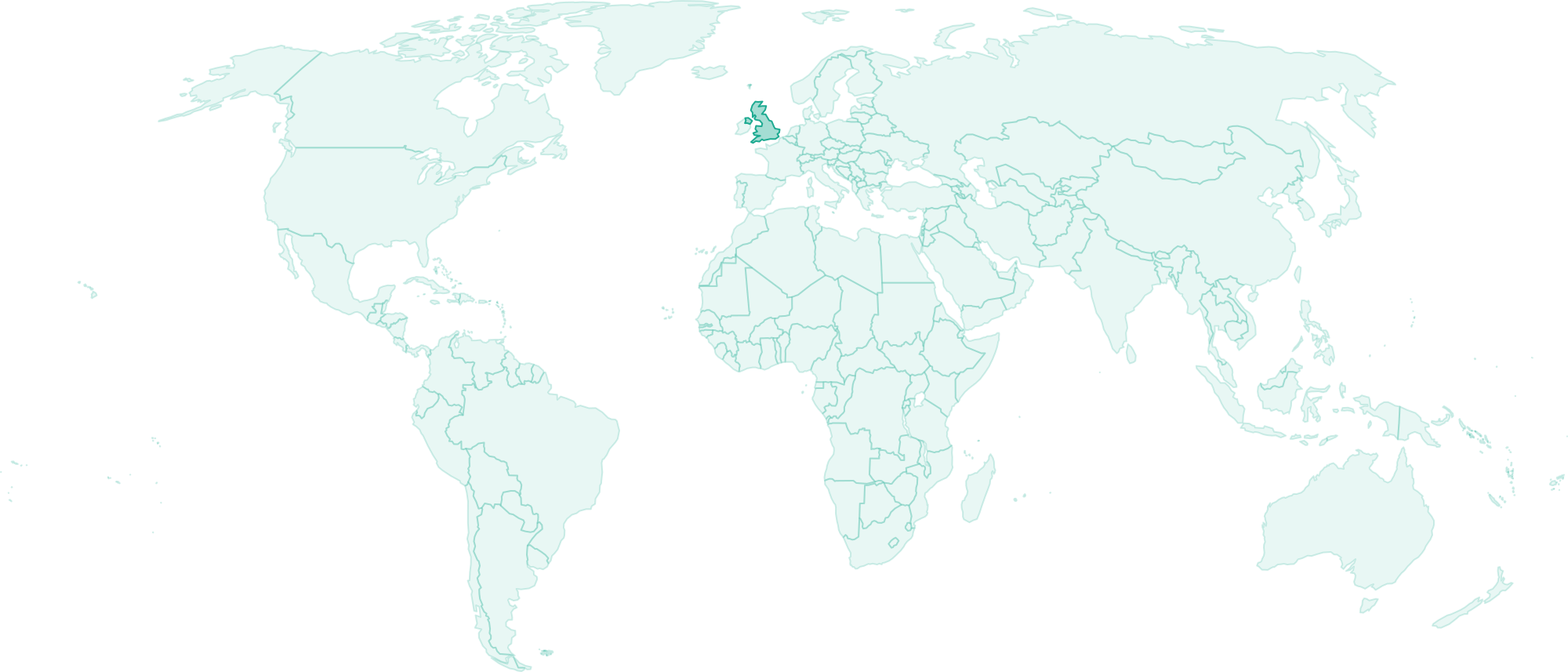
HM Revenue and Customs (HMRC) assesses trading income on a case-by-case basis, using its Business Income Manual (BIM) 56800 guidance on financial trading. The classification depends on the nature of your activity and how you conduct it.
For most funded traders, HMRC treats payouts as self-employment income. You report this through the UK Self Assessment system. If you have not already registered as self-employed, you are required to do so and file an annual Self Assessment tax return.
Being self-employed in the UK also triggers National Insurance obligations. Class 2 and Class 4 National Insurance contributions may apply on trading profits above the relevant thresholds. Many funded traders are unaware of this. Confirm your NI position with a UK-qualified accountant.
Spread betting profits in the UK are exempt from Capital Gains Tax and income tax under current UK tax law. However, this exemption does not apply to prop trading income in the standard funded account model. Do not assume it applies to your situation without taking specific advice.
Canada

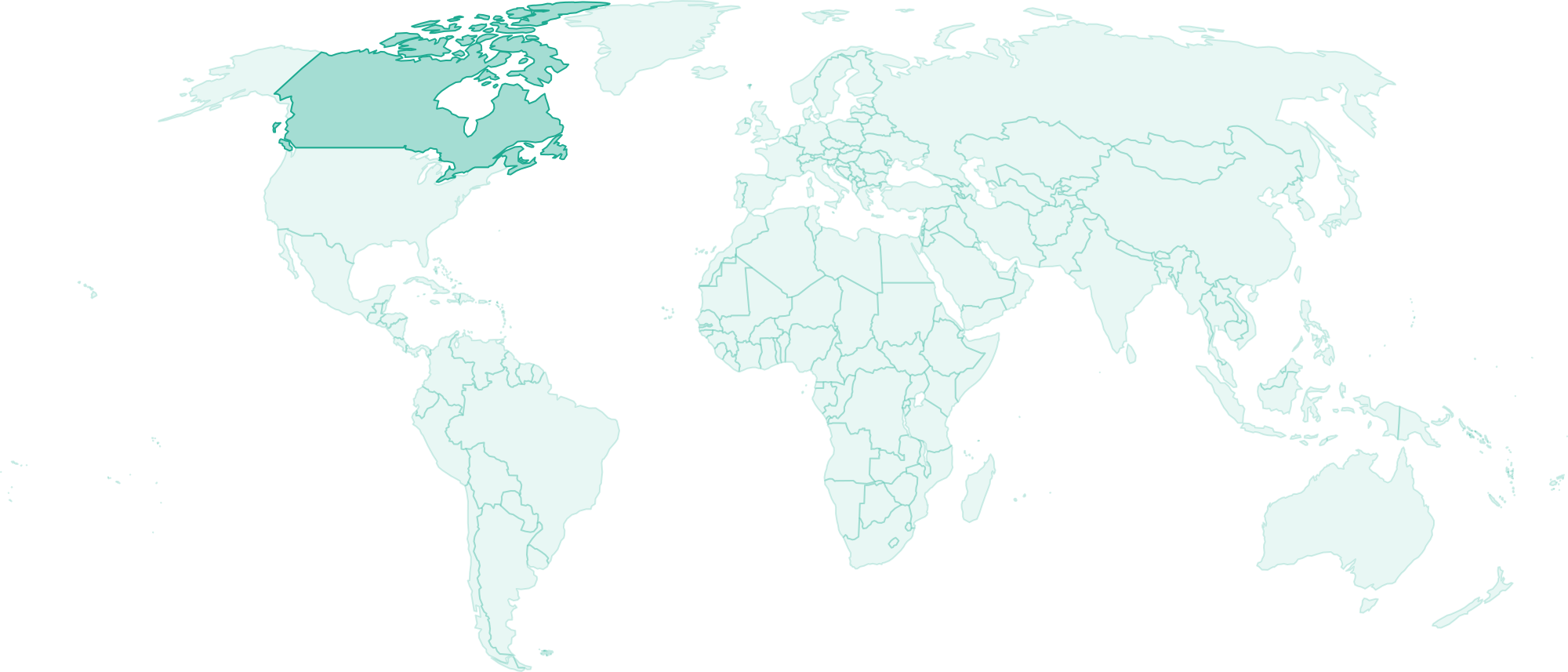
The Canada Revenue Agency (CRA) treats income from active trading as business income where you trade in a business-like way, with a genuine intention to make a profit. See the CRA guidance on business income for details.
Business income is fully taxable in Canada and does not qualify for the lower tax rate applied to capital gains. The CRA treats investing and active trading differently. Capital gains rules may apply to investing. Active trading is treated as a business.
If you receive regular payouts from a prop firm, the CRA is likely to classify you as carrying on a business. Report this income as business income on your T1 General tax return. Business expenses directly related to your trading activity may be deductible, subject to CRA rules.
High-earning Canadian traders should also check whether their business income exceeds the GST/HST registration threshold. If it does, you may need to register for and remit GST/HST. Confirm with a Canadian tax professional.
Australia

The Australian Taxation Office (ATO) classifies regular trading activity as a business activity where you operate consistently and with a profit motive. See the ATO guidance on business versus hobby.
The ATO treats prop trading payouts as assessable income – that is, income subject to tax. You include this in your Individual Tax Return (ITR) for the relevant financial year. The frequency, regularity, and commercial nature of your activity determine your classification.
Australian traders classified as carrying on a business may also need to lodge quarterly Business Activity Statements (BAS). This applies if your trading business is registered for GST. Confirm your BAS obligations with a registered Australian tax agent.
Jurisdiction Comparison Table
How tax authorities typically classify prop trading payouts. This is a general guide only – individual circumstances vary.
| Country | Classification | Reporting Method | Key Authority | Additional Note |
| United States | Self-employment/contractor income | Individual tax return | IRS | SE tax (Social Security & Medicare) may apply |
| United Kingdom | Self-employment/trading income | Self Assessment return | HMRC | Class 2 & 4 NI may apply |
| Canada | Business income | T1 General return | CRA | GST/HST registration may be required |
| Australia | Assessable business income | Individual Tax Return (ITR) | ATO | Quarterly BAS may be required |
Always confirm your classification with a qualified tax professional in your country. This table reflects common treatment, not universal rules.
Do Prop Firms Provide Tax Forms?
Whether your prop firm issues tax documentation depends on the firm and the jurisdiction. Practices vary across the industry.
In the United States, firms that pay a contractor USD 600 or more in a tax year are required to issue a Form 1099-NEC under IRS rules. However, this applies primarily to firms with a US presence. Many overseas prop firms do not have US operations and do not issue 1099 forms. Do not wait for a form before reporting. Your obligation to report income exists regardless of whether any documentation arrives. For information on how FXIFY handles payouts, see FXIFY fast payouts.
In other jurisdictions, prop firms do not issue formal tax documentation. You keep your own records and report your income accurately. This is self-reported income.
Ask your prop firm the following questions directly:
• Do you issue tax documentation for payouts? If so, in what format?
• Which jurisdictions does your tax reporting cover?
• Do you report payments to any tax authority on my behalf?
Common Tax Mistakes Prop Traders Make
These errors appear frequently among funded traders. Understanding them helps you avoid costly problems.
Assuming evaluation payouts are not taxable
Some traders believe payouts received during an evaluation phase are not real income. In most cases, they are. If you receive money in exchange for trading activity, tax authorities treat it as income – regardless of the label attached to the program.
Treating payouts as capital gains
Performance splits from prop firms are not capital gains. Capital gains arise from the sale of an asset. A payout from a prop firm is income earned from a service. Applying the wrong classification leads to underpayment of tax.
Failing to record payouts consistently
If you receive payouts across multiple months or from multiple firms, you must track every amount. Every payout is reportable. Incomplete records make accurate reporting difficult and increase your audit risk.
Ignoring income from overseas prop firms
If you are based in the UK and receive payouts from a US-based firm, you must still report that income to HMRC. Most tax systems require you to declare worldwide income. The foreign origin of the payment does not remove your obligation.
Example of Prop Trading Income Reporting
Illustration only. This is not tax advice and does not represent the rules of any specific jurisdiction.
Imagine a funded trader who receives performance-split payouts totalling $24,000 over a tax year, split into twelve monthly payments. During the same year, they spent $800 on a charting software subscription and $400 on a trading data feed. These are costs directly related to their trading activity.
At the end of the year, the trader calculates their taxable income. If their jurisdiction allows business expenses to be deducted from trading income, the calculation might look like this:
| Item | Amount (illustrative) |
| Total payouts received | $24,000 |
| Charting software (allowable expense) | −$800 |
| Data feed subscription (allowable expense) | −$400 |
| Illustrative taxable income | $22,800 |
Expenses that may be deductible – costs you can subtract from your income before tax – include trading software subscriptions, charting platforms, data feeds, trading course fees, and a proportion of home office costs where you trade exclusively from home. What qualifies depends entirely on your jurisdiction and individual circumstances. Consult a tax professional before claiming any deduction.
This is a simplified illustration. Do not use it as the basis for filing your tax return.
Record Keeping for Prop Traders
Accurate records are the foundation of compliant tax reporting. Keep documentation for every payout received and every relevant business expense.
Step 1 – Record every payout. Save payout statements from your prop firm and bank or payment processor transaction records. Screenshots of your dashboard earnings can support formal statements.
Step 2 – Track exchange rates for foreign currency payouts. If you receive payouts in a foreign currency, record the exchange rate on the date of each payment. Use a consistent conversion method throughout the year and document it. Many tax authorities require you to report income in your local currency.
Step 3 – Separate records per firm. If you trade with more than one prop firm, keep separate records for each. Mixing records from different sources without tracking their origin makes accurate reporting harder and raises your audit risk.
Step 4 – Track expenses. Keep invoices and receipts for all business expenses. Use accounting software such as QuickBooks or FreeAgent, or a well-organised spreadsheet. Do not leave this until tax season – missing receipts are difficult to recover.
Key Takeaways
• Prop trading is taxable. Whether prop trading is taxable has a clear answer in most jurisdictions: yes. Performance split payouts are income.
• Classification drives everything. Your income may be treated as self-employment income, contractor income, or business income – the classification determines your reporting obligations and potential deductions.
• Prop trading payouts are not capital gains. Do not apply capital gains treatment to performance split income.
• You are responsible for reporting. Whether or not your prop firm sends documentation, you must declare your income.
• Worldwide income rules apply. If you are a UK or Australian resident trading with a US-based firm, you must still declare those payouts locally.
• Record keeping protects you. Keep payout statements, expense receipts, and exchange rate records throughout the year – not just at tax time.
• Seek qualified advice once. Tax law is complex, and individual circumstances differ. Find a tax professional with experience in trading income and consult them before you file.
Frequently Asked Questions
Do prop traders pay taxes on payouts?
Yes. Payouts from prop firms are taxable income in most jurisdictions. The classification – and therefore the rate – depends on your country and your individual circumstances. Report all payouts to your relevant tax authority.
Are prop firm payouts capital gains?
No, in most cases. Capital gains arise from selling an asset you own. A prop trading payout is income earned from a trading service. In most jurisdictions, tax authorities treat it as income rather than a capital gain. Confirm the correct classification with a tax professional.
Do prop firms send tax forms?
It depends on the firm and the country. US-based firms that pay you USD 600 or more in a year are required to issue a Form 1099-NEC under IRS rules. Firms based outside the US do not issue 1099 forms. Maintain your own records and report income regardless of whether you receive any documentation.
How do funded traders report income?
The method depends on your jurisdiction. In the UK, you report via Self Assessment. In the US, you report on your individual tax return. In Canada, you file a T1 General and report business income. In Australia, you file an Individual Tax Return (ITR). Check with a local tax adviser to confirm your specific obligations.
Is prop trading considered self-employment?
In many jurisdictions, yes. Funded traders are treated as independent contractors or self-employed individuals because they provide a trading service in exchange for a share of profits. Being self-employed may mean additional reporting obligations – and in the UK, National Insurance contributions. Confirm with a qualified adviser what applies to you.
Does it matter if the prop firm is based in another country?
Yes. If you are a UK resident receiving payouts from a US-based firm, you must still report that income to HMRC. Most tax systems require you to declare worldwide income. The firm’s location does not reduce your reporting obligations.
Are prop firm challenge fees tax-deductible?
This depends on your jurisdiction and how you are classified. In jurisdictions where your trading is treated as a business, the cost of an evaluation program may be deductible as a business expense. This is not universal. Seek advice from a tax professional familiar with trading income before claiming any deduction.