

NFP Today: What’s in the Print and What It Signals
US Non-Farm Payrolls releases at 2:30 PM SAST today (8:30 AM ET). Here’s what’s in the data going in, what to watch in the print,…
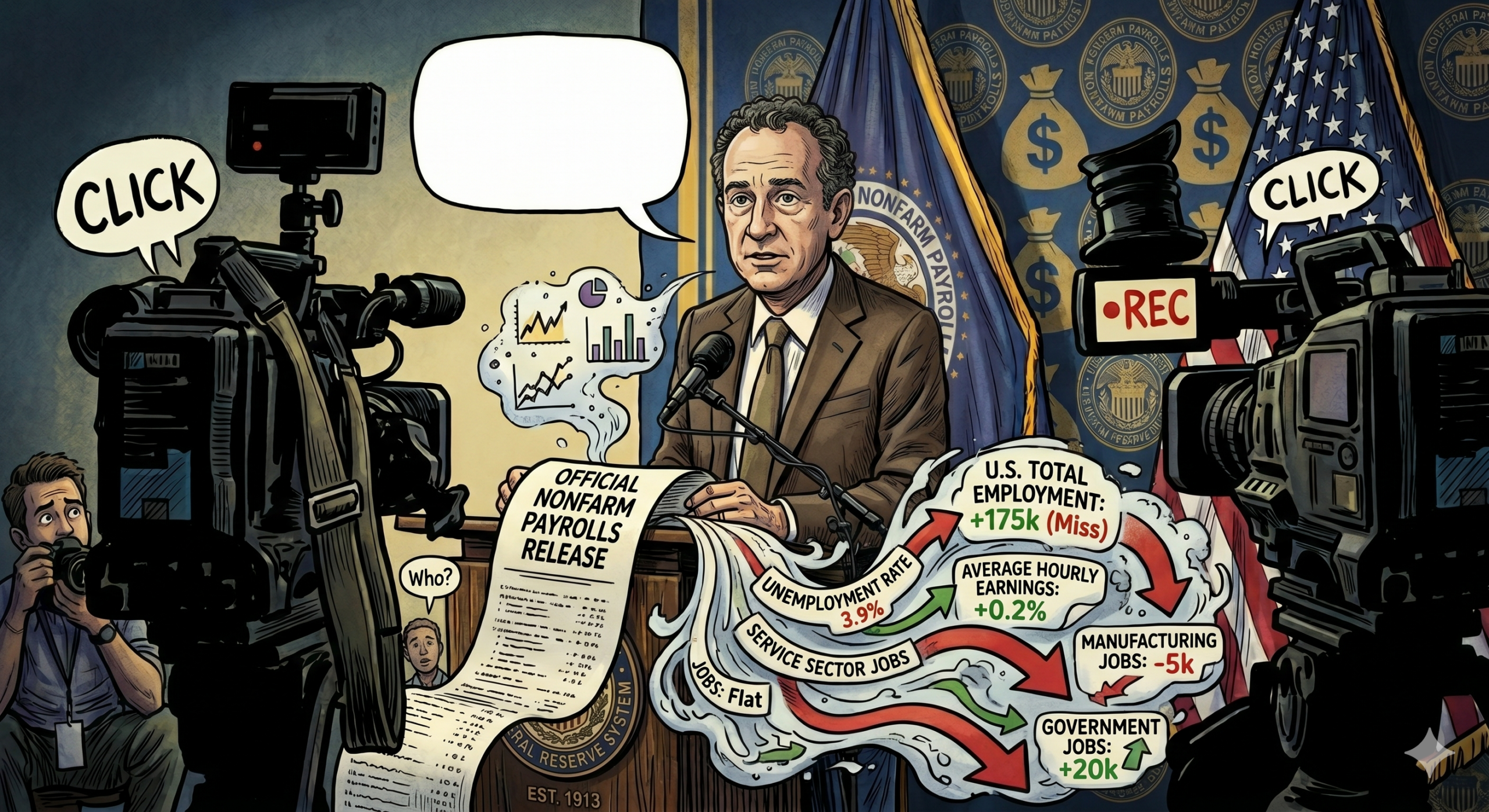
US Non-Farm Payrolls releases at 2:30 PM SAST today (8:30 AM ET). Here’s what’s in the data going in, what to watch in the print, and what each outcome would typically signal for the Fed’s next move.
This is a contextual breakdown, not a market call. Trading decisions are yours to make.
Key Terms
| Term | What it means |
| Non-Farm Payrolls (NFP) | The monthly US jobs report from the Bureau of Labor Statistics. Reports how many jobs were added or lost in the prior month, plus unemployment rate, average hourly earnings, and labor force participation |
| FOMC | Federal Open Market Committee. The Fed body that sets US interest rate policy. Meets eight times a year |
| Dovish / Hawkish | Dovish leans toward lower rates and easier policy. Hawkish leans toward higher rates and tighter policy. Used to describe Fed officials, statements, and market positioning |
| DXY | The US Dollar Index. Measures the dollar’s value against a basket of major currencies (euro, yen, pound, Canadian dollar, Swedish krona, Swiss franc) |
| Stagflation | Rising prices alongside slowing economic growth and weak job creation. The combination is harder for central banks to manage than either problem on its own |
| Slippage | The difference between the price you set on a stop loss and the price the order actually fills at. Increases sharply during high-impact news |
| Real-time equity | The current value of a trading account, including unrealised P&L on open positions. Most prop firms calculate breaches against real-time equity, not the final settled balance |
What the Consensus Looks Like
Headline: 55,000 to 60,000 jobs added in April, based on Wall Street and prop firm forecasts.
Unemployment rate: consensus holds at 4.3%.
Average hourly earnings: 0.3% month-over-month, around 3.7% year-over-year.
Prediction markets put the probability of a print above 60K at around 53% and above 80K at around 91%, according to Kalshi and Polymarket data (low volume).
Yesterday’s ADP Report
The ADP National Employment Report on 6 May printed +109,000 private-sector jobs for April, beating its consensus of around 99,000. ADP characterised it as the fastest pace of private-sector job growth since January 2025.
Sector breakdown from ADP:
- Goods-producing: +15,000
- Services: +94,000
- Health care and education leading
- Manufacturing added jobs
- Finance and government lagged
ADP’s wage data showed job-stayers at 4.4% year-over-year and job-changers at 6.6% year-over-year.
ADP and BLS NFP measure different things, so the ADP beat doesn’t directly predict NFP. But it’s the best preview the day before.
The Labor Market Context

The four-month average of NFP prints since December sits around 47,000 jobs per month. By 2024 standards, even today’s 60K consensus would have read weak.
Reduced immigration has lowered the breakeven number of jobs the economy needs each month. Most analysts and Fed officials have been describing the current backdrop as a “low-hire, low-fire” labor market — fewer firings, fewer hires, less churn.
Fed Positioning
The 29 April FOMC held rates at 3.50%–3.75% on an 8-4 split vote. Powell delivered his final press conference as Chair without leaning hawkish, and the statement kept the door open to future cuts.
Dissenters split between those who wanted a 25-basis-point cut (Stephen Miran) and those who supported the hold but wanted the door-open language removed from the statement (Beth Hammack, Neel Kashkari, Lorie Logan).
Kevin Warsh has since been confirmed as the incoming Fed Chair through the Senate Banking Committee. His first FOMC as Chair is scheduled for 17-18 June. Since his nomination, Warsh has signalled openness to faster easing.
CME Group’s FedWatch tool currently puts the probability of a June rate cut to 3.25%-3.50% at around 28%, with roughly 70% probability of a hold at 3.50%-3.75%. That pricing implies the market expects a hold with dovish guidance, not an immediate cut.
What to Watch in the Print
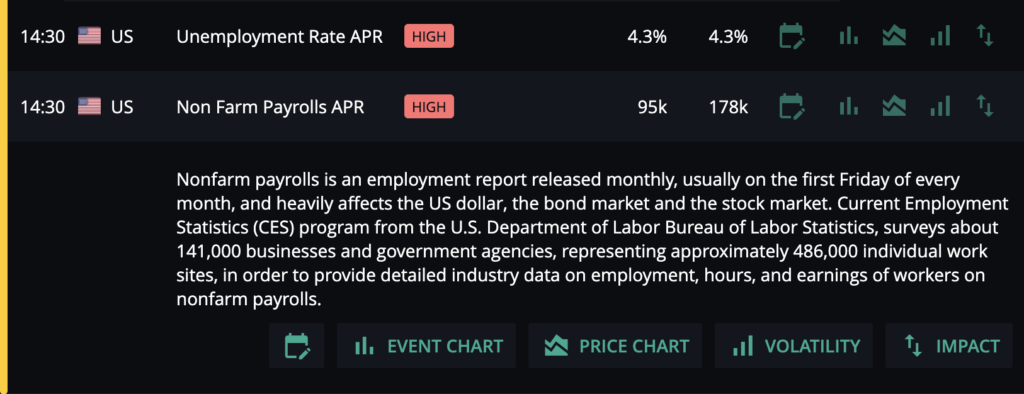
The headline number is the lead, but four secondary data points often matter as much.
Average hourly earnings. Wages running hot while hiring slows is the textbook stagflation signal. The April ISM Manufacturing PMI report showed the Prices Index at 84.6, the highest reading since April 2022.
Prior-month revisions. March came in at +178,000, well above its 60K forecast. A material downward revision today would shift the multi-month trend read more than the April number itself.
Unemployment rate. Any move above 4.3% typically accelerates rate cut pricing. A move below 4.3% typically reduces it.
Labor force participation. The Congressional Budget Office (CBO) has projected prime-age participation at 82.9% for 2026. The print today gives traders an updated reading.
What Each Scenario Typically Signals
These are general patterns based on how Fed pricing has historically responded to NFP prints. They aren’t predictions for today.
Weak print (under 40,000). Would typically be read as confirming the slowdown narrative. Standard response: traders price in a higher probability of June and July cuts; Treasury yields ease.
Consensus print (50,000 to 70,000). Would typically be read as confirming the low-hire, low-fire backdrop without forcing a Fed response. Standard response: small adjustments to rate cut pricing, attention shifts to the next data release. The next major US data point is CPI on Tuesday, 13 May.
Strong print (above 100,000). Would typically be read as challenging the slowdown narrative. Standard response: rate cut probability falls, and the conversation around whether the Fed needs to ease in 2026 reopens.
Prediction markets are skewed toward dovish outcomes. That kind of one-sided positioning historically tends to make a strong print more disruptive than a weak one when expectations have to unwind.
Geopolitical Context

The White House is reportedly close to a preliminary memorandum of understanding with Iran covering enhanced UN inspections, a 12-15-year halt to enrichment, and gradual sanctions relief. Defense Secretary Pete Hegseth has confirmed that the ceasefire signed in early April is still in effect, while Secretary of State Marco Rubio has said offensive operations against Iran have concluded. The ceasefire remains fragile, with sporadic attacks on commercial vessels continuing.
Oil has retreated from $100+ levels in recent weeks. The retreat has eased inflation concerns, giving the Fed more room to cut if jobs come in soft.
DXY sits near 98.0, the lowest since February 2026, down 1.11% over the past month, according to Trading Economics. Gold spot is around $4,710 per JM Bullion’s 7 May reading, having rallied 3%+ on yesterday’s session. Goldman Sachs published a year-end gold target of $5,400.
Execution During High-Impact News
Three mechanics worth knowing if you’re trading around the release.
- Spreads widen. The bid-ask spread can widen by 5 to 10 times during the actual print. A trade that normally costs 1 pip in spread might cost 10 pips for those few seconds.
2. Slippage increases. Stop-loss fills at the available price, not at the price you set. Slippage of 20-50 pips on majors during NFP is realistic. On the most volatile prints, 50-100+ pips is possible.
3. Real-time equity matters. At most prop firms, breach detection runs on real-time equity rather than on settled balances. A price spike that takes equity below the Daily Loss Limit or Max Drawdown level for even a second can trigger a breach, even if the trade closes at a better price afterwards.
Execution quality during these windows depends on the broker pipes the firm runs on. FXIFY is broker-backed by FXIFY Markets, a real broker operating since 2010, with spreads from 0.0 on major FX pairs and Gold on either pricing feed.
Bottom Line
The data going in:
- Consensus 55-60K headline, 4.3% unemployment, 0.3% MoM earnings
- ADP printed 109K yesterday
- Four-month NFP average around 47K
- CME pricing roughly 28% June rate cut probability, 70% hold
- Fed under Powell for one more meeting before Warsh takes over 17-18 June
What each outcome would typically signal:
- Under 40K: standard pattern is rate cut, pricing rises
- 50K-70K: standard pattern is Fed pricing largely unchanged
- Above 100K: standard pattern is rate cut pricing falls, and rate hike conversation may re-enter
The next major US data point is CPI on Tuesday, 13 May. Today’s print also feeds into the BLS revisions data and the broader trend going into Warsh’s first FOMC.
Whatever you’re trading, the calendar tells you when volatility shows up.
Risk Disclaimer
Trading foreign exchange, CFDs, and other leveraged products carries a high level of risk and may not be suitable for all investors. You may lose some or all of your initial capital. Past performance is not indicative of future results. The information in this article is for educational purposes only and is not financial advice. Always consult a qualified financial professional before making any trading decisions.