

Prop Firm Evaluation Failure: Why Risk Habits Break More Accounts Than Bad Strategies
You failed the evaluation. Again. Your first thought: “My strategy doesn’t work.” Or maybe: “I’m not cut out for this.” Here’s what actually happened: your…
You failed the evaluation. Again. Your first thought: “My strategy doesn’t work.” Or maybe: “I’m not cut out for this.”
Here’s what actually happened: your risk-taking habits breached the account before your strategy had a chance to play out properly.
Most prop firm evaluation failures don’t come from bad trade ideas or weak market analysis. They come from how you sized positions, how often you traded, and how you responded when things went wrong. The evaluation wasn’t testing your strategy; it was stress-testing your risk behavior under a fixed rule set.
The “traders’ mistake” everyone talks about is mostly about risk management failures.
This article is not about passing checklists or secret setups. It is about what your failed evaluations are actually telling you about your risk habits.
| SUMMARY BOX Most failures in prop firm evaluations stem from risk behaviour, such as oversizing, overtrading, and rule blind spots, not from weak strategies. Risk habits compound under pressure. Early drawdowns shrink your safety buffer, trigger emotional responses, and make later rule breaches far more likely. A smooth equity curve beats a single home‑run trade every time. |
What Evaluation Failure Actually Looks Like (Not What You Think)
When you fail, you blame the obvious stuff.
“The market was too choppy.”
“Spread widened right when I entered.”
“My strategy just stopped working this week.”
Prop trading experts see the evaluation failures as something completely different.
They see your account data. And the data tells a clear story:
- You took three trades at double your normal size
- You placed five entries within ten minutes during a news release
- Your equity jumped 8% in two days, then dropped 10% in three
- You touched your drawdown limit on Monday, again on Wednesday, again on Friday, and then you breached your account.
Here’s the pattern: Evaluation failure is almost never caused by a single terrible trade.
It’s a week of small risk decisions that built pressure until something broke.
The real chain of events:
Your risk habits (position size, how often you traded, when you took trades) → created rule violations → triggered account failure.
Your win rate might have been 60%. Most of your trades might have been winners. But the way you managed risk made the account unsustainable.
Prop firms don’t care if you were “mostly right.” They care if you can stay inside the lines when the market doesn’t cooperate. It rewards your patience and discipline.
Common Account Breaching Patterns and the Risk Habits Behind Them
Pattern 1: Front-Loading Risk (“I’ll Hit Target Fast, Then Relax”)
You start the evaluation risking 3% per trade instead of your usual.
Maybe you open three positions on correlated pairs at the same time.
The thinking: hit the profit target in week one, and stay tension-free for the rest of the month.
What actually happens:
Day 2: One early loss drops you down closer to 5% immediately.
Now you’re sitting near max drawdown. Every trade from here feels different. Heavier. You can’t afford normal variance anymore.
Day 4: Another loss. Now you’re at 7% down.
The “must win it back” voice starts. Bigger size. Faster entries. Rules start to bend.
Day 6: Evaluation over.
The critical insight: The pressure didn’t build slowly. You created pressure on day one by oversizing. Everything after that was a reaction to the hole you dug earlier.
Many accounts break in week one. Not week four.

Pattern 2: Overtrading (Death by a Thousand Tiny Cuts)
Here’s what overtrading actually means: trading outside your written plan.
Not “taking too many trades.” Not “being a scalper.” Not “trading more than someone else.”
It means deviating from your strategy’s criteria.
What this looks like in practice:
Your plan says 1-hour timeframe setups. You start taking 15-minute chart entries because “the account is just sitting there.”
Your plan says trade EUR/USD and Gold only. You jump into US30, GBP/JPY, and Oil because you’re “looking for opportunities.”
Your plan says a maximum of 5 trades per day. You take 12 because you got bored after lunch.
Your plan says trade the London session only (8 AM–12 PM). You’re placing orders at 11 PM “just to see what happens.”
Why this happens:
- Boredom during slow market periods
- Fear of “wasting” the evaluation time
- Seeing movement on other pairs and feeling FOMO
- Thinking activity = productivity
The real effect:
Trades stop coming from your criteria. They come from impulse.
Your position sizing becomes inconsistent (each trade type has different rules, you’re now mixing).
Small losses cluster because you’re taking lower-quality setups.
You hit your daily loss limit from eight random trades instead of three planned ones.
By Thursday, you’re mentally exhausted. Later decisions deteriorate.
The critical insight: A scalper taking 50 trades per day following their system isn’t overtrading. A swing trader taking 10 trades when their plan says 3 IS overtrading.
High trade count isn’t the problem. Deviation from your plan is the problem.
When trades stop matching your written criteria, frequency becomes a risk behavior, regardless of whether you took 5 or 50 trades.
Pattern 3: Rule Blind Spots (Profitable But Still Failed)
You skimmed the rules during signup.
You assumed this firm works like the last one.
You didn’t know some restrictions were absolute.
Examples
- Trading through the news when news restrictions apply
- Not realizing program-based rules, one rule may apply to one program but not to others.
- Use restricted strategies.
The painful result:
Your account shows 10% profit.
The firm sees a rule violation.
Evaluation: Failed.
Your gains didn’t matter. You violated the contract.
Why firms treat this seriously: If you miss details during evaluation, you’ll miss details when trading a funded account. Rule breaks aren’t about the specific trade. They’re about your attention to parameters.
The critical insight: These failures hurt the most because “technically, you traded well.” But technically, you also broke the agreement.
But the good news is that some prop firms, like FXIFY, offer performance protection for funded accounts. Which lets you keep your profit.
Pattern 4: Strategy Hopping Mid-Evaluation
Three losses in a row.
Panic kicks in.
You abandon your most used strategy yet.
Two days later, you’re on YouTube learning a new indicator setup.
What this creates:
- Random position sizing (each “strategy” has different rules)
- No real sample of any single approach
- An equity curve that looks like pure noise
At that point, the evaluation is no longer testing a strategy. It’s testing mood swings.
From the firm’s view: Inconsistent trader.
The critical insight: Inconsistency becomes the risk pattern now. Even if you somehow end the week positive, the behavior signals instability. And instability doesn’t scale.
How Risk Habits Compound Under Evaluation Pressure
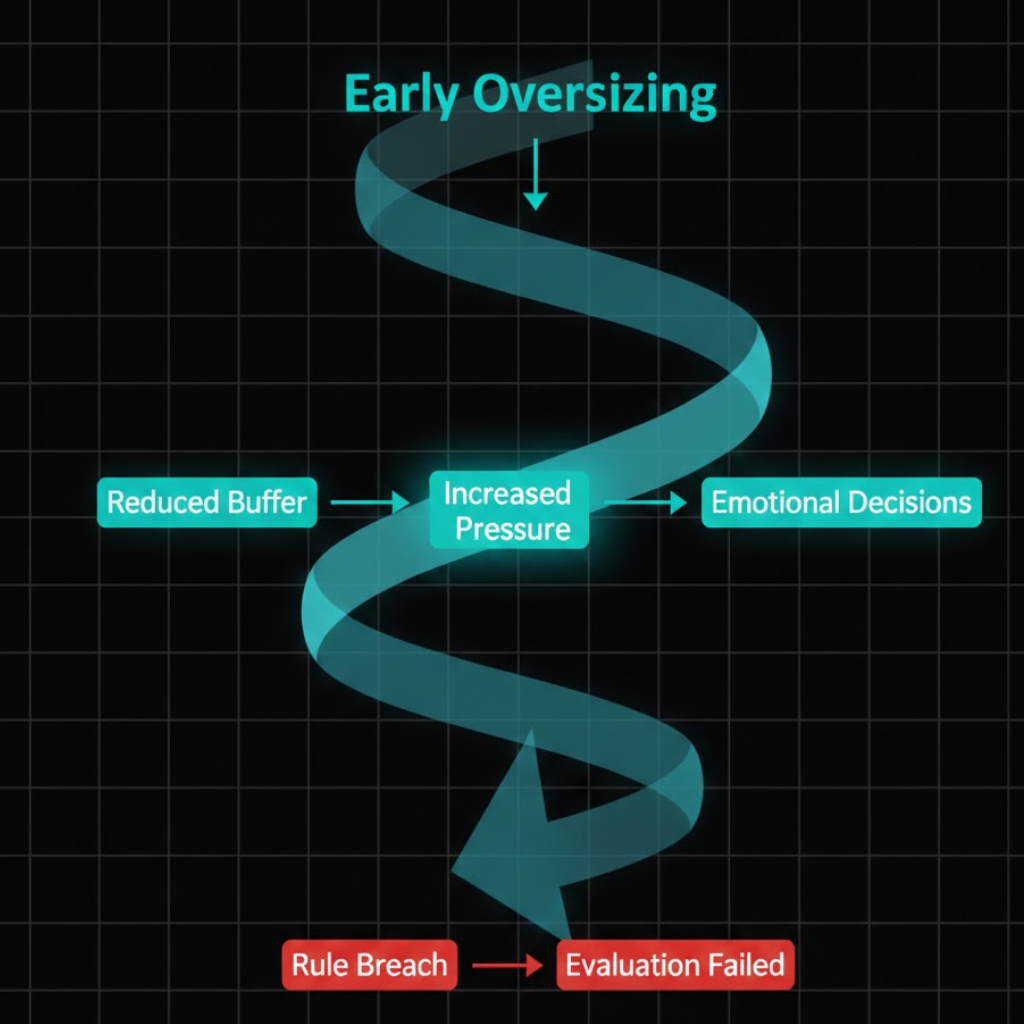
Here’s a scenario that plays out constantly:
You risk slightly too much on your first three trades. Not reckless, For example, your strategy advises you to take 1.5% risk. But instead you take 2.5% per trade instead of 1.5%. Two of them lose. You’re down 5% in two days.
Now the compounding starts:
Day 3: You have a 2–3% buffer left before breaching the max drawdown rule. Every trade now carries a different psychological weight. Normal variance feels like a threat.
Day 4: Market moves against you early in a position. Usually you’d let the stop work. Today, you move it wider. You can’t afford another loss yet. Position hits your new stop. You’re down 7%.
Day 5: Tension has been building for three days. You take an entry that doesn’t quite match your criteria because “I need a win.” Bigger size than planned. It loses. Account breached!
The critical insight: The risk habit (oversizing on Day 1) built the conditions for failure long before the final trade. Each subsequent decision was made under mounting pressure that you created.
The evaluation didn’t become harder. Your risk-taking behavior created a narrower margin for error, amplifying emotions and increasing the likelihood of rule-breaking.
| Why Pressure Makes You Trade Differently Here’s something most traders don’t want to admit: The same person who risks 1% per trade on their personal account starts risking 2-3% in evaluations. Why? The evaluation environment adds: – A profit target you need to hit – The feeling of being watched – Fear of paying for another reset – Ego (“I need to prove I belong here”) What happens under this pressure: – Risk per trade drifts higher (you don’t even notice it happening) – Trading sessions run past your usual hours – Breaks get skipped (“I’ll rest after I hit the target”) – Journaling becomes “I’ll do it later” (never happens) – Your normal routine falls apart The critical insight: The evaluation doesn’t create new bad habits. It amplifies the ones that were already shaky. That’s the actual test. |
Behavioral Causes of Rule Breaches
- Fear of Wasting the Opportunity
The story in your head: “I paid for this. I need to trade every single day.”
What you do: Trade through choppy markets, low-volume sessions, and unclear price action. Anything to “maximize” the account time.
The result: Constant exposure to bad conditions. Small losses pile up. You go toward drawdown limits one mediocre trade at a time.
- Performance Anxiety and Identity
The story in your head: “If I fail this, it means I don’t have what it takes to be a funded trader.”
What you do: Second-guess good setups and miss entries. Then chase the market at worse levels because you can’t handle “missing out.”
The result: You skip high-quality trades (fear of being wrong), then force low-quality ones (fear of doing nothing). Frustration builds. Risk discipline slips.
- Revenge Trading vs. Overconfidence (Two Sides, Same Problem)
After losses: Urgency to recover. Bigger size. Faster entries. Stops removed.
After wins: Overconfidence. “I can handle more risk now.” Rules feel less important. “Just this once” trades start appearing.
The result: Both emotions, fear and confidence, pull you away from your plan.
The feeling changes. The outcome (broken rules) stays the same.
- “It’s My Account” Mindset
You treat the evaluation like your personal demo account or broker account.
You’ve bent rules there before. Moved stops mid-trade. Added to losers without planning. Traded through news, “just this once because the setup was too good.”
The difference: Your retail broker doesn’t care about your risk behavior.
Your prop firm does. These aren’t judgment calls to them; they’re data points showing how you’ll handle a funded account.
One “just this once” moment can end the evaluation.
The behavior is the issue. Not the single trade outcome.
Why Consistency Beats Aggression in Evaluations
Prop firms don’t prefer the most aggressive traders. They prefer the most predictable ones.
What shows up in account data that firms prefer:
- Position sizing stays proportional to balance
- Loss days are contained within similar percentage ranges
- Profits are distributed across multiple sessions, not one massive spike
- Drawdown never approaches limits even during losing streaks
Two different traders, same evaluation:
| Trader A (Aggressive): Up 15% in four days. One 8% loss on day five. Evaluation failed. | Trader B (Consistent): Up 1-2% most days. Two small red days. Finishes at 10% with zero rule touches. |
| Trader A had a higher total profit at one point. Trader B gets funded. Why? From the firm’s view, Trader B’s behavior scales. It’s sustainable. Predictable. Trader A’s pattern signals volatility; big wins will come with big losses. That doesn’t scale safely. The critical insight: Consistency in risk application (size, stops, frequency) is what lets any strategy show up clearly. Without consistency, outcomes are random. Dominated by emotion and luck, not skill. A smooth equity curve isn’t boring to a prop firm. It’s the exact signal they’re looking for. |
How FXIFY Looks At Risk Behaviour
At FXIFY, evaluation data is not just a checklist of rule hits and misses. It’s a record of how a trader manages risk across a series of trades. The trader dashboard and internal monitoring highlight patterns in position sizing, loss frequency, and adherence to drawdown limits across days. That picture of behaviour matters because it signals whether a trader is likely to scale safely once funded, not just whether they happened to hit a profit target once. The evaluation environment is designed to observe how risk discipline holds up under real pressure from targets, limits, and time.
Rethinking “Failure” as Risk Feedback
A failed prop firm evaluation isn’t a judgment on your intelligence.
It’s not even a judgment on your market strategy.
It’s feedback on how you handle risk under pressure. That’s it.
The patterns are predictable:
Small habits compound. Position sizing. Trade frequency. How carefully you read the rules. How you react to losses.
Those habits either stay consistent or they drift. Consistency passes. Drift fails.
Each failed evaluation is a map.
It shows your current risk behavior under evaluation conditions. Not your potential. Not your “worthiness.” Just your current habits when pressure is on.
That map is useful. It tells you exactly what needs to change.
The question was never “Am I good enough?”
The question is, “What does my behavior actually look like when it’s being measured?”
The account data has already been answered. Now you know.
