


Setting Up Your Trading VPS for 1ms Latency: A 2026 Guide
Learn how VPS infrastructure reduces trading latency, improves execution consistency, and protects against slippage in prop trading environments. Updated for 2026.
| Summary Latency is the time between submitting a trade order and receiving execution confirmation. In 2026, tighter prop firm rules and faster market conditions mean that even small delays affect fill quality and rule compliance. This guide explains how trading VPS infrastructure reduces latency, what realistic latency expectations look like, and how to configure your setup for consistent execution. |
Why Your Home Connection Is Already Working Against You
Home internet introduces delays that traders do not control. Your router, your ISP’s routing tables, and the physical distance from the broker servers all add time to every order you submit.
Each millisecond of added delay gives the market more time to move before your order is filled. That price movement becomes slippage, the difference between the price you targeted and the price you received.
In standard retail trading, occasional slippage is an inconvenience. In prop firm environments, it becomes a compliance issue. Prop firms enforce rules around drawdown, entry timing, and execution quality. Slippage from slow connections does not exempt a trade from those rules.
1. What Latency Actually Means in Trading
Latency in trading is the time elapsed between when an order leaves your device and when it is confirmed as executed at the broker’s server.
The path an order travels involves multiple steps:
• Your device generates the order and sends it over your local connection
• The order travels through your ISP’s network to reach the wider internet
• It routes through one or more network nodes to reach the broker’s data centre
• The broker’s matching engine processes the order
• A confirmation signal returns along a similar path
The total time for all of those steps is the round-trip latency. Each leg of that journey adds delay. Distance, network congestion, and hardware processing all contribute.
The mechanism that makes latency matter is simple: markets move continuously. A longer round trip means more time for the price to change between the time of order submission and execution. The further the price moves during that window, the larger the gap between your intended entry and your actual fill.
| Mechanism Higher latency = wider window for price movement before fill = higher probability of slippage. |
2. Why Home Internet Is Not Stable Enough
Home broadband is designed for general consumer use. It shares bandwidth across a neighborhood, is subject to congestion during peak hours, and routes traffic dynamically based on network conditions rather than prioritizing your trading connection.
Variable routing is a structural problem for traders. On one trade, your order might travel directly to the broker’s data centre. Next, it might route through a different path with three additional hops. Each route change produces a different latency result.
The specific problems with home connections include:
• ISP congestion during high-traffic periods increases round-trip times unpredictably
• Dynamic routing changes the physical path your data travels, altering the latency between orders
• Distance from broker infrastructure cannot be reduced from a home connection
• Consumer-grade routers introduce packet queuing that adds inconsistent delay
The result is inconsistent fills. An order executed at 08:00 may fill differently from an identical order at 09:30, not because market conditions differ, but because network conditions differ. For traders operating under strict execution rules, that inconsistency is a risk.
3. How VPS Infrastructure Reduces Latency
A Virtual Private Server is a remote computer hosted in a professional data center. When you run your trading platform on a VPS, your orders originate from that server, not from your home connection.
The latency reduction comes from two factors:
• Physical proximity: Data centres that host VPS services are often located in the same facilities or near the data centres used by brokers and liquidity providers. Shorter physical distance means less time for data to travel.
• Connection stability: Professional data centre connections use dedicated fibre infrastructure with guaranteed uptime and consistent routing paths. No ISP congestion or dynamic rerouting is affecting your order flow.
The mechanism is straightforward. An order sent from a server 5 kilometres from the broker’s matching engine travels less distance and encounters fewer routing variables than an order sent from a home broadband connection in a residential area. Less distance and fewer variables produce faster, more consistent fills.
A VPS also operates independently of your home internet. Power outages, Wi-Fi drops, and local network issues do not interrupt an active VPS session. For traders running automated strategies or holding positions overnight, this continuity matters.
4. What ‘1ms Latency’ Actually Means
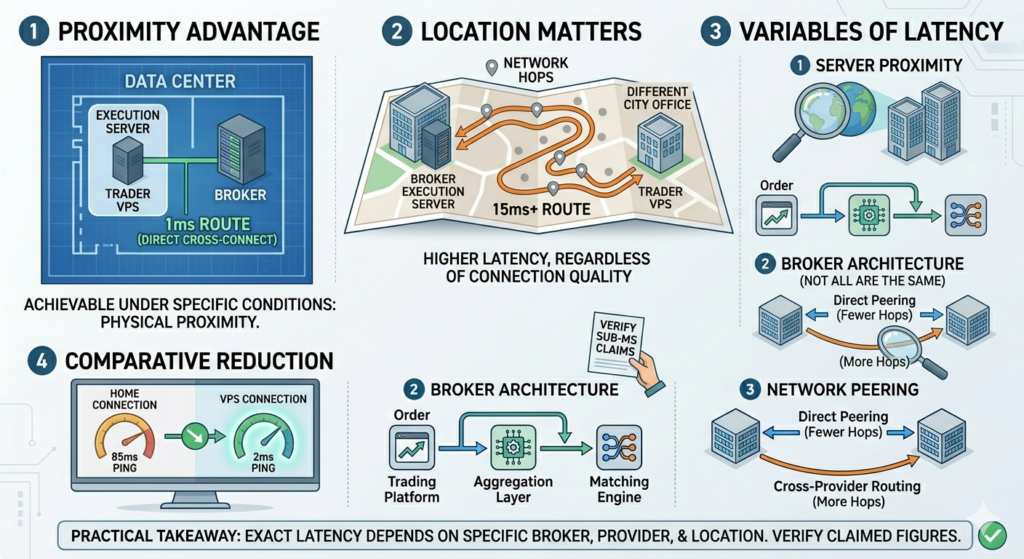
The figure of 1 millisecond appears frequently in VPS marketing. It is achievable under specific conditions. It is not a universal guarantee.
Latency at the sub-5ms level depends on three variables:
• Server location relative to broker infrastructure: A VPS physically located in the same data centre as the broker’s execution server can achieve very low round-trip times. A VPS in a different city achieves higher latency, regardless of connection quality.
• Broker infrastructure: Not all brokers use the same execution architecture. Some route orders through aggregation layers before reaching the matching engine, adding processing time that no VPS configuration eliminates.
• Network routing between the VPS and the broker: Even within the same city, network paths vary. Direct peering arrangements between data centres reduce the number of hops. Cross-provider routing adds them.
The practical takeaway is this: a well-located VPS typically reduces latency relative to a home connection, but the exact figure depends on factors specific to your broker, VPS provider, and server location. Claims of guaranteed sub-millisecond execution should be verified against the broker’s published infrastructure details.
| Key Point 1ms latency is a condition, not a promise. Achieve it by selecting a VPS with servers co-located or close to your broker’s execution environment. |
5. Slippage: Where Latency Becomes Cost
Slippage is the difference between the price at which you submitted an order and the price at which it was executed. It is a direct cost. A 2-pip slippage on a standard lot represents real monetary loss regardless of whether the trade is ultimately profitable.
The mechanism connecting latency to slippage is price movement during the transmission window. When you submit a market order, the price displayed at submission is not locked until execution is confirmed. If the price moves between those two events, your fill price reflects the new market price, not the one you saw.
Higher latency widens the window in which that price movement can occur. In stable, low-volatility conditions, even high-latency connections produce acceptable fills because the price barely moves during the extra milliseconds. During news releases or high-volatility periods, the same latency window can lead to significant slippage because prices move rapidly.
For prop traders, this creates a compound problem. Slippage costs reduce the buffer before drawdown limits are triggered in conditions where accurate entry pricing matters, breakout strategies, and news-based setups. Consistent high latency systematically degrades entry quality.
6. Why Prop Firm Rules Make Latency More Important
Prop firms enforce execution rules that retail traders do not. Drawdown limits, daily loss caps, and sometimes restrictions around high-impact news events mean that execution quality directly affects rule compliance.
The connection between latency and prop firm rule compliance works through several mechanisms:
• Slippage eats into drawdown buffers: A trader operating near a daily loss limit cannot absorb unexpected slippage costs that a more comfortable account balance would obscure. High latency increases the probability of slippage, thereby increasing drawdown risk.
• Entry timing affects strategy performance: Strategies designed around specific price levels depend on fills near those levels. Consistent slippage from high latency shifts actual entries away from planned entries, changing risk-to-reward ratios on every trade.
• News trading restrictions: Many prop firms restrict trading during scheduled high-impact news events. Some enforce this through platform restrictions, while others do so through performance reviews. Slow connections that delay order processing can result in fills at prices reflecting post-announcement volatility, even when the order was submitted before the announcement.
The result is that latency is not purely a performance concern in prop trading environments. It is an infrastructure decision that affects whether your execution environment supports the precision your evaluation rules require.
7. How to Set Up a VPS for Trading: Step-by-Step
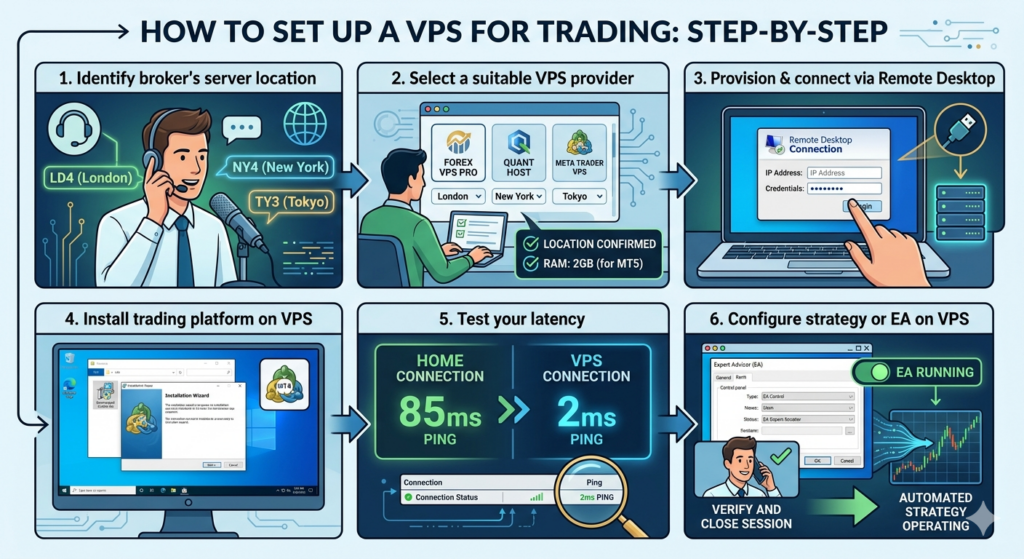
Step 1: Identify your broker’s server location
Contact your broker’s support team and ask which data centre their execution servers are hosted in. Common locations include LD4 in London, NY4 and NY5 in New York, and TY3 in Tokyo. This information determines where your VPS should be located.
Step 2: Select a VPS provider with servers in the target location
Choose a provider that explicitly lists server locations in its infrastructure documentation. Confirm that the available plan offers the RAM required to run your trading platform. MT4 typically requires at least 1GB; MT5 requires more.
Step 3: Provision the VPS and connect via remote desktop
After purchasing your plan, you will receive an IP address and login credentials. Use Windows Remote Desktop (RDP) or equivalent to connect to the server. You will see a standard Windows desktop environment hosted remotely.
Step 4: Install your trading platform on the VPS
Download the trading platform installer directly to the VPS using the browser available in the remote desktop session. Install as you would on a local machine. Log in to your trading account using your broker credentials.
Step 5: Test your latency
Most trading platforms display server ping in the connection status bar. Note the figure after installation. Compare it against your home connection’s ping to the same server. A significant reduction confirms that the VPS is providing a closer network path.
Step 6: Configure your strategy or EA to run on the VPS
If you run automated strategies, load them on the VPS instance. Verify that the Expert Advisor or automated system is running correctly before closing the remote desktop session. The VPS will continue operating independently of your local machine.
8. Common Mistakes Traders Make with VPS Setup
Choosing the cheapest plan instead of the closest server
A VPS priced at a discount often saves cost by using servers in a non-optimal location. If your broker’s infrastructure is in London and your cheap VPS is in Frankfurt, you still have lower latency than a home connection in a different country. Still, you have not achieved the proximity that produces the lowest latency. Always prioritize location over price when the primary goal is execution speed.
Ignoring server location entirely
Some traders choose a VPS provider based on marketing claims about speed without verifying server locations against their broker’s infrastructure. A VPS in New York provides no proximity advantage for a broker whose servers are in London. The physical path the order travels determines the achievable latency floor.
Assuming VPS eliminates all slippage
Slippage has multiple causes. Network latency is one of them. Market liquidity, broker execution architecture, and order type also affect fill quality. A well-located VPS reduces slippage from network delay. It does not eliminate slippage caused by thin liquidity, wide spreads during news events, or order routing through aggregation layers. Traders who expect zero slippage from a VPS misunderstand what the technology addresses.
Failing to monitor VPS performance over time
Data centers occasionally migrate hardware, change routing arrangements, or experience congestion. Latency that was low at setup may change weeks later. Periodically checking the platform ping from the VPS and comparing it against baseline figures confirms whether the setup continues to perform as intended.
Conclusion
Latency is the time your orders spend in transit before execution. That transit time creates a window for price to move, and price movement during that window produces slippage. Slippage is a cost and a compliance risk in prop trading environments.
A VPS addresses network latency by placing your trading platform on a server physically closer to your broker’s infrastructure, connected via a stable, professional-grade network. It does not eliminate all sources of execution variance, but it removes the most controllable one.
The result of a well-configured VPS setup is more consistent fills, reduced exposure to network-driven slippage, and a trading environment that operates independently of your home internet conditions. Consistency does not guarantee profitable outcomes, but it ensures your execution environment is not working against your strategy.
Frequently Asked Questions
What is good latency for trading?
There is no single threshold that applies universally. Lower is better, but the relevant benchmark is your latency relative to your broker’s server, not an absolute figure. A round-trip time of under 10ms to your broker’s execution server is generally considered low latency for most trading strategies. Sub-5 ms is achievable with co-located or nearby VPS servers. What matters most is consistency — a stable 8ms is more useful than a connection that swings between 2ms and 80ms.
Does a VPS eliminate slippage?
No. A VPS reduces slippage caused by network latency by placing your platform closer to the broker’s execution environment. It does not affect slippage caused by liquidity conditions, broker execution architecture, or order type. Market orders during low-liquidity periods will still experience slippage regardless of how fast the order reaches the matching engine, because the issue is the absence of matching counterparties at the target price, not transmission delay.
Is VPS necessary for prop trading?
VPS is not a universal requirement for prop trading. Traders with home connections that are geographically close to their broker’s servers and who trade in non-time-sensitive conditions may achieve acceptable fills without one. VPS becomes more important when using automated strategies that must run continuously, trading latency-sensitive setups where precise entry is critical, or operating from a home connection far from the broker’s infrastructure. The decision depends on the gap between your current execution quality and your strategy’s requirements.
Where should my VPS be located?
Your VPS should be located as close as possible to your broker’s execution servers. Ask your broker which data centre their servers use. Major financial data centres include Equinix LD4 (London), NY4 and NY5 (New York), and TY3 (Tokyo). Choose a VPS provider that lists explicit server locations and offers servers in or near the same facility. Proximity is the primary variable that determines the latency benefit of a VPS.
Can I trade without a VPS?
Yes. Many traders operate without a VPS and achieve results that meet their requirements. A VPS is an infrastructure choice that addresses specific problems: network instability, geographic distance from broker servers, and the need for always-on execution without dependence on your local machine. If those problems do not affect your trading, a VPS adds cost without proportionate benefit. If they do, particularly if you run automated strategies or trade from a location far from your broker’s servers, a VPS is a practical solution to a real constraint.