

The Prop Trader Calendar: Events That Require No Trading
The economic calendar is a schedule of major data releases and policy decisions that move the forex market. Most traders know it exists. Fewer use it to identify when the market’s basic mechanics are about to change and when staying out is the right call.
There is a common assumption in trading that if you are not in a trade, you are missing out. For prop traders, that thinking can be costly. Some of the best decisions a funded trader makes happen before the market opens, specifically, the choice to leave certain windows completely alone.
The economic calendar is a schedule of major data releases and policy decisions that move the forex market. Most traders know it exists. Fewer use it to identify when the market’s basic mechanics are about to change and when staying out is the right call.
| Summary: Major news events change how the market operates, not just where prices move. Spreads widen, and orders fill at worse prices regardless of how strong the setup looks. These conditions are visible in advance. The economic calendar that forex traders use shows exactly when the risk windows are, often days before they arrive. Sitting out a news event is a real trading decision. Protecting your account from poor execution conditions is not passive; it is part of managing risk. |
Why News Events Change More Than Just Price
In normal conditions, the forex market runs smoothly. Prices move, but orders fill close to what you see on screen. That breaks down around major scheduled events.
Before a big release, large participants pull back and wait. With fewer firms actively quoting prices, the gap between the buy and sell prices widens. When the data is released, the price can move sharply in a fraction of a second. Stop-loss orders may execute at prices far from their original levels. This is called slippage, a normal feature of how markets behave around high-impact news, not a glitch.
For prop traders with fixed daily drawdown limits, a stop that fills 15 or 20 pips worse than expected can eat into your risk buffer in a way that affects the rest of your trading day.
The Events That Cause the Most Disruption
Central Bank Rate Decisions
Decisions from the US Federal Reserve, the European Central Bank, and the Bank of England are the highest-impact events on the forex news calendar. They directly affect how currencies are valued — and the market reacts not just to the number, but to every line of the accompanying statement. Most decisions are followed by live press conferences, which trigger a second wave of volatility. A rate decision and press conference combined can keep execution conditions disrupted for 60 to 90 minutes.
Non-Farm Payrolls
Released on the first Friday of each month, the US Non-Farm Payrolls report measures jobs growth in the American economy. On release, spreads on major USD pairs can jump to five or ten times their normal levels, and prices can move 100 pips or more in seconds. Traders with open positions at that moment face execution risk that no stop placement can fully mitigate.
CPI Inflation Data
Inflation figures directly influence interest rate expectations, which means they move currencies. A CPI reading that surprises the market in either direction can produce a fast, sharp repricing of affected pairs. The reaction tends to be immediate: the number either confirms expectations or it does not.
GDP and PMI Releases
GDP figures and Purchasing Managers Index surveys both measure economic health. They carry less consistent impact than the events above, but they can produce sharp moves when results differ significantly from forecasts.
Days With Multiple High-Impact Events
When two or more major releases fall close together, the market may not recover between them. Spreads can stay wide, and execution conditions remain unpredictable for an extended window. These days warrant extra caution.
What This Means for Your Prop Account
Every prop account has rules around how much you can lose in a day and overall, and those limits are fixed. A single trade that suffers unexpected slippage during a news event can push you toward a threshold you had no intention of reaching. The risk is not just about being wrong on direction. It is about the market handling your order poorly in conditions that made that outcome more likely.
Choosing not to trade around these events is a recognition that your strategy was built for normal market conditions, and that news windows are not those conditions.
Building a No-Trade Window Into Your Week
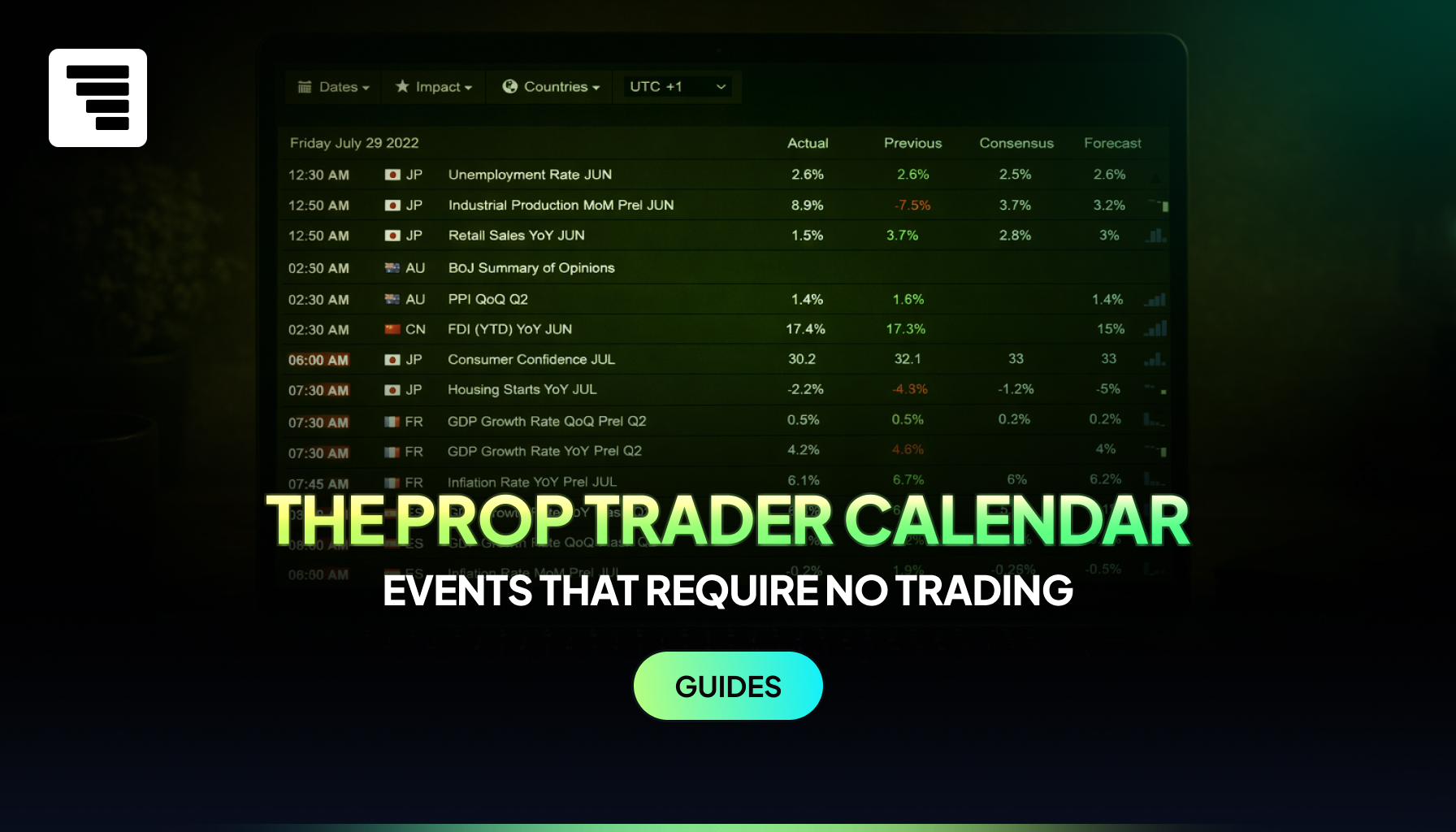
Most economic calendar tools mark high-impact events with a red label. Checking at the start of each week takes a few minutes and tells you exactly when the disruption windows are. As a starting point, treat the 15 minutes before and 30 minutes after a release as a no-trade zone. For central bank decisions with press conferences, extend that to cover the full conference.
This is not a forecast. It is a consistent boundary around a known period of disruption.
Key Takeaway
The economic calendar that forex traders rely on is not just a list of potential setups. It is a guide to when normal conditions are likely to break down, when spreads widen, fills become unpredictable, and the environment on which most strategies depend temporarily stops working. For prop traders, that has a direct practical cost. Choosing not to trade through those windows is a deliberate decision to protect your account from conditions it was never designed for, and that discipline is part of what separates traders who stay funded from those who do not.
Frequently Asked Questions
What counts as a high-impact event on the economic calendar?
The main ones are central bank rate decisions, US Non-Farm Payrolls, CPI inflation data, and GDP releases. Most calendar tools mark these clearly, often with a red label or a similar high-priority indicator.
Why do spreads widen during news events?
Large market participants reduce their activity before major releases to avoid being caught on the wrong side of a fast move. Fewer firms quoting prices means the gap between buy and sell widens. It normalises after the event, but not instantly.
Can slippage really push me into a drawdown breach?
Yes. A stop-loss fills at the available price when the order reaches the market, not at the price you set. During a sharp news move, those can differ materially, and in a prop account with fixed daily limits, even one instance of this can change your picture for the day.
Does sitting out news events mean I miss out on big moves?
Some moves after news releases are large. But they happen in conditions where execution is unreliable, and the cost of being wrong is higher than usual. Sitting out a news window does not reduce your edge; it protects it from an environment it was never built for.
How far in advance can I see what is coming on the calendar?
Most high-impact events are known well in advance. Checking the calendar at the start of each week gives you a full picture of the risk windows before you sit down to plan your trades.