



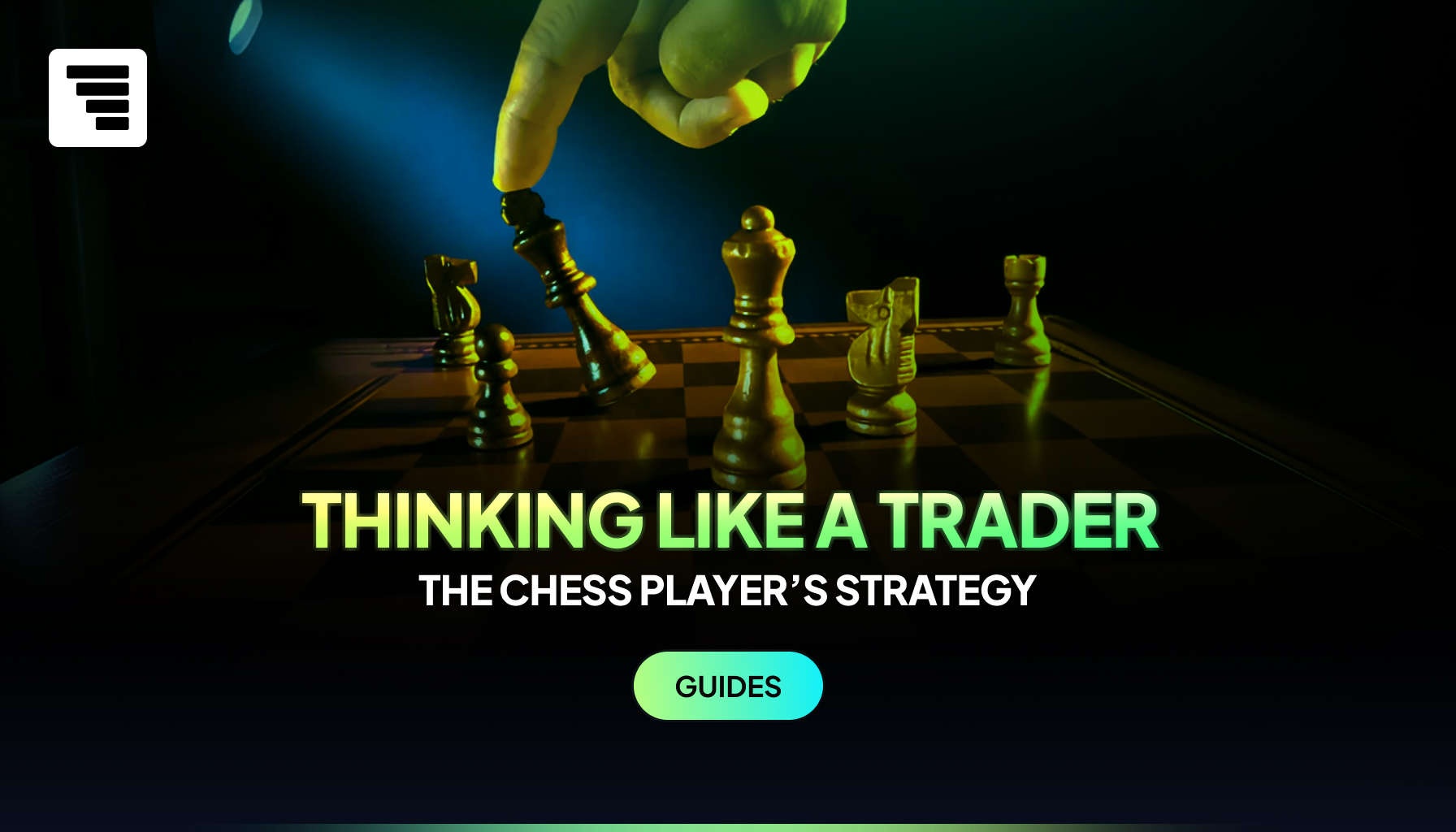
Thinking Like a Trader: Lessons from Chess Strategy
Chess players evaluate risk before every move. Traders should too. This guide breaks down the decision-making habits that separate consistent traders from reactive ones.
Most traders lose money not because they lack market knowledge, but because they make poor decisions under pressure. They enter trades too early, hold losing positions too long, and abandon their rules the moment a trade moves against them. The gap is rarely in the analysis. It is in how decisions get made when it counts.
A strong trading mindset starts with accepting that markets cannot be predicted consistently. What can be controlled is the quality of your decision-making. Structured thinking of this kind – the kind that a game of chess demands of every player is what separates consistent traders from reactive ones.
In this article:
- Trading success is built on structured decisions, not market prediction.
- Risk must be defined and accepted before any position is entered.
- All outcomes are probabilistic; consistency in process matters more than individual results.
Why Structured Thinking Matters in Trading
As a trader, you might assume that better analysis leads to better results. In reality, analysis is only part of the picture. Two traders can look at the same chart, reach the same conclusion, and produce completely different outcomes because their decision-making processes differ.
Trading without a framework is inconsistent by design:
- Entries are taken on instinct rather than defined criteria.
- Exits are managed emotionally rather than according to a pre-set plan.
- Rules are invented mid-trade, which means they are not really rules at all.
Even when this approach produces winners, it does so for the wrong reason, which means those wins cannot be reliably repeated.
Structured decision-making means having a defined process for every phase of a trade: when to consider entering, how much to risk, where to exit if wrong, and when to take profit. None of these decisions should be made after a position is open. They should be settled before, in the same way a chess player evaluates a position before committing to a move.
This approach does not guarantee winning trades. What it does is make your results explainable and, over time, improvable.
Planning Your Trade vs Reacting to the Market
A trade plan is a specific set of conditions defined before the session begins:
- The setup that needs to be present before you consider entering
- The price level at which your analysis is invalidated
- The target that justifies the risk
Most traders skip this step, or do it loosely. They have a broad idea of what they are looking for, then make a series of small decisions in real time: Is this move strong enough? Should I wait for confirmation? The spread has widened slightly. Does that change anything? Each decision is made while watching live price movement, which means it is made under pressure. Pressure degrades decision quality.
Reactive trading is also structurally disadvantaged. When you enter impulsively, you are typically:
- Entering late, after the optimal price has passed
- Using a larger stop than the setup actually requires
- Working with a risk-reward ratio that has already deteriorated
Chess players do not commit to moves they have not thought through. A move made under time pressure, without evaluating the consequences, tends to create problems further into the game. Entries taken without a plan work the same way; you end up managing a position you never properly defined.
Risk Comes First
Before you enter any trade, two numbers must be fixed: the stop-loss level and the position size. Not estimated, not approximate, fixed.
Stop-loss placement marks where your analysis is invalidated. It is placed at the point where the reason you took the trade no longer holds. If you are long because price broke above a key level, the stop goes below that level. If price returns below it, the setup is gone, and so should the position be. The stop is not a reflection of how much loss you can stomach; it is a reflection of where the market tells you that you were wrong.
Position sizing determines how much capital is at risk if that stop is hit. This is how risk vs reward trading works in practice. A common approach is to risk a fixed percentage of account equity per trade, typically 1–2%. This keeps individual losses proportionate regardless of how strong any one setup feels.
The sequence matters more than most traders realise:
- Define your stop level based on trade structure.
- Calculate position size based on that stop distance and your risk percentage.
- Execute the entry.
Many traders reverse this. They decide how many lots they want to trade first, then find a stop level that feels manageable for that number of lots. That means risk is being driven by preference rather than by the logic of the trade itself, a subtle but damaging inversion.
Before a chess player commits a piece to an aggressive move, they calculate what can be captured in return. The potential downside is evaluated before the action is taken, never after.
Thinking in Probabilities
No setup, however well-constructed, guarantees a result. The market does not reward thorough analysis with a guaranteed win. Accepting this is a difficult adjustment for traders, and also a critical one.
Thinking in terms of probabilities means evaluating a setup not by whether it will work, but by whether it works often enough, with a sufficient reward relative to risk, to be worth taking over many repetitions. Consider the numbers:
- A setup that wins 45% of the time with an average 2:1 reward-to-risk ratio is profitable
- A setup that wins 70% of the time but averages 0.5:1 is not
Frequency and magnitude both matter and have to be considered together. High win rate does not equal profitability. Neither does high reward-to-risk in isolation.
This reframes how you should relate to individual trade outcomes:
- A losing trade taken according to your plan is not a mistake
- A winning trade taken impulsively is not evidence of good judgement
- What matters is whether the process was sound, because the process is what produces results at scale
It also means you cannot draw meaningful conclusions from five or ten trades. A good strategy will still produce losing streaks. A poor one will produce winning streaks. Neither tells you much in isolation. Traders who need every trade or every week to be profitable are working against probability and usually against themselves.
In chess, the best move is the one that gives the highest probability of reaching a favourable position. A strong player accepts that even correct decisions can lead to difficult positions. What they do not accept is making decisions without evaluating the odds first.
Emotional Control
The most technically proficient traders often underperform their own strategies because of emotional interference. This is well-documented and nearly universal. Understanding trading psychology at a theoretical level is not the challenge, but maintaining discipline when it is actively uncomfortable is.
The most disruptive patterns follow predictable triggers:
- A losing streak generates fear, which causes traders to stop taking valid setups or tighten their stops too early, turning viable trades into losses.
- A winning streak generates overconfidence, which causes position sizes to drift upward and risk management to loosen.
- A single large loss triggers the urge to recover quickly, driving entries into setups that do not meet the criteria, which is commonly called revenge trading.
All of these patterns have the same effect: the trader deviates from their plan. Decisions are no longer based on the setup in front of them, but on how recent results feel. Recent results are statistically irrelevant to whether the next trade works, but they feel relevant, and that is where the damage happens.
There is a useful distinction between adapting a plan and abandoning one. Adapting is legitimate if a trade moves significantly in your favour; moving your stop to breakeven or taking partial profit is a pre-planned response to a favourable scenario. Abandoning is different. Widening a stop because a losing trade has not yet hit its level, or exiting a winning trade early out of anxiety, are emotional responses to the discomfort of uncertainty.
Top chess players do not revise their strategic evaluation because they are frustrated with how a game is going. They stay committed to the position they calculated. In trading, the equivalent is executing your plan as written, not the version that feels better in the moment.
How This Applies at FXIFY
FXIFY structures its evaluation process around clearly defined rules: maximum daily loss limits, overall drawdown thresholds, and minimum trading day requirements. These rules create an environment where disciplined, plan-based trading is the only viable path through the challenge.
When external structure mirrors the internal discipline a trader is trying to build, the two reinforce each other. Traders who might otherwise widen a stop or over-leverage in a moment of frustration are, in part, protected from those decisions by the framework. Over time, trading within that structure builds habits that make disciplined decision-making more automatic and less reliant on willpower alone.
Key Takeaway
Consistent trading performance comes from process, not prediction. The traders who perform well over time are not necessarily the ones who are right most often, but the ones who define their risk before they enter, follow their rules under pressure, and evaluate their edge across a meaningful sample of trades rather than reacting to individual outcomes.
These ideas are straightforward on paper and genuinely difficult in practice because they require discipline in moments when instinct pulls in a different direction.
Build a repeatable process. Measure it. Refine it. That is what a professional trading mindset looks like in practice.


