

Trading Gold on a Funded Account: A Risk Management Guide
Trading gold on a funded account means managing volatility spikes, weekend gaps, and FOMC-day risk. Here is how to size positions and protect rules.

If you trade gold on a funded account, you have already noticed that XAU/USD does not behave like a forex pair. It runs quietly for stretches and then expands hard around scheduled events. The trader who sizes positions for last week’s volatility breaches the rules during this week’s FOMC release.
Gold’s macro drivers create a volatility profile that punishes unprepared sizing. On a funded account, where daily loss limits and maximum drawdown thresholds are fixed, that profile demands a different discipline than forex trading.
This guide covers why gold trades differently and the macro drivers behind it. It also walks through position sizing, weekend gap risk, FOMC mechanics, and how all of it interacts with FXIFY’s rule structure.
Key Terms
| Term | What it means |
| XAU/USD | The trading symbol for gold against the US dollar. One standard lot represents 100 troy ounces |
| Spot gold | The current market price of gold for immediate delivery, quoted in USD per ounce. See the Investopedia gold definition for broader context |
| Pip value (gold) | The dollar value of a one-unit price move on XAU/USD at a given lot size. On a standard lot (100 ounces), a $1 move equals $100 |
| Real yields | The yield on inflation-adjusted government bonds. Gold typically moves inversely to real yields |
| Safe-haven demand | Buying pressure on gold during periods of geopolitical or economic uncertainty |
| FOMC | The Federal Open Market Committee, whose rate decisions and statements drive significant gold volatility |
| Daily Loss Limit | The maximum amount your account can lose in one trading day on a funded program |
| Maximum Drawdown | The total loss limit across the trading account, applied during both evaluation and funded stages |
What’s in this guide
- Why gold trades differently from forex pairs
- Gold’s macro drivers in brief
- ATR-based position sizing for gold
- Weekend gap risk and Sunday open
- FOMC and economic calendar volatility
- How gold’s mechanics interact with FXIFY rules
- Common gold trading mistakes
- Key takeaways
- FAQs
Why Gold Trades Differently from Forex Pairs
Three things make gold structurally different from EUR/USD or GBP/JPY for funded traders.
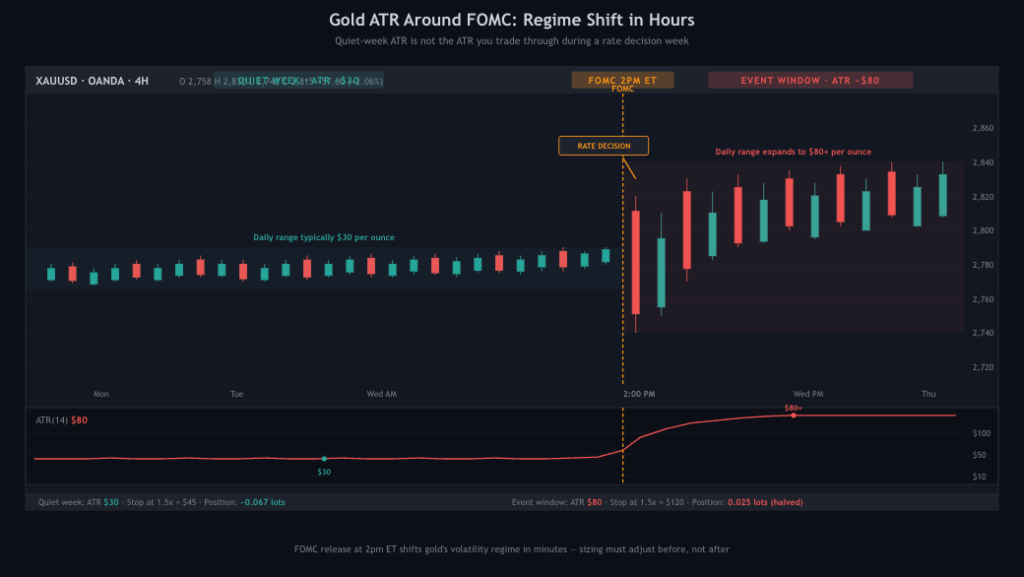
Event-driven volatility profile. Forex pairs see steady volatility distributed across sessions. Gold sees relatively quiet stretches punctuated by sharp expansions around macro events — FOMC days, CPI prints, geopolitical incidents. The ATR reading you see on a quiet Tuesday is not the ATR you trade through during a Wednesday rate decision.
24/5 trading window with weekend gaps. Gold trades from Sunday evening to Friday afternoon US time. The chart pauses during the 49-hour weekend close, but news, geopolitical events, and macro developments do not. Anything that happens on Saturday or Sunday is repriced into the chart at Sunday open as a single jump.
Inverse correlation with USD strength and real yields — most of the time. Gold’s traditional driver is the dollar. When the dollar strengthens, gold tends to fall, and when the dollar weakens, gold tends to rise. Real yields and central bank rate expectations work the same way — most of the time, they move inversely to gold. But this relationship is not absolute. During periods of macro stress, banking instability, or major geopolitical events, gold can rise alongside the dollar as both attract safe-haven flows simultaneously. The discipline is to watch the dollar and yields as the default driver, but recognise when broader risk sentiment shifts the dynamic.
If you have ever sized a gold position based on Tuesday’s ATR and watched it breach your daily loss limit on Wednesday’s FOMC release, the issue was not your read on the trade. The volatility regime changed at 2 pm ET, and your sizing did not.
Each of these three differences requires a specific risk management adjustment. The rest of this guide walks through each one.
Gold’s Macro Drivers in Brief
Three drivers shape gold’s volatility patterns. Knowing them is not optional for a funded trader trading XAU/USD.
USD strength. Gold is priced in dollars. When the dollar strengthens, the same ounce of gold costs fewer dollars, so the gold price falls. When the dollar weakens, gold rises. The DXY (dollar index) typically moves inversely to gold across short and medium timeframes. Trading gold without checking the DXY is trading without seeing the currency leg of the trade.
Real yields. Real yields equal nominal bond yields minus expected inflation. When real yields rise, holding gold (which yields nothing) becomes more expensive in terms of opportunity cost. When real yields fall, gold becomes more attractive relative to bonds. The 10-year TIPS yield is the cleanest reference point for tracking the relationship.
Safe-haven flows. Geopolitical incidents, banking stress, and equity drawdowns drive risk-off flows into gold. These moves are sharper and less predictable than yield-driven moves because they react to news in real time rather than to scheduled releases.
The practical implication: gold’s volatility regime shifts with macro events, not with chart patterns. A funded trader needs to know what is on the calendar this week to size positions appropriately. Trading gold without checking the FOMC schedule, the CPI release date, and the geopolitical news cycle is sizing for yesterday’s regime.
ATR-Based Position Sizing for Gold
Gold’s typical daily ATR varies dramatically across volatility regimes. At current gold price levels, ATR readings typically fall into these ranges:
- Quiet conditions: $15-25 per ounce daily ATR
- Normal conditions: $25-40 per ounce daily ATR
- Elevated/event conditions: $50-100+ per ounce daily ATR
Actual readings vary with current gold prices and prevailing market conditions. Always check the live ATR on your chart before sizing.
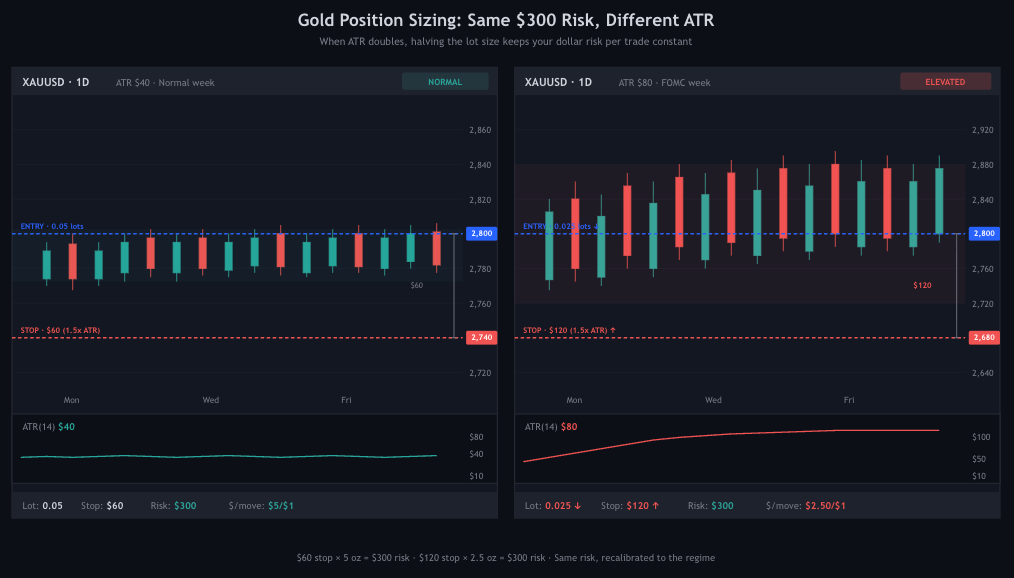
The position sizing rule from the ATR foundational article applies directly: when ATR doubles, the appropriate stop distance doubles to match. Halve the lot size to keep your dollar risk per trade constant.
A worked example on XAU/USD using a $300 risk-per-trade target on a $100,000 account:
Normal regime:
- Daily ATR: $20 per ounce
- 1.5x ATR stop: $30 per ounce stop distance
- Position size: 0.10 lots (10 ounces, $10 per $1 move)
- Stop hit cost: $30 × 10 oz = $300 risk per trade
Elevated regime (ATR doubled to $40):
- 1.5x ATR stop: $60 per ounce stop distance
- Position size: 0.05 lots (5 ounces, $5 per $1 move)
- Stop hit cost: $60 × 5 oz = $300 risk per trade
Same dollar risk. Halved position size. Wider stop. Same strategy, recalibrated to the regime.
The discipline that breaks down most often: sizing for quiet-week ATR before an event week. If your trade goes on Tuesday — and FOMC is on Wednesday, the position you took on Tuesday is now sized for the wrong regime, even though nothing about your trade thesis changed.
For the full ATR mechanics framework, see Average True Range Explained. For the same volatility-sizing logic applied to oil, see Trading Oil Volatility on a Funded Account.
Weekend Gap Risk and Sunday Open
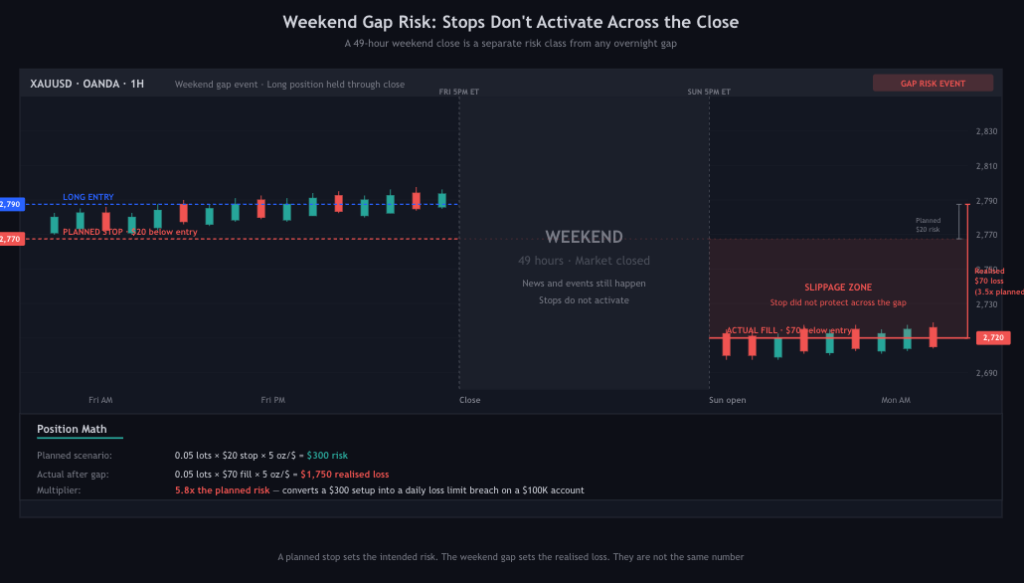
Gold trades from Sunday 5 pm ET to Friday 5 pm ET. The 49-hour weekend close is a separate risk class from anything that happens during the trading week.
The risk profile:
- A position you held into Friday close gets repriced at Sunday open
- A stop-loss set on Friday is not active during the weekend gap — it executes at the next available price after Sunday open, which can be far from the stop level
- Slippage on the gap can convert what a planned $300 risk into a $1,500+ realised loss
If you have ever opened your platform on Sunday evening and seen your account already in drawdown before placing a single trade, the gap was not the failure. Holding the position through the weekend without sizing for the gap was.
Three approaches to weekend gold positions on a funded account:
Flatten before Friday’s close. The simplest rule. No position, no gap risk. The trade-off is giving up potential weekend movement in your favour. But on a funded account, the loss from a bad gap is usually bigger than the gain from a good one. Flattening is the safer choice.
Halve the position before Friday’s close. Reduces gap exposure to half its weekday level. Useful if you have strong directional conviction and do not want to fully exit. Still leaves you exposed if a major event hits over the weekend.
Accept the gap and size for it. If you are going to hold through, treat the weekend as a 5x volatility expansion event. Size as if ATR is 5x its normal reading. Most positions become uneconomic to hold under this framing, which is the rational signal that the weekend trade was not worth holding.
The discipline most surviving funded traders converge on: do not carry gold positions over the weekends. The reason traces back to the rule mechanics. Daily loss limits and maximum drawdown thresholds do not forgive Sunday-open gaps.
FOMC and Economic Calendar Volatility
FOMC days are the single largest scheduled volatility event for gold. Rate decisions, the accompanying statement, and press conferences can move XAU/USD by $50-150+ per ounce within minutes — significantly larger than the normal daily ATR, which occurs within a 30-60 minute window. The volatility extends from the 2 pm ET rate decision through the 2:30 pm ET press conference.
Other macro events that affect gold materially:
- US CPI releases — inflation prints drive real yield expectations and gold reactions
- Non-Farm Payrolls (NFP) — affects rate expectations and DXY moves
- PCE inflation — the Fed’s preferred inflation measure
- ECB and BOE rate decisions — affect cross-currency dynamics that feed into the DXY
- Geopolitical incidents — unscheduled but materially affect gold
Three approaches around scheduled events:
- Flatten 30 minutes before, re-enter 30 minutes after. The cleanest discipline. Avoids the volatility spike entirely. Loses any move you would have caught during the spike, but protects against the regime-shift losses that take down funded accounts.
- Halve the position size into the event. Keeps you in the trade with reduced exposure to the spike. Suitable when your conviction is high and the directional call is consistent with the expected event reaction.
- Stand aside on event days entirely. Some funded traders simply do not trade gold on FOMC, CPI, and NFP days. The expected volatility spike is not worth the risk on a funded account.
If you have ever placed a trade ten minutes before NFP because the setup looked clean, you have already learned what gold’s ATR can do in 90 seconds. The setup was not the problem. The timing was.
The discipline: gold’s calendar is part of gold’s risk management. Trading gold without checking the week’s macro releases is sizing for a market that does not exist this week.
How Gold’s Mechanics Interact with FXIFY Rules
Funded accounts apply two fixed risk thresholds that interact directly with gold’s volatility profile.
Daily loss limit. Daily loss limits typically range from 3% to 5% across FXIFY programs. On a $100,000 account, a 5% limit is $5,000. Gold’s event-driven volatility means a single FOMC-day position can hit the daily loss limit on its own if sized for the wrong regime. The discipline: treat gold’s elevated-regime ATR as the default for sizing during event weeks, not the quiet-week reading.
Maximum drawdown. On programs with trailing drawdown, the threshold moves with account equity until it locks at the starting balance. On static drawdown programs, the threshold sits at a fixed dollar amount from the starting balance.
Both interact with gold the same way: a weekend gap or news spike can produce a drawdown faster than a forex pair would, even with similar nominal lot sizes. The drawdown lock at starting balance after the first payout (on eligible programs) gives gold traders meaningful breathing room — but only after that first payout lands.
The discipline:
- Size gold positions based on the volatility regime you are about to trade through, not the regime you traded through last week
- Treat scheduled macro events as forced sizing recalibrations
- Treat weekend exposure as a separate decision from weekday sizing
- Use the daily loss limit as a sizing budget that accounts for gold’s event-day volatility profile
For the full rule set on FXIFY’s evaluation programs, see How FXIFY Works.
FXIFY offers multiple evaluation paths suited to different risk profiles, including One Phase, Two Phase, Three Phase Challenge, and Instant funding programs. Each applies its own rule structure that gold sizing should be calibrated to.
Common Gold Trading Mistakes
Sizing for quiet-week ATR before an event week. Gold’s volatility profile shifts dramatically around FOMC, CPI, and NFP. A position sized for normal $40 ATR conditions can produce 2-3x the intended dollar risk during an event window where ATR runs $80-100+ per ounce. Always check the calendar before sizing.
Holding positions through the weekend without adjusting size. A 49-hour gap is not the same risk as a 9-hour overnight gap. Geopolitical news that drops on Saturday hits Sunday open as a single jump. Stops do not protect across the gap. Either flatten or size for the gap.
Trading gold without watching the DXY. Gold moves because the dollar moves. A bullish chart pattern on XAU/USD with a bullish setup on the DXY is two trades fighting each other. Confirm the dollar direction before committing to a gold trade.
Treating gold like a forex pair on stop placement. PIP conventions on gold differ between brokers — some count $0.01 per unit, others count $0.10. Setting a stop without verifying what a unit means on your broker can produce 10x the intended exposure. Always verify the actual dollar move per unit on your platform.
Trading the news event itself. Gold’s volatility around FOMC and major releases is mechanical, not strategic. The first move after a release is often reversed within hours as the market re-prices the actual data. Trading the spike is more reflex than analysis. Most funded traders are better served by flattening before the event and re-entering once the regime has stabilised.
Key Takeaways
- Gold’s volatility is event-driven and macro-correlated. Quiet-week ATR is not the ATR you trade through during FOMC weeks
- Weekend gaps are a separate risk class. Stops do not protect across the Friday-to-Sunday close. Either flatten or size for the gap
- The DXY drives gold direction. Trading gold without watching the dollar is trading without seeing the actual driver
- Scheduled events require sizing recalibration. FOMC, CPI, and NFP shift the volatility regime in predictable windows
- Verify your broker’s pip definition on gold. Forex pip conventions do not transfer cleanly to commodity instruments
- On a funded account, gold’s event-day volatility can hit daily loss limits with a single oversized position. Size for the regime you are about to trade through
FAQs
Is gold a good instrument to trade on a funded account?
Gold can fit a funded account well for traders comfortable with macro volatility and event-driven trading. The drawbacks are the volatility spikes around scheduled events and weekend gap risk. Traders who prefer steady, range-bound conditions across sessions may find forex majors more aligned with their style.
What is the typical ATR for gold (XAU/USD)?
Gold’s daily ATR varies dramatically across volatility regimes. In quiet conditions, daily ATR can be $15-25 per ounce. In normal conditions, $25-40 per ounce. Around major events like FOMC days, ATR can spike to $50- $ 100 per ounce or higher during the event window. Always check the current ATR on your chart before sizing, as it varies with the current gold price.
How do you handle weekend gap risk when trading gold?
Three options: flatten positions before Friday close, halve position size before Friday, or treat the weekend as a 5x volatility event and size accordingly. Most funded traders flatten before weekends because the daily loss limit and maximum drawdown rules do not forgive Sunday-open gaps.
Should you trade gold during FOMC?
Trading gold during FOMC is a higher-risk decision than trading on quiet days. The volatility spike around the rate decision and press conference can move XAU/USD by $ 50–$150+ per ounce within minutes. Many funded traders flatten 30 minutes before the announcement and re-enter once the regime stabilises. Some stand aside entirely on FOMC days.
How does gold relate to the US dollar?
Gold trades inversely to the US dollar across most short-term and medium-term windows. When the dollar strengthens, gold typically falls. When the dollar weakens, gold typically rises. The DXY (dollar index) is the cleanest reference point for tracking the relationship.
What is the difference between trading gold and trading oil on a funded account?
Both are commodity instruments with elevated volatility profiles compared to forex pairs, but they respond to different drivers. Gold reacts to macro events (FOMC, CPI, real yields, safe-haven flows). Oil reacts to inventory data, OPEC decisions, and supply disruptions. Both require ATR-based sizing, but the calendars to watch are different.
For the same volatility framework applied to oil, see Trading Oil Volatility on a Funded Account.
For the full rule set on FXIFY’s evaluation programs, see the FXIFY FAQs.
Bottom Line
On a funded account, the discipline that separates surviving gold traders from breached gold traders is sizing for the volatility regime you are about to trade through, not the one you just traded through. Gold rewards traders who watch the calendar and respect the macro context. It punishes traders who treat XAU/USD like a forex pair.