

Trading Oil Volatility on a Funded Account: Risk Guide
Trading oil volatility is a position sizing problem before it is a directional one. When the daily range of WTI or Brent doubles, an appropriate…
Trading oil volatility is a position sizing problem before it is a directional one. When the daily range of WTI or Brent doubles, an appropriate stop distance widens to match. Holding the same lot size through that shift doubles the dollar risk per trade. The trader’s inputs have not changed. The context around them has.
For traders operating on a funded account, that dollar risk shift carries a specific consequence: daily loss limits and maximum drawdown thresholds are fixed numbers. Volatility expansions do not adjust them. A position sized for normal conditions can breach a daily loss limit during an elevated volatility window before the directional view has time to play out.
This guide covers what changes when trading oil volatility rises, how to adjust position sizing, why weekend exposure carries disproportionate risk on leveraged oil, and which correlated instruments offer exposure to the same directional moves at lower dollar risk per lot.
Key Terms
| Term | What it means |
| Volatility | How much a market moves per given time period. Measured numerically by indicators such as Average True Range. |
| ATR (Average True Range) | A technical indicator that measures how much a market moves per candle on average. See the Investopedia ATR definition for the full formula |
| Lot Size | The size of a trading position. On oil CFDs, 1 lot typically equals 100 barrels, producing $10 per pip movement. |
| Pip Value | The dollar value of a one pip move for a given lot size. Determines how much a trade gains or loses per unit of price movement. |
| Daily Loss Limit | The maximum amount an account can lose in one trading day on a funded program. Measured against the previous day’s closing balance on FXIFY evaluation programs. |
| Maximum Drawdown | The total loss limit across the entire evaluation period. Measured against the original starting capital. |
| Floating Loss | An unrealised loss on an open position. Counts toward the daily loss limit in real time on FXIFY evaluation programs. |
| Weekend Gap | The difference between Friday’s closing price and Sunday’s opening price when the market reopens. Standard stop-loss orders on leveraged accounts do not protect against gaps because the position closes at the next available market price, which can be significantly worse than the stop level. |
What’s in this guide
- Why trading oil volatility matters for funded traders
- How volatility changes account risk
- Position sizing when oil volatility rises
- Weekend gap risk on leveraged oil
- Correlated instruments to consider
- How FXIFY’s rules apply
- Key takeaways
- FAQs
Why Trading Oil Volatility Matters for Funded Traders
Oil produces some of the sharpest volatility spikes in liquid markets. Supply shocks, OPEC policy decisions, inventory surprises, and geopolitical events in major producing regions can all double or triple the average true range of WTI and Brent within days.
The implications for a funded account are mechanical rather than strategic. A $2 move in WTI for a standard 1-lot CFD position represents $200 of profit or loss per contract. On a day of elevated volatility producing a $5 intraday move, a 5-lot position represents $2,500 of exposure, half of a typical $5,000 daily loss limit on a $100,000 evaluation account.
The same principle that applies to physical training applies to trading oil volatility: load is relative to capacity. A weight handled safely at rest can injure at fatigue. A position size handled at 0.35 ATR can breach a daily loss limit at 0.70 ATR. Nothing about the weight changed. Capacity did. Oil volatility is cyclical. It compresses during stable periods and expands sharply around known event categories. Traders who recognise the pattern can adjust position sizing before entering trades, rather than after taking avoidable losses during a spike window.
How Volatility Changes Account Risk
Position risk on any instrument is determined by a simple relationship:
Risk per trade = Lot size × Stop distance × Pip value
The trader controls all three inputs. What the market determines is which combinations are reasonable.
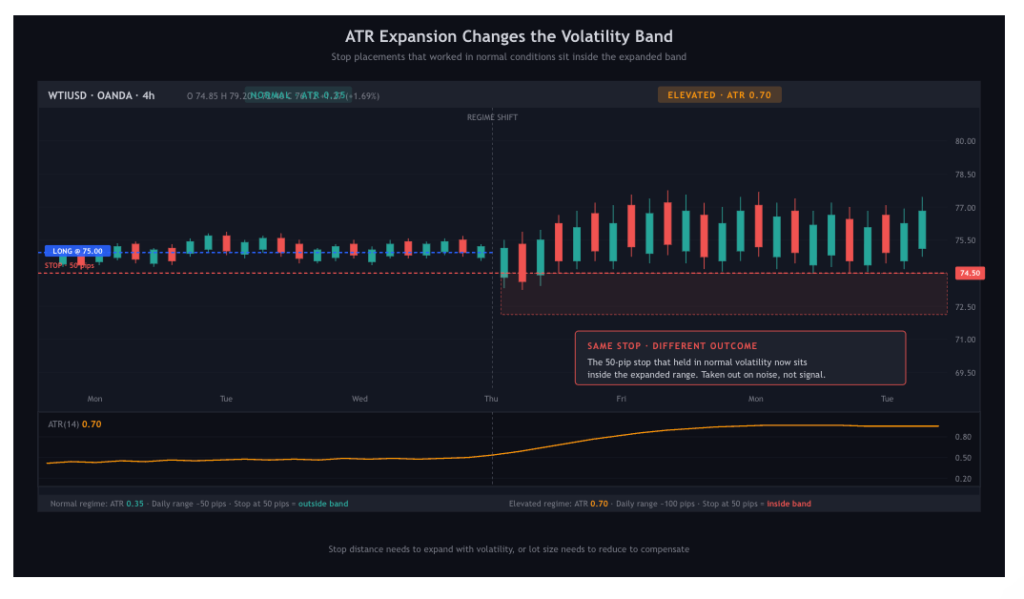
When volatility rises, an appropriate stop distance widens. Holding the same lot size through that transition increases dollar risk per trade, even though none of the inputs was forced to change.
The 14-period Average True Range (ATR) on the 1-hour chart is one practical way to measure this. A trader who typically sets stops at 1.5x ATR will find that stop distance doubles when ATR doubles. Holding the same lot size through that transition doubles the dollar risk per trade, without changing the strategy.
Take a standard WTI position of 0.5 lots with a $5 stop distance, representing $250 in risk on a $100,000 account (0.25%). If ATR doubles and the stop widens proportionally to $10, the same 0.5 lots now represents $500 of risk per trade, or 0.5% of the account. Three consecutive stop-outs at that size put the account 1.5% down for the day, a meaningful portion of a typical daily loss budget.
The fix is not to hold smaller stops against the widened market. Stops set too tight inside the volatility band get taken out on normal price action. The fix is to reduce the lot size proportionally to the ATR expansion, which is covered in the next section.
Position Sizing When Oil Volatility Rises
The principle: when volatility doubles, halve the lot size. Dollar risk stays constant. The strategy continues to produce consistent account exposure across different market conditions.
The math is straightforward. If a trader normally places 0.5 lots with a $5 stop-loss distance for a $250 risk, and the ATR doubles, the new stop-loss distance needs to be $10 to stay outside the volatility band. Holding 0.5 lots at $10 is $500 risk. Halving to 0.25 lots at $10 brings the position back to a $250 risk.
This approach keeps three things stable:
- Dollar risk per trade remains at the account’s normal risk percentage
- Stop placement respects the current volatility band rather than sitting inside it
- Position count can remain constant without compounding account exposure
Traders running multiple concurrent oil positions need to apply the same adjustment to total portfolio exposure, not just individual trades. Two 0.25 lot WTI positions in the same direction during an elevated volatility window carry the combined risk of a single 0.5 lot position, which needs to fit within the account’s total risk tolerance for the day.
FXIFY’s evaluation programs list account sizes and capital allocations on the main programs page.
Weekend Gap Risk on Leveraged Oil
Oil markets close late Friday and reopen Sunday evening GMT. During that 48-hour window, news accumulates that the market cannot price in until the open. Geopolitical events, OPEC announcements, major inventory data, and tanker incidents have all produced double-digit Sunday open gaps in the historical record.
CFD stop orders do not protect against gap fills. A stop placed at $75 on a long WTI position closes the trade at the first available price after the market reopens, which, during a gap, can be several dollars below the intended stop level. The realised loss can exceed the intended risk by a meaningful margin.
For funded accounts, the consequence is specific. Floating losses on open positions count toward the daily loss limit in real time on FXIFY evaluation programs. A position that gaps against the trader at Sunday open can breach the daily loss limit before the trader is at the desk to react. The account’s evaluation can end on a weekend gap.
The practical response is to close leveraged oil positions before the Friday close during periods when major weekend-event risk is elevated. Learn more about how FXIFY’s funded trading works.
Correlated Instruments to Consider
Traders who want exposure to oil directional moves without the per-lot dollar risk of WTI or Brent CFDs have several correlated instruments to choose from.
USD/CAD has a structural inverse correlation with oil. Canada is the largest supplier of crude oil to the United States by volume, and the Canadian dollar tends to strengthen when oil rises. USD/CAD typically has a narrower daily range than WTI CFDs at comparable leverage, reducing per-lot dollar risk while preserving directional exposure to the same underlying driver.
USD/NOK offers similar petrocurrency exposure through Norway’s Brent-heavy export base. Liquidity is thinner than USD/CAD, and spreads are wider, but the correlation to oil is historically tight.
XAU/USD (gold) has a variable relationship with oil. During periods of broad market stability, gold and oil often move independently. During supply shock events that drive safe-haven flows, the two can correlate positively, as both price in risk premiums.
One critical point for funded account risk management: correlated exposure across multiple instruments counts toward total account risk. A long WTI position and a short USD/CAD position are not offsetting hedges. They are amplified directional exposure to the same underlying move. Total account exposure needs to be calculated across all correlated positions, not per instrument.
How FXIFY’s Rules Apply
FXIFY’s evaluation programs apply two separate risk thresholds that interact with oil volatility in specific ways.
Daily loss limit. Measured against the previous day’s closing balance. Floating (unrealised) losses on open positions count toward the limit in real time. A breach ends the evaluation immediately. For oil traders, this means open positions that move against them during an elevated-volatility session can trip the daily limit before the trader manually closes them.
Maximum drawdown. Measured against the original starting capital. Does not reset daily. This is the outer boundary of the evaluation. A trader down 7% on a week of oil trading has a limited account remaining before overall breach, which changes what is strategically possible for the rest of the evaluation.
The two thresholds work together. A single session can breach the daily limit without coming close to maximum drawdown. A slow bleed across multiple sessions can breach the maximum drawdown without any single day triggering the daily limit.
FXIFY offers multiple evaluation and funded trading paths to suit different trading preferences and styles. The One Phase, Two Phase, and Three Phase Challenge programs each apply their own rule sets for traders who want to prove a strategy before receiving capital. Instant Funding and Instant Funding Lite provide funded accounts from day one with no evaluation phase, while 2 Phase Pro offers a premium two-step evaluation for experienced traders. Lightning and Crypto programs serve traders focused on specific strategies and instruments. Each path applies its own rule set, which traders can align with their strategy and goals.
FXIFY offers multiple funded trading paths to suit different trading preferences and styles. The One Phase, Two Phase, and Three Phase Challenge programs each apply their own rule sets for traders who want to prove a strategy in a structured evaluation before receiving capital. Instant Funding and Instant Funding Lite provide funded accounts from day one with no evaluation phase. Lightning challenge and Crypto programs serve traders focused on specific strategies and instruments. Each path applies its own rule set, which traders can align with their strategy and goals.
Key Takeaways
- Volatility is a sizing problem, not a directional one. The same lot size represents different dollar risk as the market’s daily range expands
- Halve the lot size when ATR doubles. This keeps the dollar risk per trade constant across different volatility conditions
- Floating losses count toward the daily loss limit in real time on FXIFY evaluation programs
- CFD stops do not protect against weekend gap fills. Leveraged oil positions held through weekends carry asymmetric gap risk
- Correlated exposure amplifies risk. USD/CAD, USD/NOK, and XAU/USD positions sized alongside direct oil exposure count toward total account risk
FAQs
How does oil volatility affect funded account risk?
Oil volatility determines how much dollar risk a given lot size represents. When the average true range doubles, the correct stop placement widens, and the same lot size now carries twice the dollar risk per trade. On funded accounts with fixed daily loss limits, this shift can turn a normal position into one that breaches the daily threshold without any change in strategy.
What is the difference between daily loss limit and maximum drawdown?
The daily loss limit is measured against the previous day’s closing balance and resets each trading day. Floating losses count toward it in real time. The maximum drawdown is measured against the original starting capital and does not reset. It is the outer boundary of the evaluation. A breach of the maximum drawdown ends the evaluation. A daily loss limit breach ends the current phase of the evaluation and is handled per the program’s specific rules.
How should position sizing change when oil volatility increases?
Halve the lot size when ATR doubles. This keeps dollar risk per trade constant across different volatility conditions. Traders running multiple concurrent positions need to apply the adjustment to total portfolio exposure, not just individual trades.
Why does weekend exposure matter on leveraged oil positions?
Oil markets close Friday and reopen Sunday evening GMT. During that 48-hour window, news cannot be priced in. CFD stop orders do not protect against gap fills, meaning a position can close at the gap level rather than the intended stop. Floating losses at Sunday open can breach the daily loss limit before the trader is at the desk.
What correlated instruments move with oil?
USD/CAD has a structural inverse correlation with oil due to Canada’s crude export base. USD/NOK offers similar petrocurrency exposure through Norway. XAU/USD has a variable relationship with oil, correlating positively during supply shock events and trading independently during stable periods. Correlated positions amplify rather than offset directional exposure.
Does FXIFY allow oil trading on evaluation accounts?
Yes. Oil CFDs including WTI and Brent are tradeable instruments on FXIFY’s evaluation programs. The standard program rules apply, including daily loss limits, maximum drawdown, and any news-trading restrictions that affect high-impact economic events. FXIFY does not impose additional restrictions on oil specifically during periods of elevated volatility. Traders are responsible for adjusting position sizing to match current market conditions and for managing weekend exposure on leveraged positions.
Is it safe to trade oil on a funded account during volatile periods?
Oil can be traded on a funded account during volatile periods with appropriate adjustments to position sizing. The risk is not the volatility itself but trading it at normal lot sizes when the market’s daily range has expanded. Traders who adjust lot size proportionally to ATR expansion maintain consistent account risk across different market conditions.
For the full rule set on FXIFY’s evaluation programs, see the FXIFY FAQs.
Bottom Line
Oil volatility rewards traders who adjust position sizing to match the market’s current range and penalises traders who do not. On a funded account, that difference is mechanical: fixed daily loss limits and maximum drawdown thresholds do not flex with the market. The trader has to.
The discipline is the same across every FXIFY evaluation program. Size positions to the current volatility, close leveraged exposure before weekend event risk, and count correlated positions as part of total account risk rather than separate trades.
Explore FXIFY’s evaluation programs to find the rule set that matches your trading style.