


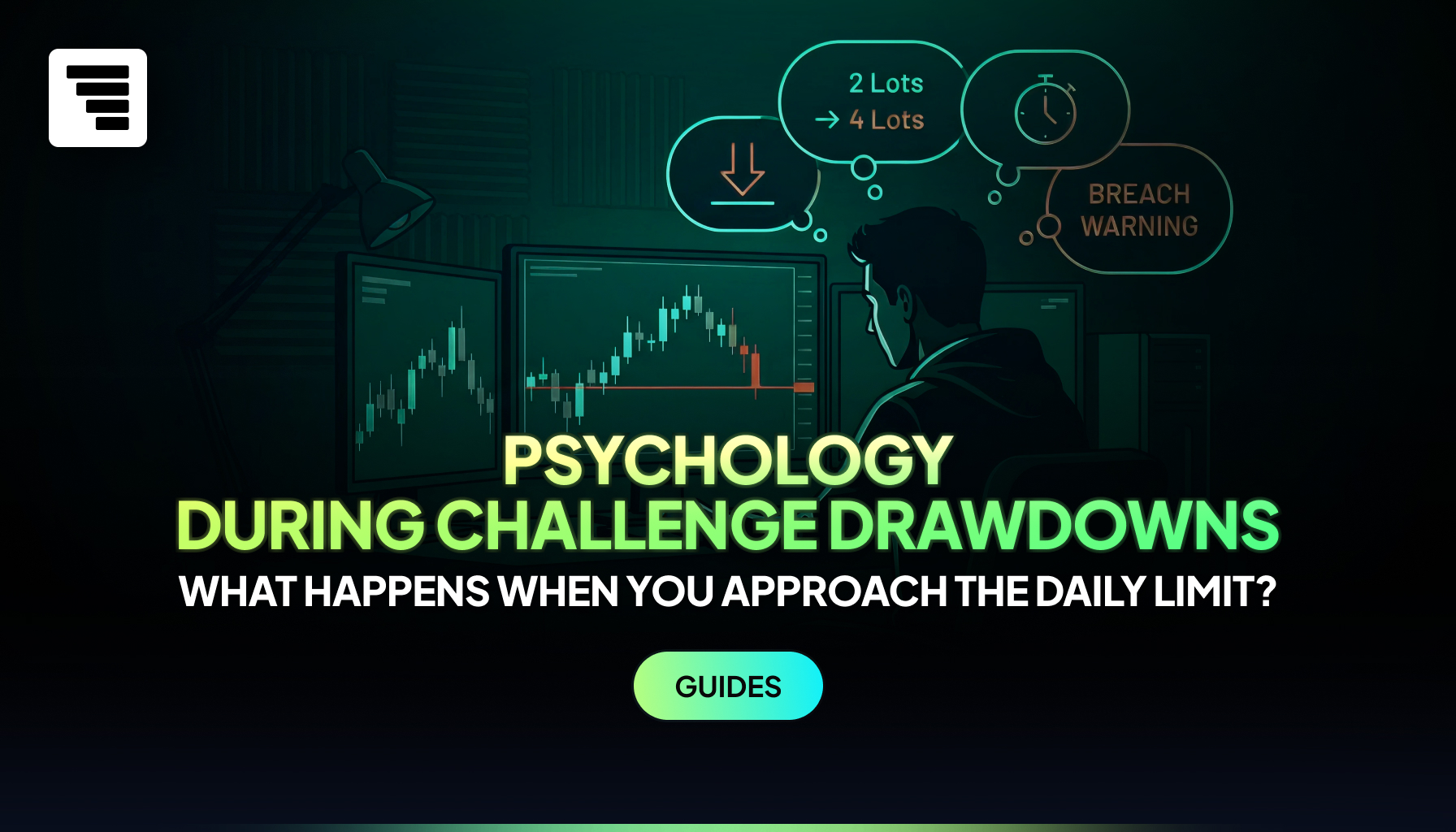
Trading Psychology During Challenge Drawdowns
What actually happens when you are close to the daily limit, and how to stop it from determining the outcome.
| IN THIS ARTICLE 1. What Drawdown Pressure Actually Does to Your Brain 2. The $100 From Breach Moment 3. Why Daily Loss Pressure Rewires How You Trade 4. 3 Cool-Down Strategies That Hold Up Under Pressure 5. How to Read the Drawdown Rule, Not Resent It 6. What to Do the Day After a Near-Breach |
You are $100 away from the daily loss limit.
The market is still moving. A setup is forming on your screen.
This is the moment that ends more challenges than bad strategy ever does.
Not because of market conditions. Not because the rule is unfair. But because of what happens inside a trader’s head when the breach number is that close.
This article explains the behaviour, the mechanism behind it, and three concrete strategies to break the cycle before it breaks your challenge.
What Drawdown Pressure Actually Does to Your Brain
Traders under daily loss pressure do not trade worse because they stop caring. They trade off worse because their brains prioritize recovery over accuracy.
This is documented behaviour, not a character flaw. Under financial stress, cognitive function narrows. The brain shifts from broad analysis to a tight focus on fixing the current situation.
In trading, that looks like this:
→ Loss aversion bias kicks in. Losses already taken feel like they must be recovered before the session ends. That feeling becomes the primary instruction.
→ Decision speed increases. As the breach number gets closer, traders make entries faster, with less checklist review and lower confirmation standards.
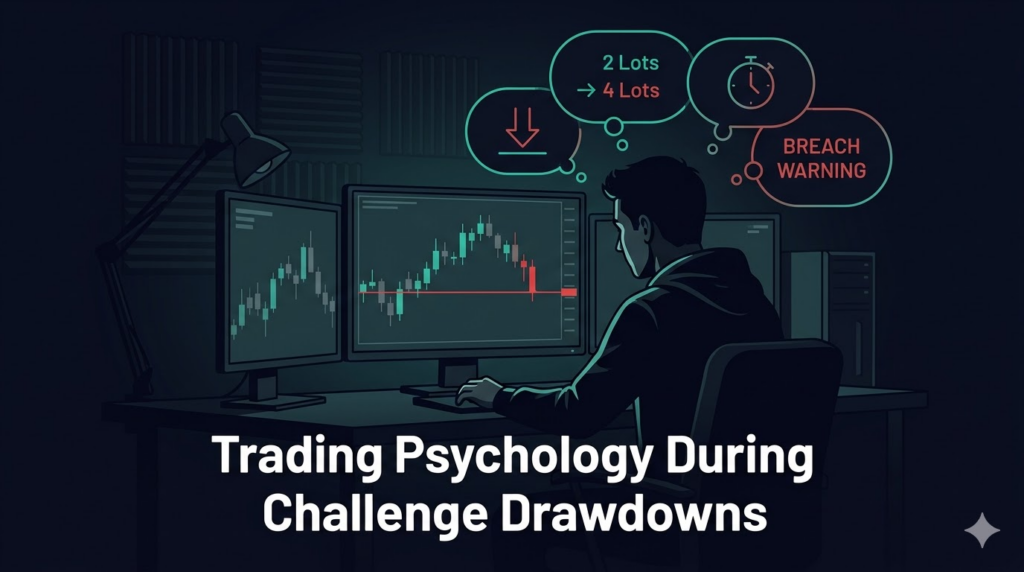
→ Position sizing drifts upward. Unconsciously, traders increase their size to recover the drawdown faster. The logic feels sound in the moment. The result is usually the opposite.
→ The setup becomes secondary. Instead of asking, “Does this trade meet my criteria?” traders ask, “Will this trade get me back?” Those are very different questions.
The $100 From Breach Moment
Here is a concrete example.
A trader on a $10,000 challenge account has a daily loss limit of $500. By midday, they are down $400. They are $100 from the breach.
The first two losses were reasonable. A breakout trade that failed. A reversal that ran against them before confirmation.
Then the behaviour shifts.
→ Trade three: They take a setup they would normally skip. The entry criteria are partial. They tell themselves it is “close enough.”
→ Trade four: The previous trade lost $60. Now they are $40 from the breach. They average down into a losing position to cut the distance.
→ Result: The daily limit is hit, not by one bad trade, but by a sequence that started with a reasonable loss and ended with reactive decisions.
Most daily limit breaches follow this same pattern. The first loss is not the problem. The trading that comes after the first loss is.
According to research on trader performance, the majority of daily limit violations occur in the final 20% of the session. Not at the open. Not on the first trade.
The $100 mark is not where the trouble starts. It is where you can see how far the trouble has already gone.
Why Daily Loss Pressure Rewires How You Trade
Three specific cognitive mechanisms make the $100 moment so dangerous.
The sunk cost loop. Losses already taken feel like they have a claim on future trades. “I am already down $400; one more trade to get back is reasonable.” It is not. Each trade exists independently. A previous loss has no bearing on whether the next setup is valid.
The breach anchor. Once the daily limit number is visible, it becomes the reference point for every decision. Traders stop measuring trades against their entry criteria and start measuring them against the distance to breach. The setup quality degrades because the evaluation standard has changed.
Session-end urgency bias. When traders believe time is running out to recover, they lower entry thresholds to take any trade. This creates a paradox: the urgency to recover losses produces the behaviour most likely to deepen them.
3 Cool-Down Strategies That Hold Up Under Pressure
These are not mindset tips. They are preset procedures. The reason they work is that they are decided before the pressure arrives, not during it.
| Strategy 1: The 15-Minute Hard Stop – When you reach 50% of your daily loss limit, set a 15-minute timer before placing any new trade. – Close the chart. Write down the trade that lost, the setup you took, and why you took it. – The point is not to calm down. The point is to interrupt the reactive sequence before it compounds into the second and third bad trades. – When the 15 minutes end, re-evaluate the session. Ask: Am I still within a normal trading scenario, or am I trying to recover? |
| Strategy 2: The Half-Size Rule – After two consecutive losing trades, cut your default position size in half for the rest of the session. – This is a pre-written rule, not a judgment call made while you are already down. – Smaller size does two things. It limits how fast the remaining drawdown room disappears. And it lowers the emotional charge on each trade, which means clearer decision-making. – The rule must be written before the session. Deciding it in the moment rarely works. |
| Strategy 3: The Pre-Set Session End Trigger – Before each session, write down your session-end condition. For example: “If I reach 70% of my daily limit before 1 PM, the session ends.” – The trigger exists, so you do not have to make that decision while you are already under pressure. – Traders who set this rule consistently report fewer compounding losses on bad days. Not because the rule stops all losing trades, but because it stops the sequence of reactive trades after the losing trade. – Set it the night before. Do not adjust it on the day. |
How to Read the Drawdown Rule, Not Resent It
The daily loss limit exists to protect the account from a single bad session turning into a total wipeout. That is the only reason it is there.
It is not designed to punish traders who have a rough day. It is designed to ensure one rough day does not remove all capacity to continue.
Traders who have reviewed their own breach history consistently find the same thing. Most violations occur on days with two or more losses in a row. Not from one large loss at the open.
That means the rule rarely fails traders on a genuinely bad-luck day. It fails them when behaviour after the first loss is not managed.
Treating the daily limit as a structure, rather than an obstacle, changes how you respond to the first loss. The first loss triggers the protocol’s application. Not the signal to recover.
What to Do the Day After a Near-Breach
If you came close to the daily limit yesterday, do not open a chart first. Open your trade log first.
Review the sequence, not just the individual trades. Find the point where your decision-making shifted from planned to reactive. That point is almost never the first trade.
→ Look at the trade that followed the first loss. What entry criteria did you use? Were they the same as your pre-session criteria?
→ Look at position sizing across the session. Did it increase after losses?
→ Look at the time. Did the frequency of your trades increase as the session went on?
Treat the near-breach as data. The session showed you where your behavioral pattern breaks down under pressure. That information is more useful than any trade setup.
Use it to adjust the protocol for the next session, not to judge the previous one.