



What Is Max Daily Loss? Simple Prop Trading Guide
Max daily loss is one of the most important prop firm rules. Here is how it works, why open losses count, and how to avoid a breach.
Max Daily Loss Explained: What It Means
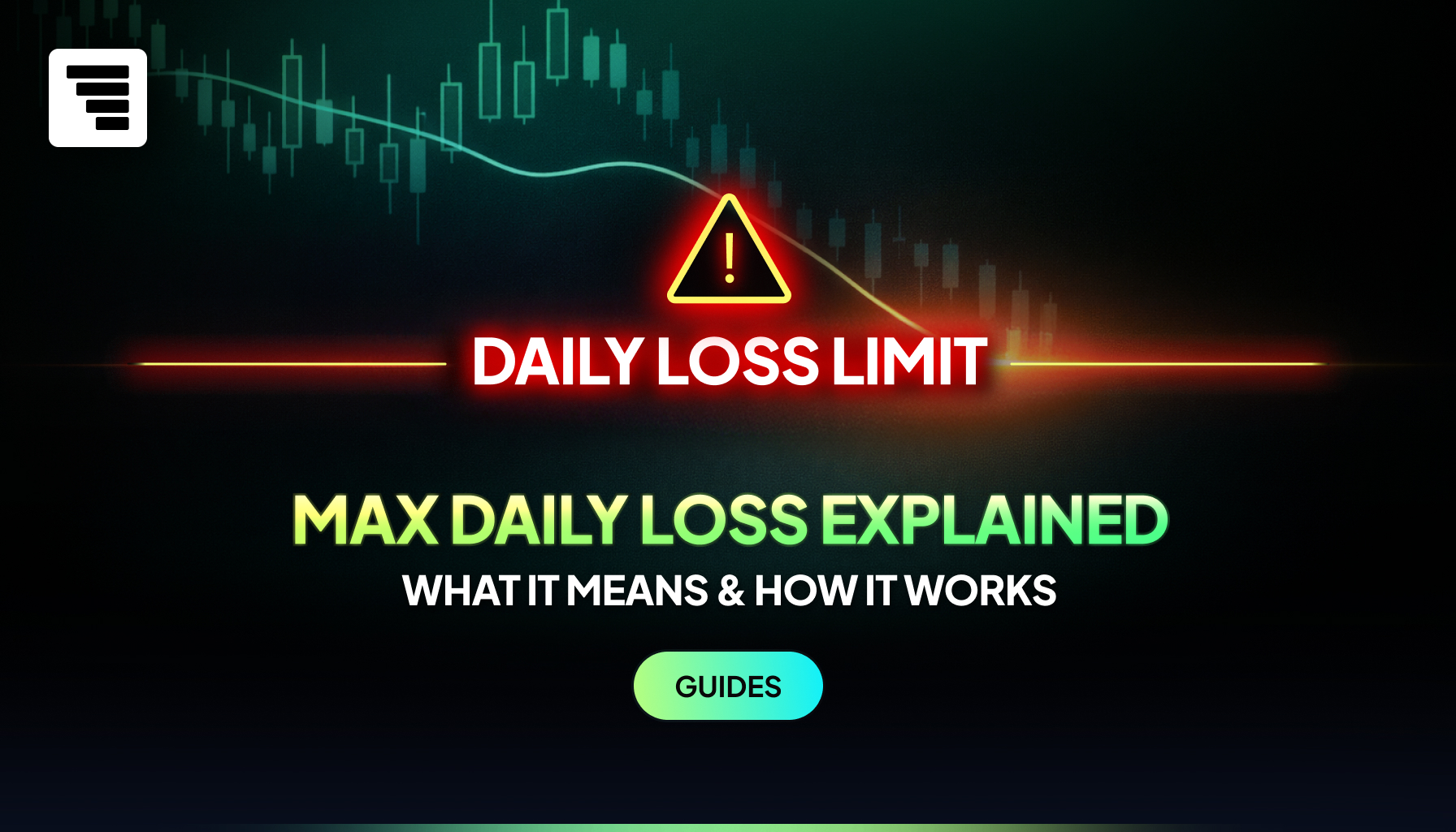
If you’re new to prop trading, max daily loss can sound more complicated than it really is. In simple terms, it is the maximum amount you can lose in one trading day before you breach the account. This is a standard approach across prop firms, where a breach occurs if equity falls below the defined limit.
Think of it as your daily risk cap. Once your equity drops below that limit, the day is effectively over. The rule protects firm capital, but it also protects traders from turning a bad start into a much worse day.
Key takeaway:
- Max daily loss is your daily risk cap
- Open losses can count
- A recovery later does not undo a breach
What Max Daily Loss Means
A maximum daily loss rule sets a strict limit that your trading account cannot exceed in a single day. For instance, imagine your account starts the day with $100,000, and the set limit is 4%.
This means the absolute maximum you can lose that day is $4,000. Your account balance must stay above $96,000. If your equity dips below this point, even just for a moment, you have broken the rule.
A common mistake many traders make is thinking that a loss on an open trade doesn’t count until it’s officially closed. At FXIFY, daily loss limits are clearly defined and include open losses. Your daily loss limit is calculated based on the balance recorded at 5:00 PM EST the previous day.
If your current equity drops below that set threshold, it counts as a breach. To put it simply: yes, open losses absolutely do count.
Max Daily Loss Vs Max Drawdown
These terms get mixed up all the time, but they are not the same.
Max daily loss is your limit for one day. Max drawdown, or overall drawdown, is the total amount the account can lose over its full life.
So if a firm gives you a 4% daily loss limit and an 8% overall loss limit, you could stay within the daily rule and still fail the account over several days if your losses keep adding up. That is why traders need to track both numbers, not just the daily one.
For a deeper breakdown, you can also read Understanding the Different Types of Drawdowns in Prop Trading.
3% Vs 4% Vs 5% Max Daily Loss on a $100K Account
Here is the same $100K account under three different daily loss limits:
- 3% max daily loss
- Dollar amount: $3,000
- Equity floor: $97,000
- In practice: Very little room for error. You need a smaller size and fewer attempts.
- 4% max daily loss
- Dollar amount: $4,000
- Equity floor: $96,000
- In practice: More breathing room, but still tight if you overtrade.
- 5% max daily loss
- Dollar amount: $5,000
- Equity floor: $95,000
- In practice: More flexibility, but still not enough to trade recklessly.
That may not look like a huge difference on paper, but it changes your trading behaviour a lot.
With a 3% limit, risking 1% per trade gives you very little space. Two losing trades already put you down 2%. One more loss, plus spread or slippage, and you are close to a breach.
With a 4% limit, you get more room, but not enough to size carelessly.
With a 5% limit, you can absorb more normal market variance, but it still does not give you permission to chase losses or force trades.
One Max Daily Loss Scenario Walkthrough
Let’s use a $100K account with a 4% daily loss rule.
- Start of day balance: $100,000
- Max daily loss: $4,000
- Breach level: $96,000 equity
Trade 1
You lose $1,200.
- New balance: $98,800
- Remaining daily buffer: $2,800
Still safe.
Trade 2
You take another trade, and it loses $1,300.
- New balance: $97,500
- Remaining daily buffer: $1,500
Still safe, but the margin is much smaller now.
Trade 3
You get frustrated and increase your size. The trade goes against you. It is still open, but your floating loss reaches $1,700.
- Balance: $97,500
- Floating loss: -$1,700
- Live equity: $95,800
That means your equity has now dropped below $96,000.
You have breached the max daily loss rule.
This is the part traders hate: the trade is still open, and the market might turn back later. But that does not matter. Once the equity falls below the daily limit, the breach has already happened. The market recovering afterwards does not undo it.
Why Traders Break the Rules
The main reason isn’t a bad strategy; it’s poor behaviour.
Traders often go over the prop firm’s daily limit because they:
- Take too much risk on one idea
- Increase their size after a loss
- Hold onto losing trades for too long
- Ignore floating losses
- Try to make up for a bad day with a single trade
The most dangerous belief is, “I just need one winning trade to recover.” This mindset can turn a small red day into a failed account. The max daily loss limit is there to prevent that kind of spiral before it gets worse.
How To Stay Within Your Max Daily Loss Limit
The easiest fix is to think in terms of a daily risk budget, not just risk per trade.
A practical way to manage it:
- Set a personal stop before the firm’s hard limit
- If your daily loss limit is 4%, consider stopping at 2%
- Keep per-trade risk small enough that a normal losing streak does not put the account in danger
- For many traders, that means risking around 0.25% to 0.5% per trade, not 1% to 2%
- Once you hit your personal cutoff, stop trading for the day
The goal is survival first. Profit comes after that.
How This Applies at FXIFY
At FXIFY, daily loss limits are clearly defined and depend on the program and account setup. In many cases, the limit is based on the previous day’s ending balance at 5:00 PM EST. If equity drops below that level, it is a breach. Open losses are included, so the daily threshold must be respected before entering new trades.
FXIFY offers Multiple Programs & Account Types and Tailored Accounts at Checkout, with different drawdown models and thresholds across setups. This allows traders to choose a structure that fits their strategy and risk tolerance, rather than operating under a single fixed model.
For a full breakdown of drawdown rules, limits, and how each option works, review the FXIFY programs and their specific conditions.
If you are still comparing evaluation paths, you can also read One Phase vs Two Phase: Which Option Is Better?.
Final Thought
If you want the cleanest max daily loss explained answer, it is this:
Your daily loss limit is the line your account cannot cross today. Not after the trade closes. Not by the end of the session. At any point.
Once you understand that, the rule becomes much easier to manage. And once you manage it properly, you stop trading emotionally and start trading with a plan. Stop trading emotionally and start trading with a plan.
What is max daily loss?
It is the maximum amount your account can lose in a single trading day before it is breached.
Do open trades count toward max daily loss?
Yes. Max daily loss is based on live equity, so open losses are included.
What happens if I breach the daily loss limit?
If your equity drops below the defined level, the account is breached. A recovery later does not reverse this.
How is max daily loss calculated at FXIFY?
At FXIFY, it is clearly defined per program and often based on the previous day’s ending balance at 5:00 PM EST, with breaches triggered using live equity.
Do all FXIFY accounts have the same drawdown rules?
No. FXIFY offers multiple programs and account types with different drawdown models and thresholds, allowing traders to choose what best fits their strategy.