What Is Intraday Buying Power?
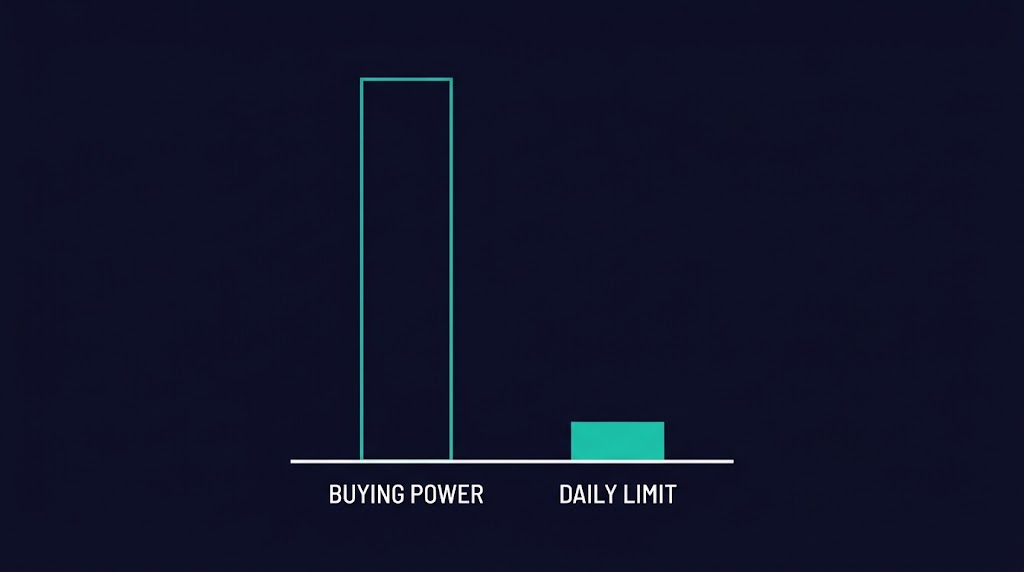
A $10,000 account at 30:1 leverage can open about $300,000 of trades. On a 1-Phase account, that same balance can only lose $300 in a…
A $10,000 account at 30:1 leverage can open about $300,000 of trades. On a 1-Phase account, that same balance can only lose $300 in a day. That gap is what intraday buying power hides. It tells you how big your platform lets you trade, but it says nothing about how much your account can survive. Here is what the term means, what changed in 2026, and how to use it on a funded account.
| Intraday buying power in short It is the amount you can use to open trades during the trading day, based on your equity and leverage. In US stock margin accounts, the rules behind it changed in June 2026. On a CFD prop account, it comes from your leverage and your free margin. |
Key Terms
| Term | What it means |
|---|---|
| Buying power | The total size of trades your account can open right now |
| Margin | The part of your equity set aside to keep a trade open |
| Free margin | The equity you have left for new trades after margin is taken |
| Leverage | How many dollars of trade size each dollar of margin controls, such as 30:1 |
| Daily loss limit | The most your account can lose in one trading day before it breaches |
What Is Intraday Buying Power?
Intraday buying power is the trading size you can use between the open and the close of one trading day. The term comes from US stock brokers. There, margin accounts get a set amount of buying power for trades opened and closed on the same day, so the name stuck.
The idea is simple. Your broker lends you trading size against your equity, so the more equity you hold above the required margin, the more you can buy. But once you hit that ceiling, the platform will not let you open anything bigger.
What Changed in 2026
For 25 years, US margin accounts ran on the pattern day trader rule. On April 14, 2026, the SEC approved FINRA’s plan to replace it, and the change took effect on June 4, 2026.
| Feature | Before June 4, 2026 | From June 4, 2026 |
|---|---|---|
| Pattern day trader label | Applied after 4 or more day trades in 5 business days | Removed |
| $25,000 minimum equity | Required to day trade often | Removed |
| How buying power is set | 4 times the prior day’s margin excess, fixed at the start of the day | Based on margin excess in real time, as trades are opened |
For US stock traders, this was a big change. For CFD prop traders, it is mostly background, because buying power on a prop account works in a different way.
Buying Power on a CFD Prop Account
On a CFD account, your buying power comes from two things: your equity and the leverage on each market. Multiply one by the other, and you get the largest trade size the account can open. Our guide to leverage in trading covers how margin and free margin fit together.
Leverage changes by market, so buying power does too. On FXIFY standard accounts, here is what $10,000 of equity can open:
| Market | Leverage | Buying power on $10,000 |
|---|---|---|
| FX and gold | 30:1 | About $300,000 |
| Indices | 10:1 | About $100,000 |
| Oil | 5:1 | About $50,000 |
| Stocks | 2:1 | About $20,000 |
Leverage per FXIFY’s leverage FAQ. A 50:1 add-on is available for FX and gold only.
In MT5, you can see how much buying power is left at any moment. Open the Trade tab and check the free margin figure at the bottom. Every new trade takes a slice of it, so the number shrinks as you add positions.
Why Buying Power Is Not Your Real Limit
Picture a trader on a $10,000 One Phase account. She checks MT5, sees plenty of free margin, and opens one standard lot of EURUSD. That trade controls about $100,000, and at 30:1 it uses roughly a third of her equity as margin. So on screen, she still looks well inside her limits.
Then price moves 30 pips against her. On one standard lot, each pip is worth about $10, so 30 pips is $300. That is her entire daily loss limit, gone on a move that EURUSD can make in a normal hour.
Her buying power was never the problem. The platform allowed the trade, but her daily limit could not absorb it, even though the account looked healthy. This is why funded traders size from the loss limit first, as our max daily loss guide explains in more detail.
How to Size With Buying Power in Mind
Turn the order around instead. Start from what you can lose, because that number does not grow with leverage.
1. Work out your daily loss limit in dollars. On a $10,000 One Phase account, that is $300.
2. Pick a risk per trade well below that figure. For example, $60 leaves room for several losing trades in one day.
3. Divide your risk by your stop loss in dollars per lot. With a 20-pip stop on EURUSD at about $10 a pip, one lot risks $200, so $60 of risk means 0.3 lots.
4. Check that the trade fits your free margin. If it does, buying power is not your constraint, and it rarely will be when you size this way.
FAQs
Is intraday buying power the same as leverage?
Not quite. Leverage is the ratio, such as 30:1, while buying power is the result. It is the total trade size that ratio gives your equity at a given moment.
Does the pattern day trader rule apply to prop firm accounts?
No. It was a rule for US broker margin accounts, and it never covered CFD prop evaluations. It was also removed on June 4, 2026.
What happened to the $25,000 day trading rule?
The SEC approved its removal on April 14, 2026, and it ended on June 4, 2026. US margin accounts now use a real-time intraday margin standard instead.
Where do I see my buying power in MT5?
Open the Trade tab at the bottom of the platform. The free margin figure shows how much equity is left for new trades, and that sets your remaining buying power.
How much of my buying power should I use?
Usually far less than the maximum, because the daily limit runs out long before buying power does. Size each trade from your daily loss limit and stop distance first. On most well-sized trades, you will use only a small share of the buying power available.
The Bottom Line
Intraday buying power tells you how big your platform lets you trade. On a funded account, the number that matters more is your daily loss limit, because that is what ends an account. Start every trade from the limit, size to your stop, and let buying power stay in the background. You can compare the FXIFY programs to see how each one sets its daily limit.