From Cards to Charts: A Guide to Poker and Trading
Poker and trading both ask you to make choices with money when you cannot know the result in advance. This guide shows which poker skills…
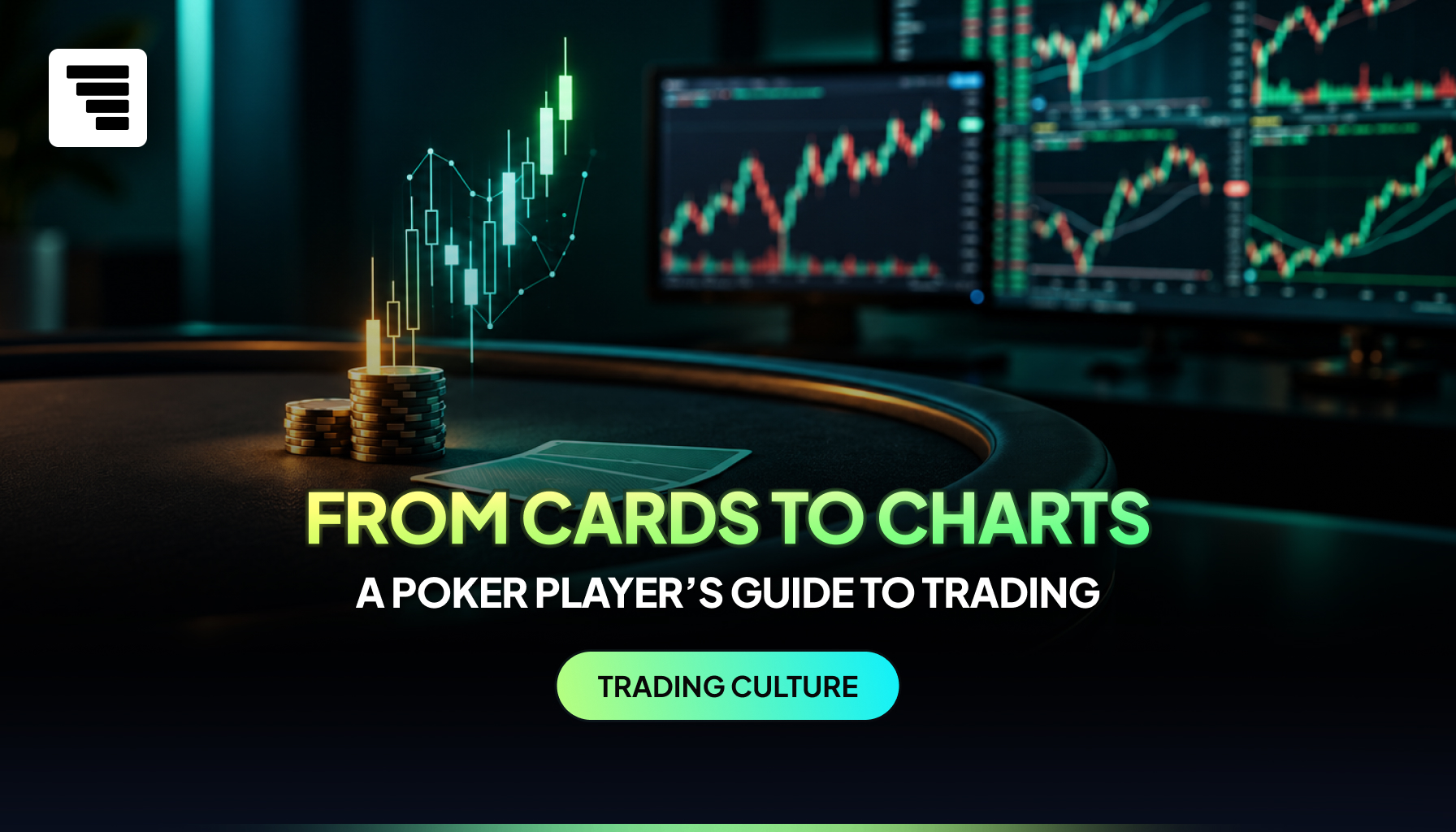
Poker and trading both ask you to make choices with money when you cannot know the result in advance. This guide shows which poker skills carry over to trading, which ones do not, and how to start.
Poker teaches you to think in odds and to size each bet so you protect your stack. It also teaches you to judge a choice by its logic, not its result. Trading needs all three. A trade is different from a hand, though. It stays open until you close it, and prices move for reasons no one at your table controls.
Key Terms
| Term | What it means |
|---|---|
| Expected value (EV) | What a choice gains or loses on average if you repeat it many times |
| Variance | The normal swing in results around your average. A sound plan still has losing runs |
| Position size | How much you risk on one trade. In poker terms, it is the size of your bet |
| Stop loss | An order that closes a losing trade at a price you set in advance |
| Risk to reward | How much you could lose on a trade compared with how much you could gain |
Three Poker Habits That Help in Trading
You Think in Odds
A strong poker player does not ask if a hand will win. The question is how often it wins, and if the price to play is worth it. A trader asks the same question about each setup.
You Protect Your Bankroll
Serious players keep enough money in reserve to get through a long losing run. One bad night is part of the game. In trading, this habit becomes risk per trade. No single trade should be large enough to end the account.
You Judge the Choice, Not the Result
Annie Duke, a former professional poker player, writes about a mistake called “resulting” in her book Thinking in Bets. It means you judge a choice only by how it turned out. A well-planned trade that loses can still be a good choice. A careless trade that wins is still a poor one.
The Poker-to-Trading Translation Guide
Much of what you know from poker already has a name in trading. Here is how the main ideas line up.
| At the poker table | On the trading chart | What carries over |
|---|---|---|
| Your chip stack | Your trading account | Protect it first, because you cannot play without it |
| Your hand | Your trade setup | A strong setup still needs the right conditions |
| The flop, turn and river | Price action after you enter | New information can change the odds after you commit |
| Reading other players | Reading the chart | The trend and key price levels shape the next move |
| Pot odds | Risk to reward | Only take a trade when the possible gain justifies the risk |
| Folding a hand | A stop loss closing a trade | A small, planned loss protects the stack for better spots |
| Going on tilt | Revenge trading | Chasing losses with larger trades can make them grow |
| Bankroll management | Risk per trade | Size each trade so a losing run cannot knock you out |
The River and the Chart
A strong starting hand can still lose on the last card. A clean trade setup can still fail when price turns against you. Neither case means you played badly. Both are part of variance.
Reading the Table and Reading the Chart
At the table, you watch betting patterns to judge if someone is strong or weak. On a chart, you read the trend and the price levels where buyers or sellers stepped in before. Together, these clues help you judge if the odds lean your way. For a first tool, see EMA for Day Trading: How to Choose Your Settings.
Your Edge Shows Over Many Hands and Many Trades
Online poker players track their win rate in big blinds per 100 hands, written as bb/100. A win rate can take a very large number of hands before it means much. Variance can hide a skill edge for a long time.
Trading works the same way. Ten trades tell you very little. You need a large sample of trades before you can judge a plan fairly.
Keep a Trade Journal Like a Hand History
Here is an example. A poker player studies a hand history each week to find leaks. When that player starts trading, a trade journal does the same job.
For each trade, record the setup, the entry, the exit, the reason for the trade and the result. Then review the trades as a group, not one at a time. Your notes will show which setups work, which ones you force and when your trading slips.
Tilt, Stop-Loss Nights and the Daily Loss Limit
Poker players know tilt. You take a bad beat, then play the next hands too loose because you want the money back. Some players set a stop for the night, such as quitting after a fixed number of lost buy-ins.
A funded account has a daily loss limit, which works as a fixed line for each trading day. On the FXIFY One Phase account, the daily loss limit is 3% of the previous day’s balance at 5 PM EST. It is checked against equity, so open trades count.
Here is FXIFY’s own example. If the previous day’s balance at 5 PM EST was $100,000, the loss allowance for the day is $3,000. The breach level is equity of $97,000. If equity falls to $97,000, the daily loss limit is breached.
Treat that line like a hard stop for the night. Then set your own personal stop well inside it, so you stop trading before you get close. Read more about how these rules shape a challenge in Why Traders Fail Prop Firm Challenges.
Where Poker and Trading Part Ways
The skills carry over, but the two are not the same. Four differences matter.
A Trade Has No Natural End
Each poker hand ends when the cards are shown. A trade stays open until you close it or your stop loss closes it. You need an exit plan before you enter, not after.
There Are More Moving Parts
Poker results depend on the cards and the players at your table. Prices react to interest rates, large orders and many other forces at once. A move can start far from your chart.
There Are No Blinds
In poker, the blinds make you pay to keep your seat. In trading, you can wait for hours or days without a cost to sit out. You can wait for the setups that fit your plan.
You Cannot See the Other Side
At the table, you face a few known players. In a market, you trade alongside a large number of people you will never see. Reading the chart replaces reading faces.
How to Move From Poker to Trading
Step 1: Learn the Language
Terms like pips, lots, spreads and leverage are your new hand rankings. See Forex Trading Terminology: Key Terms Explained. FXIFY also offers a free prop trading course that covers forex and CFDs, orders, risk and leverage.
Step 2: Pick One Market
Learn how one market behaves, the way you would learn one game format before you try another. Our guide to choosing forex pairs explains what to look for.
Step 3: Learn Two Chart Tools
Support and resistance show where price has turned before. Trendlines show the direction of a move. For one pattern built from trendlines, see Symmetrical Wedge Pattern Explained.
Step 4: Practise on a Demo Account
Trade a demo account and keep a journal from your first trade. Treat each trade like a hand you will review later.
Step 5: Understand How Funded Accounts Work
In poker, some players are staked. A backer pays for their games in return for a share of any winnings.
A funded account works in a similar way, with one difference. With staking, the backer pays for the games. With a funded account, you pay a fee and take an evaluation under set rules. If you pass, you trade a funded account under the program’s rules. If you make a profit and follow the rules, you can receive a share of it, called the performance split. You can compare the rules for each program on the FXIFY programs page.
Is Poker a Good Base for Trading?
Poker gives you a head start in how you think. You already respect variance. You size bets to protect a stack. You know a good choice can still lose.
Poker will not teach you how markets work, though. You still need to learn charts, trade sizing and how to manage a trade that does not end on its own. Treat your poker experience as a base, then build your trading knowledge on top of it, one step at a time.
FAQ
Can Poker Skills Help You Trade?
Yes, in part. Thinking in odds, protecting a bankroll and judging choices by their logic all carry over. You still need to learn how markets work and how to manage open trades.
Is Trading the Same as Gambling?
No. Both involve risk and uncertain results, but trading is based on market prices, not cards. A trading plan, a stop loss and a set risk per trade help you control how much you can lose.
Which Market Should a Beginner Start With?
There is no single right market. You can start with major forex pairs, such as EUR/USD. They trade 24 hours a day, five days a week, and you can change your trade size in small steps.
Which Trading Terms Should I Learn First?
Start with pip, lot, spread, leverage and stop loss. Together, they explain how a trade is priced, how large it is and how much it can lose. Then learn risk to reward and position size.
What Is Prop Trading?
Prop trading is short for proprietary trading. With a funded account prop firm, you pay a fee and pass an evaluation. You then trade a funded account and can receive a performance split of any profit. In poker terms, it is a little like being staked.
Key Points
- Poker and trading both reward thinking in odds, protecting your bankroll and judging choices by their logic.
- A trade stays open until you close it, so plan your exit before you enter.
- Your edge only shows over a large number of trades, so keep a trade journal.
- On the FXIFY One Phase account, the daily loss limit is 3% of the previous day’s balance at 5 PM EST, checked against equity.
- Learn the language, pick one market, practise on a demo account, then compare funded programs.