

News Events for Prop Traders: When to Sit Out
Slippage, real-time equity ticks, weekend gap risk, and how to use the economic calendar as a defensive tool. Practical guidance for funded traders.
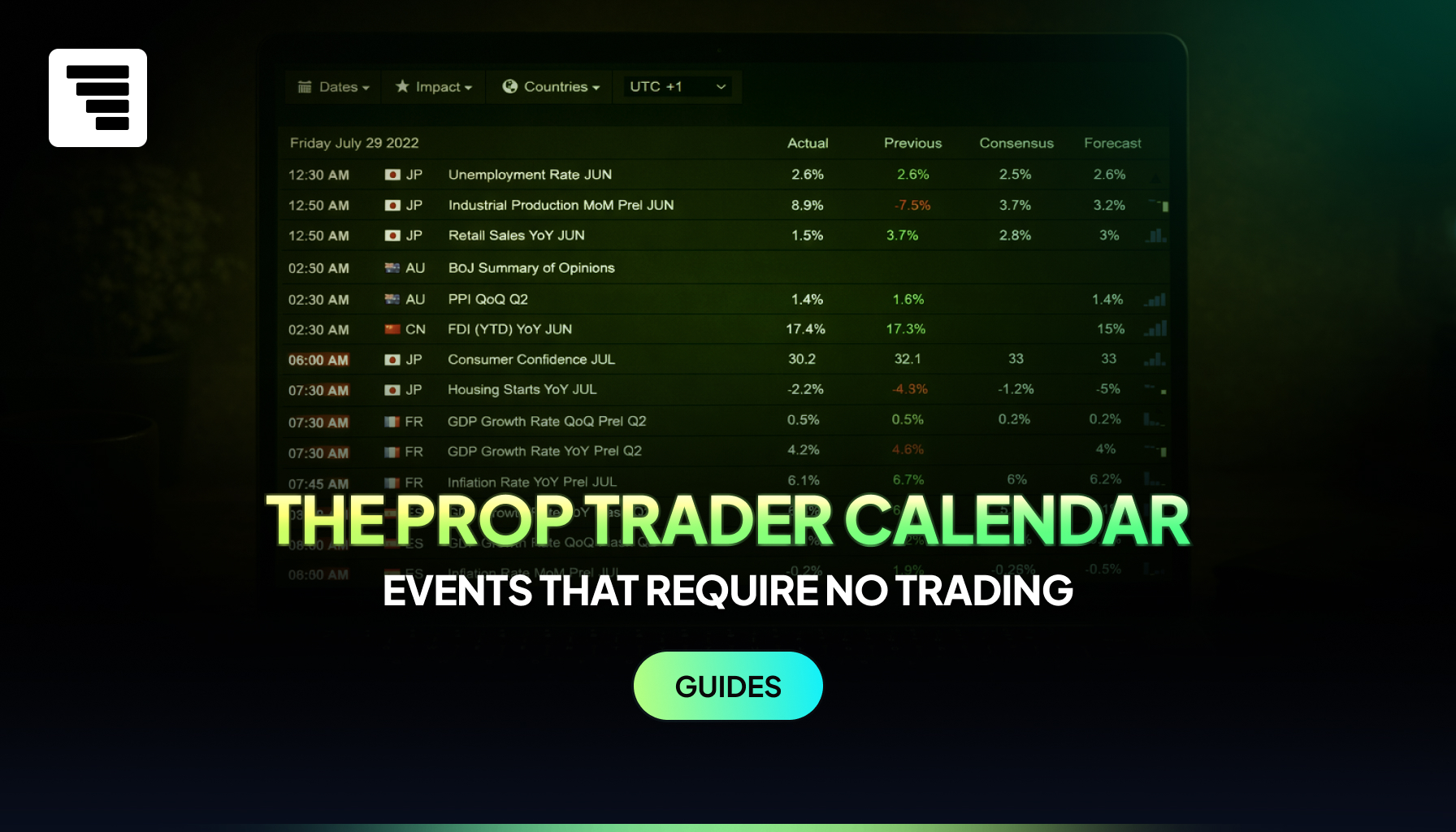
The economic calendar isn’t a list of trade ideas. It’s a list of windows where the market behaves differently from how your strategy assumes it does.
For prop firm traders, that matters in three concrete ways: slippage on stop fills, spread widening, and real-time equity dips during price spikes. Each one can affect your account in ways that go well beyond whether your trade direction was correct.
This article walks through how news events actually affect funded accounts and how to use the calendar as a defensive tool, whether you trade through news or sit it out.
Key Terms
| Term | What it means |
| High-impact news | Events flagged on economic calendars are likely to cause large price moves. Central bank rate decisions, Non-Farm Payrolls, CPI releases, and GDP prints |
| Slippage | The difference between the price you set on a stop loss and the price the order actually fills at |
| Spread widening | The temporary increase in the bid-ask spread during high volatility |
| Real-time equity | The current value of an account, including unrealised P&L on open positions. On most prop firms, breach detection runs on real-time equity, not on the final settled balance |
What’s in this guide
- Why news events matter for prop traders
- How news slippage interacts with drawdown
- Real-time equity and the news breach risk
- When news doesn’t show on the calendar
- How to use the calendar defensively
- FAQs
Why News Events Matter for Prop Traders

Three things happen during high-impact news that change how your account behaves, and none of them depend on whether your trade direction is right.
Spreads widen. The bid-ask spread can widen by 5 to 10 times during the actual release. A trade that normally costs 1 pip in spread might suddenly cost 10 pips for those few seconds.
Slippage increases. Stop-loss orders fill at the available price, not at the price set. During NFP or rate decisions, slippage of 20 to 50 pips on majors is realistic. On the most volatile releases, slippage of 50 to 100+ pips is possible.
Volatility spikes briefly. Price can swing through your equity buffer for two or three seconds before settling back down. On programs where breach is determined by real-time equity, those few seconds are enough to end your account.
These mechanics don’t care about your trade direction. They depend on the execution conditions at the time of release, and those during high-impact news are nothing like normal market conditions.
How News Slippage Interacts With Drawdown
This is where mechanics catch traders out. Run the math.
You’re on a $100,000 funded account. Your 4% Daily Loss Limit gives you a $4,000 daily floor on this trading day, calculated from the previous day’s closing balance at 5 PM EST. You’ve already taken a $1,500 loss earlier in the day, leaving $2,500 of room before the daily limit triggers.
You enter a EURUSD short at 1.0850 with a stop at 1.0880. That’s 30 pips of risk. With a 1-lot position where 1 pip equals $10, your planned loss on the trade is $300.
NFP releases. Price spikes to 1.0930. Your stop fills at 1.0905, not at 1.0880. That’s 25 pips of slippage. Actual loss on the trade is $550, not the $300 planned.
Run the math:
- Daily limit: $4,000
- Loss earlier in the day: $1,500
- Planned loss this trade: $300
- Actual loss with slippage: $550
- Day total: minus $2,050
- Remaining room before daily limit: $1,950
Your buffer just shrunk from $2,500 to $1,950, and the rest of the trading session is still ahead of you. The slippage didn’t change the direction of the trade. It changed your distance to the daily limit.
Real-Time Equity and the News Breach Risk
On most prop firms, breach detection runs on real-time equity, not on settled balance. If your equity drops below either breach level for even a single second, the system triggers a breach. The two levels:
Daily Loss Limit: Calculated from the previous day’s closing balance at 5 PM EST. Each new trading day recalculates the limit.
Max Drawdown level: On Static programs, fixed at the starting balance for the life of the account. In trailing programs, the line trails your closed trading balance. It locks at the starting balance when profits hit the drawdown percentage, or when a payout is processed.
This is why news matters. Price spikes can take your equity through the floor for two or three seconds before settling. The trade might recover. The fill might come back at a better price than the spike. It doesn’t matter. The breach was already triggered at the spike.
The trade can close at a more favourable price afterward, and your account is still gone. The platform shows your current equity after trades close, but it doesn’t roll back to the moment the breach triggered. The breach stands.
The point for news exposure specifically: every program has a buffer between current equity and the breach line, and a news-driven price spike can compress that buffer faster than the spread shows on the platform.
When News Doesn’t Show on the Calendar

The calendar covers scheduled releases. The biggest account-killers don’t get scheduled.
Geopolitical escalation, military action, sanctions announcements, emergency central bank interventions, and sovereign currency moves arrive without warning. A central bank can drop a currency floor with no announcement, and the affected pair can move 20 to 30% in minutes. A military escalation in an oil-producing region can move energy markets and risk-correlated currencies before any headline reaches retail traders. None of these events appears on any calendar.
Weekend exposure carries the same risk in a different form. The forex market closes Friday at 5 PM EST and reopens Sunday at 5 PM EST. Anything that happens in those 48 hours, escalation in an active conflict, a central bank announcement, a sanctions package, or a state of emergency, produces a Sunday open gap with no opportunity to manage exposure during the gap. Your stop-loss is still set, but the gap means it fills at the market open rather than where you placed it. A 50-pip stop can fill significantly worse on a weekend gap.
Unscheduled news creates the same three mechanics as scheduled news: wider spreads, slippage on stop fills, and real-time equity ticks. The difference is the warning. With scheduled news, you can size down or sit out. With unscheduled news, by the time you see the headline, the price has already moved.
You can’t trade around what you can’t predict. What you can do is reduce your exposure to it. Hold smaller positions through weekends. Avoid carrying directional risk into known geopolitical flashpoints. Recognise that Sunday open gaps are a structural feature of the forex market, not a rare event.
How to Use the Calendar Defensively
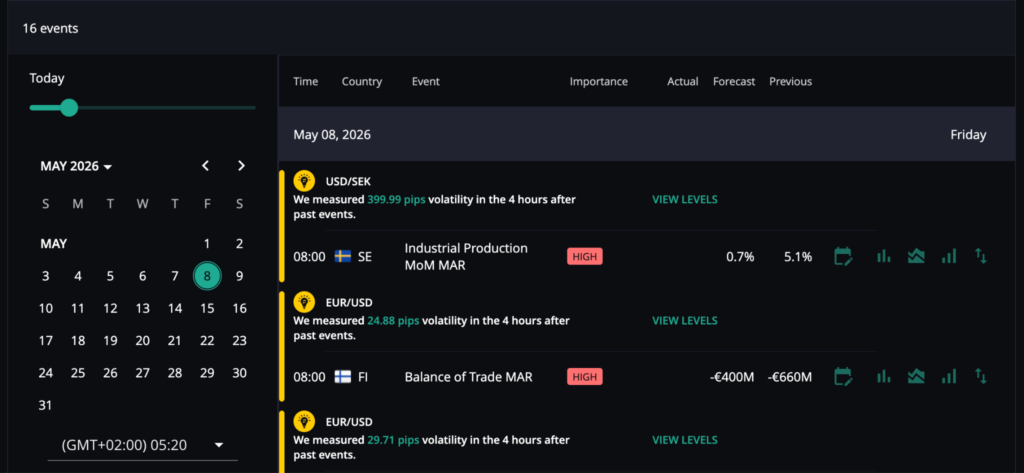
Most high-impact events are scheduled weeks or months in advance, which means you can plan around them. Treat the economic calendar like a defensive tool.
- Check the calendar at the start of each week. Identify all the red-flagged events for the week ahead. Most calendars (Forex Factory, Investing.com, Trading Economics) flag events by impact level, so you can scan for high-impact ones quickly. FXIFY’s economic calendar covers the major releases for funded traders in one place.
- Mark trading windows in advance. Decide before sitting down whether to be in or out for each event. Holding an active position 30 minutes before NFP is a very different decision from entering a fresh position after the dust settles.
- Account for cross-pair exposure. A USD-driven event, such as NFP, affects every USD pair simultaneously. Long EURUSD and long GBPUSD means NFP affects both at the same time, doubling your total dollar risk whether you notice or not.
- Size down or sit out. If you’re holding through a release, size down so slippage can be absorbed without threatening your daily limit. Holding a full-sized position through high-impact news exposes your account to slippage and equity risk that the buffer can’t absorb.
FAQs
What counts as high-impact news?
Central bank rate decisions, Non-Farm Payrolls, CPI inflation data, and major GDP releases. These produce the biggest spread widening, the most slippage, and the most equity disruption.
How does slippage cause drawdown breaches?
A stop loss fills at the available price when the order reaches the market, not at the price you set. During major news, the gap between your stop level and the actual fill can be 20 to 50 pips on majors, with 50 to 100+ pips possible on the most volatile releases. That’s a realised loss bigger than your planned risk per trade, eating into your daily limit buffer faster than your strategy expected.
Why does real-time equity matter more than settled balance?
Breach detection for most prop firms runs on real-time equity data. If equity drops below either breach level for even a second during a price spike, the system triggers a breach.
- The two levels are your Daily Loss Limit (calculated from the previous day’s closing balance at 5 PM EST and recalculated each new trading day) and your Max Drawdown level (fixed at starting balance on Static programs, or on Trailing programs, a line that trails the closed balance up and locks at the starting balance once profits hit the drawdown percentage or a payout is processed).
- The position can recover, and the trade can close in profit afterwards.
- The account is still gone if equity touched either level at any point.
Can I avoid news risk by removing my stop loss?
No. Trading without a stop is worse, not better. The stop is what limits your loss when slippage occurs. Without a stop, the position runs against you until you close it manually, and that’s not fast enough during a news-driven price spike. Stops fill at worse prices during news, but they still fill.
What’s the safest way to handle news as a funded trader?
Sit out the window completely, or size down significantly before the release. Holding a full-sized position through high-impact news exposes your account to slippage and real-time equity risk that the buffer can’t absorb.
Bottom Line
The economic calendar is a list of windows during which the market behaves differently from what your strategy assumes.
Whether or not your program allows trading during those windows, the mechanics are the same: wider spreads, increased slippage, and real-time equity ticks that can end your account in seconds.
The traders who stay funded treat the calendar like a stop loss. A defined boundary around conditions they choose not to take.
Execution quality during these windows is structural. FXIFY is broker-backed by FXIFY Markets, a real broker operating since 2010, with direct liquidity-provider relationships and control over how orders are routed, rather than running on a third-party retail broker’s feed.
Explore FXIFY’s programs to find the rule set that matches how you trade.
Risk Disclaimer
Trading foreign exchange, CFDs, and other leveraged products carries a high level of risk and may not be suitable for all investors. You may lose some or all of your initial capital. Past performance is not indicative of future results. The information in this article is for educational purposes only and is not financial advice. Always consult a qualified financial professional before making any trading decisions.