

The Final Powell FOMC: Inside the Most Divided Fed Vote Since 1992
On 29 April 2026, the Federal Open Market Committee held the federal funds rate at 3.50%–3.75%. The decision itself was expected. The vote that delivered…
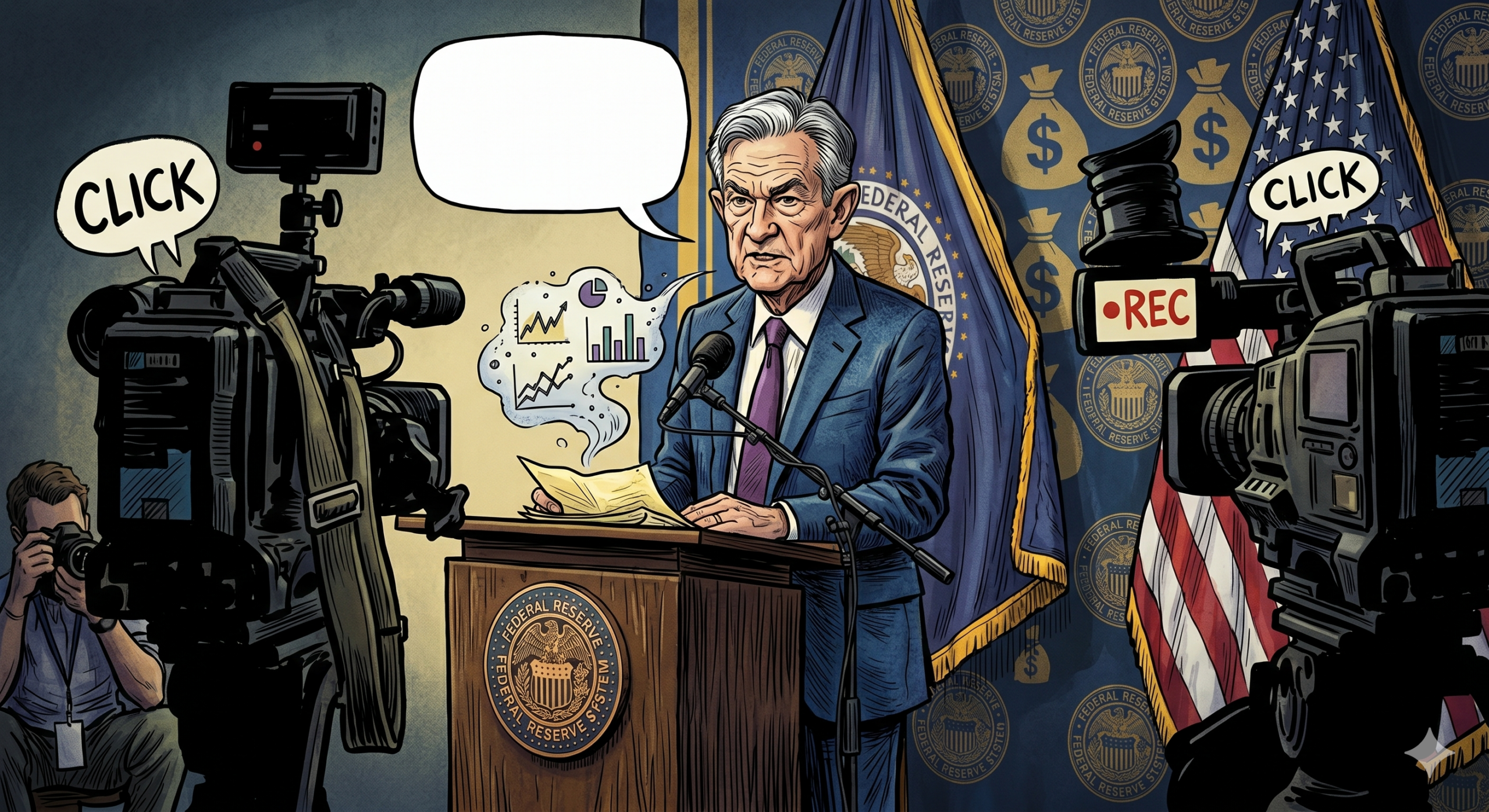
On 29 April 2026, the Federal Open Market Committee held the federal funds rate at 3.50%–3.75%. The decision itself was expected. The vote that delivered it was not.
Eight FOMC members voted to hold. Four dissented. It was the most divided Fed decision in 33 years. The last time four FOMC members dissented was in October 1992. The meeting was also Jerome Powell’s final one as Chair.
This piece walks through what happened, who voted which way, why the dissents are historically unusual, and what a divided Committee looks like for a trader watching the dollar.
Key Terms
| Term | What it means |
| FOMC | Federal Open Market Committee. The Fed body that sets US interest rate policy. Meets eight times a year |
| Dissent | A formal “no” vote by an FOMC member. Recorded in the official statement with the dissenter’s name and reason |
| Dovish / Hawkish | Dovish leans toward lower rates and easier policy. Hawkish leans toward higher rates and tighter policy |
| Easing bias | Statement language that signals the next move is more likely to be a cut than a hike |
| Federal funds rate | The benchmark interest rate the Fed sets. Drives the cost of borrowing across the US economy |
The Vote Breakdown
The 29 April FOMC statement records the vote at 8-4.
Voting for the hold (8): Jerome H. Powell (Chair), John C. Williams (Vice Chair), Michael S. Barr, Michelle W. Bowman, Lisa D. Cook, Philip N. Jefferson, Anna Paulson, Christopher J. Waller.
Voting against (4):
- Stephen I. Miran preferred to lower the target range by a quarter percentage point
- Beth M. Hammack (Cleveland Fed President) — supported holding rates but did not support inclusion of an easing bias in the statement
- Neel Kashkari (Minneapolis Fed President) — same position as Hammack
- Lorie K. Logan (Dallas Fed President) — same position as Hammack
What makes this one unusual is that the dissenters argued in opposite directions.
Why the Dissents Were Unusual
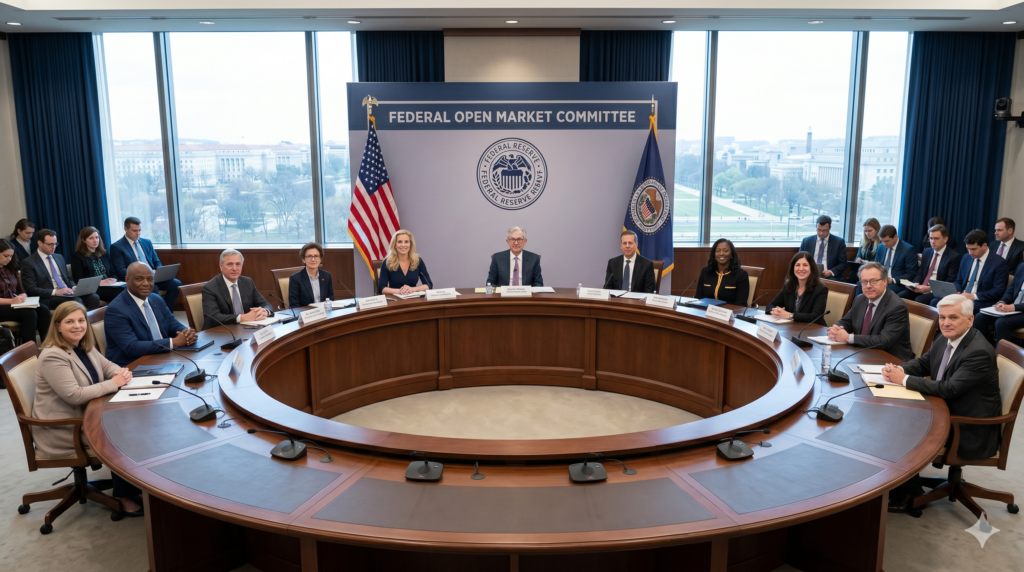
Miran wanted a cut. Hammack, Kashkari, and Logan wanted the easing bias removed from the statement entirely.
In policy terms, those positions are opposites. Miran argued the Fed should already be easing more aggressively. The other three argued the Fed should not be signalling future cuts at all.
The statement language at issue was this addition retained from previous meetings: “In considering the extent and timing of additional adjustments to the target range for the federal funds rate, the Committee will carefully assess incoming data, the evolving outlook, and the balance of risks.” The word “additional” implies the next move is downward. Hammack, Kashkari, and Logan wanted that implication taken out, leaving the Committee free to move in either direction.
Powell summarised the situation at his press conference: “The center of the Committee is moving toward a more neutral place.” He also noted: “Nobody’s calling for a hike right now.”
Coverage of the meeting noted that the vote was the most divisive since October 6, 1992.
Historical Context: October 1992
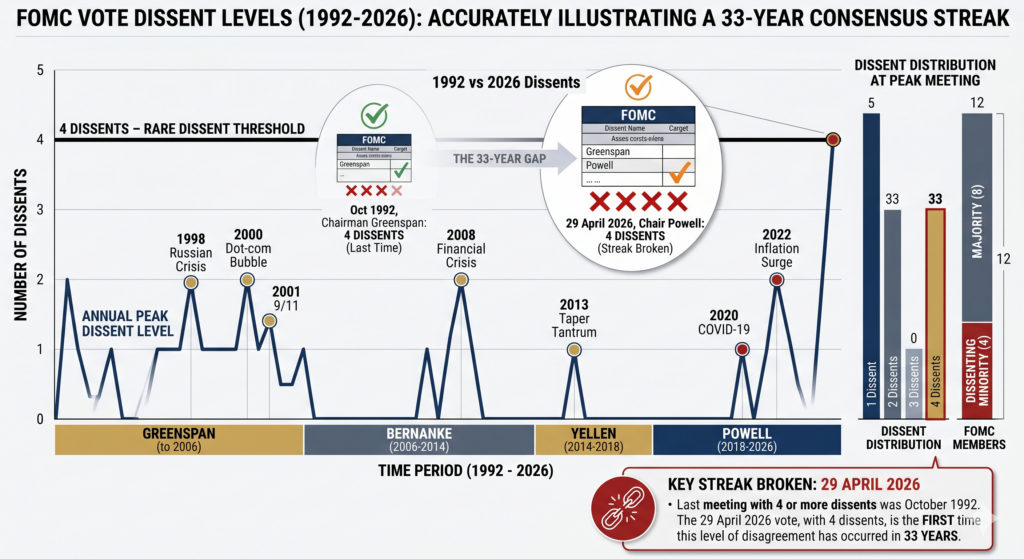
The October 1992 FOMC meeting took place under the Chairmanship of Alan Greenspan. Four members dissented at that meeting, the last time the FOMC produced this level of formal disagreement before 29 April 2026.
Reporting on the 29 April vote noted that no FOMC since October 1992 has produced four dissents. That stretch covered the Greenspan, Bernanke, and Yellen years, as well as most of Powell’s tenure, including the 2008 financial crisis, the COVID-19 pandemic, the 2022 inflation surge, and multiple rate-hiking cycles.
The fact that it took 33 years to break the streak gives a sense of how rare formal disagreement at this scale is at the Fed.
What Powell Said
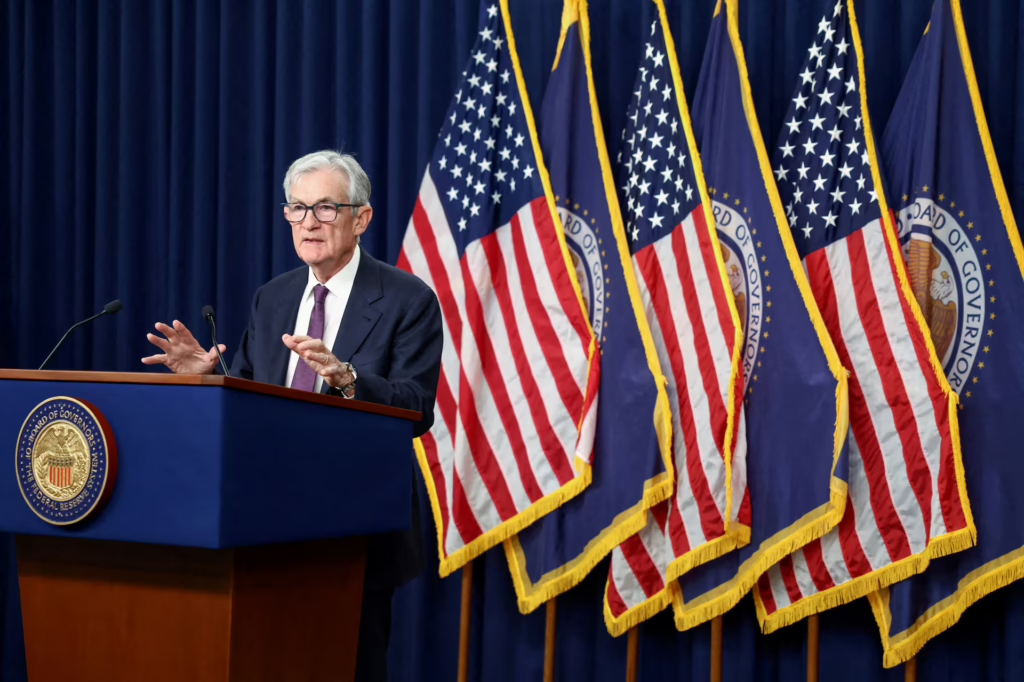
Powell’s final press conference included several remarks that have since been widely quoted.
On the divided room: “The center of the Committee is moving toward a more neutral place.”
On the prospect of rate hikes: “Nobody’s calling for a hike right now.”
On stepping down as Chair: “I won’t see you next time”, spoken at the close of the press conference.
Powell also confirmed that he would remain on the Board as a Governor after his term as Chair ends 15 May 2026, with his Governor term running until January 2028. He said he intends to “keep a low profile” and stated, “There’s only ever one chair of the Federal Reserve Board. When Kevin Warsh is confirmed and sworn in, he will be that chair.”
Powell becomes the first outgoing Fed Chair to remain on the Board since Marriner Eccles in 1948.
The Handover Mechanics
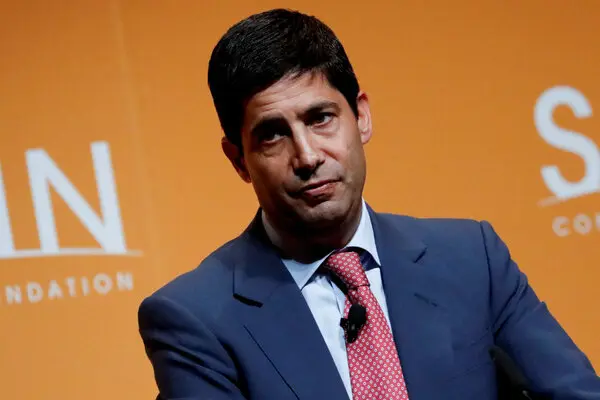
Kevin Warsh’s nomination cleared the Senate Banking Committee on the same day as the FOMC vote, on a 13-11 party-line split. The full Senate vote is expected the week of 11 May 2026, ahead of Powell’s chairmanship ending on 15 May.
If Warsh is confirmed, he replaces Miran on the FOMC. Miran has been serving on a short-term appointment and is expected to leave the Committee when his successor is confirmed. As ClearBridge Investments analyst Josh Jamner noted, this means “Warsh will take Stephen Miran’s seat given Powell’s seat will not be open for the time being.”
The composition shift: the most consistently dovish dissenter (Miran) leaves the Committee. The new Chair (Warsh) arrives with positions articulated during his Senate Banking Committee confirmation hearing, including a preference for a smaller Fed balance sheet, less detailed forward guidance from Fed officials, and openness to rate cuts under specific conditions.
Warsh’s first FOMC as Chair would be 17-18 June 2026, assuming Senate confirmation by 15 May.
Why This Matters for Forex Traders
When eight or more members vote together, the post-meeting statement and press conference give traders a clear read on the Committee’s direction. When four members dissent in opposite directions, the statement becomes a compromise document, and the press conference has to address multiple competing positions at once.
For forex traders, that’s the operating context. Speeches by individual Fed officials between meetings often draw more attention when the room is divided, because each dissenter has a public position to articulate. Statement language becomes a compromise between competing positions rather than a clean read on direction.
This is the operating environment heading into Warsh’s first FOMC on 17-18 June. The meeting takes place within a Committee that has just produced its most divisive vote in 33 years, with a new Chair stepping in mid-cycle.
Quality of execution during high-impact news releases is structural, not a nice-to-have. FXIFY is broker-backed by FXIFY Markets, a real broker operating since 2010, with spreads from 0.0 on major FX pairs and Gold on either pricing feed. For more on how news events affect funded accounts, see The Prop Trader Calendar: Events That Require No Trading.
Bottom Line
The 29 April 2026 FOMC produced the most divided Fed vote since October 1992. Eight members voted to hold the federal funds rate at 3.50%–3.75%. Four dissented: Miran wanted a cut, while Hammack, Kashkari, and Logan wanted the easing bias removed from the statement.
The meeting was Jerome Powell’s last as Chair. His term ends 15 May 2026, after which he stays on as Governor through January 2028. Kevin Warsh is expected to be confirmed as the next Chair the week of 11 May, with his first FOMC scheduled for 17-18 June.
The takeaway is institutional, not directional: when the FOMC is split this widely, statement language and press conference signals get harder to read cleanly. That’s the current operating context for any trader watching the dollar.
For an overview of FXIFY’s program range, see the programs page.
Risk Disclaimer
Trading foreign exchange, CFDs, and other leveraged products carries a high level of risk and may not be suitable for all investors. You may lose some or all of your initial capital. Past performance is not indicative of future results. The information in this article is for educational purposes only and is not financial advice. Always consult a qualified financial professional before making any trading decisions.