

What a Sustainable Prop Firm Looks Like in 2026
Picking a prop firm used to feel simple. Find one with a good performance split, reasonable rules, and a clean website. Pay the fee. Start…
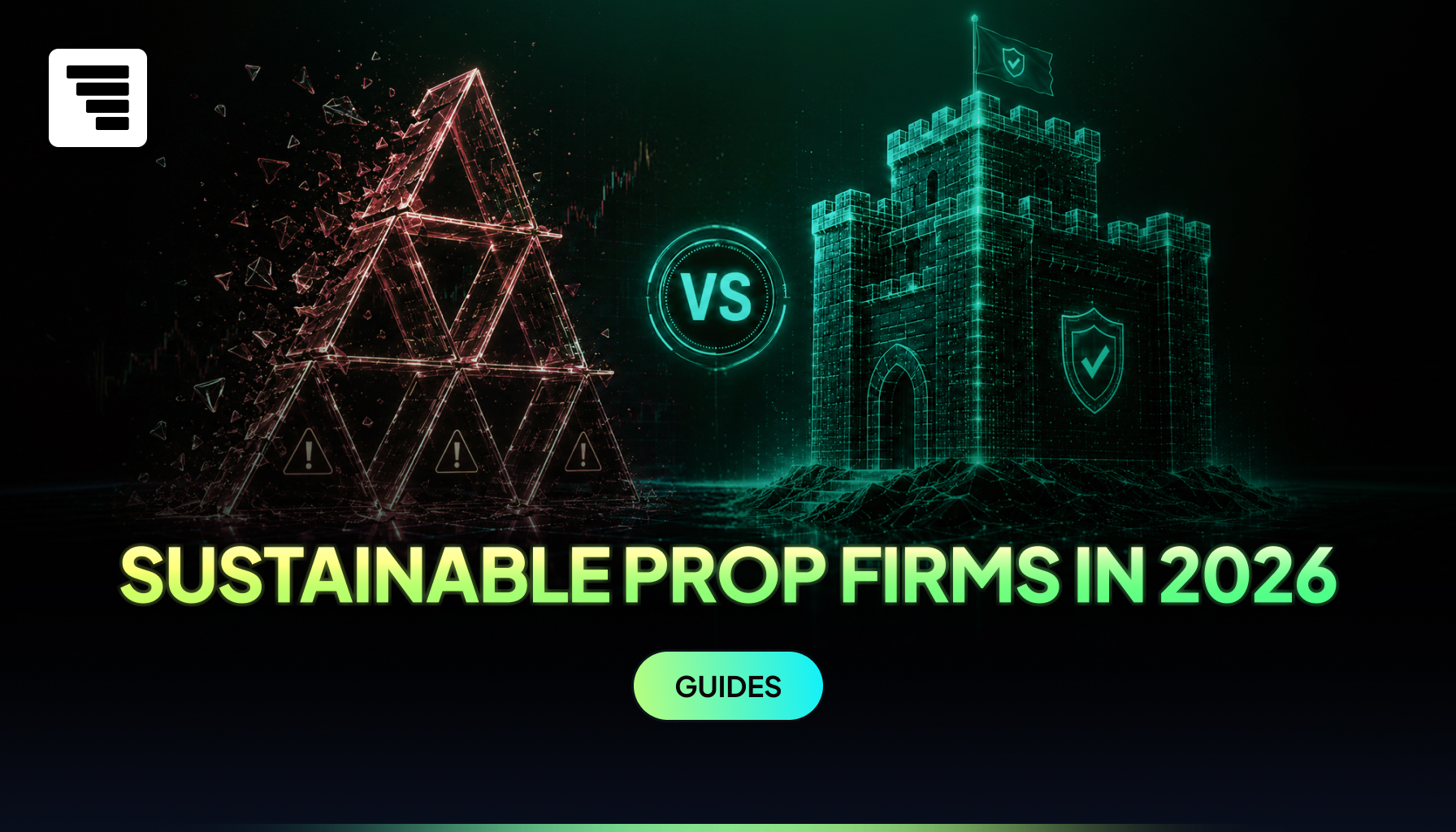
Picking a prop firm used to feel simple. Find one with a good performance split, reasonable rules, and a clean website. Pay the fee. Start trading.
That approach has cost many traders a lot of money.
The countless firms that failed did not look broken from the outside. They had active communities, paid out early traders, and ran promotions. The problems showed up later, when withdrawal times quietly stretched, when rules changed after traders had already qualified, and the payouts stopped coming.
The real question is not whether a firm looks legitimate today. It is about whether the business is built in a way that makes it likely to continue paying traders two or three years from now.
What Sustainability Actually Means
There is one question that tells you almost everything about a prop firm: does it make money when traders succeed, or only when traders fail?
A firm that lives on evaluation fees needs a constant flow of new signups. It needs most traders to fail and rebuy. That is not a business built around funded traders. It is a business built around selling evaluations.
A firm that earns from trading volume and funded trader activity is different. It needs traders to get funded and stay active. It needs them to trade well. When the trader earns, the firm earns. That alignment is the foundation of a sustainable business.
Everything else- payouts, transparency, and longevity- follows from this.
Five Signs a Firm Is Built to Last
1. A payout history you can verify
Any firm can publish a number on its homepage. What matters is whether that number is backed by real evidence. Community posts, public payout certificates, and years of consistent withdrawals across different market conditions. A firm three years into paying traders has demonstrated something. A firm that is six months old has not, regardless of what its marketing says.
2. Rules that are published, fixed, and applied consistently
The rules you agree to on day one of your evaluation should be the rules that apply when you are funded. Retroactive additions are a warning sign. So are T&C updates that quietly change what traders already agreed to. A firm with stable, published rules isn’t trying to find reasons to deny payouts.
3. A revenue model that works when traders get paid
Ask yourself: how does this firm make money if traders succeed? If the answer is unclear, or if the math only works when most traders fail, that tells you something important. A sustainable firm earns from funded trader activity. Evaluation fees may be part of the picture, but they should not be the whole picture.
4. Brokerage infrastructure owned by the firm
Almost every prop firm says it is broker-backed. Very few own the brokerage. Most rent a platform licence and plug into a third-party broker for pricing, which works until the provider changes its mind. In early 2024, platform licences were pulled from prop firms with no warning, and brokers withdrew prop services weeks later. So do not ask whether a firm uses a regulated broker. Almost everyone passes that one. Ask who owns the entity behind your pricing, and what happens to your account if that relationship ends tomorrow.
5. A track record through different market conditions
Volatility tests firms. Major macro events, rate decisions, and flash crashes all put pressure on a firm’s operations and liquidity. A firm that has navigated several of these cycles and kept paying traders has proven something. A firm that launched in a calm period and has never faced real stress has not.
Seven Red Flags You Can’t Ignore
1. Payouts funded by new challenge sales
One major firm paid out $17 million in two months while denying over $2 million in withdrawals across the same period. Weeks later, it paused operations entirely. When withdrawals come out of this month’s evaluation fees rather than trading revenue, the model only holds as long as sales keep climbing.
How to spot it: heavy discount codes and buy-one-get-one challenge passes are not generosity. They are a cash flow requirement.
2. Rented infrastructure with no fallback
In 2024, firms that lost a platform licence went from operational to insolvent in under four months, leaving hundreds of traders unpaid. Several were not accused of anything dishonest. They simply depended on infrastructure they did not own, and the owner walked away.
How to spot it: ask which entity holds the platform licence and provides liquidity, and whether it sits inside the same group.
3. Retroactive rule changes on live accounts
Minimum hold times, higher targets, and reduced splits, applied to accounts already trading, with profits retroactively invalidated. Moving the goalposts mid-game is rarely risk management. It usually means too many traders are winning.
How to spot it: check whether the terms page has a visible version history. Search community forums for “new rule” alongside the firm’s name.
4. The demo-to-live execution skew
Regulators have alleged that some firms placed traders in demo environments while presenting them as live, and applied artificial slippage to suppress profitability. This remains the most technically hidden risk in the industry because it is invisible unless you look for it.
How to spot it: compare execution logs across phases. If your funded account slips 0.5–1.0 pip more than your evaluation account on identical setups, the firm might be restricting your profitability through back-end settings.
5. Withdrawal times that stretch, then stall
The pattern almost never varies. First payout clears in 24 hours. Second takes a week. Third triggers a verification request, then another, then silence. Firms that pause operations have been known to clear barely a third of what they owe months afterwards.
How to spot it: sort reviews by date, not rating. An average score describes last year. The last fortnight describes now.
6. Anonymous Founders and Offshore Shell Companies
Anonymity is not a style choice. It lets owners pull the plug and vanish with your money overnight.
How to spot it: find the registered entity, the jurisdiction, and named leadership. If the most senior identifiable person is an avatar on X, that is your answer.
7. Rules enforced only at payout
This is when a firm ignores minor technical breaches (like a 0.01 lot trade during a news window) as long as you are losing money, but suddenly ‘discovers’ them the moment you request a large payout.
How to spot it: ask whether breaches are flagged automatically in real time. A firm that only raises a violation weeks later, at withdrawal, was not monitoring risk. It was monitoring your balance.
How FXIFY Measures Against This Framework
Applying this framework to FXIFY directly:
- Payout history. FXIFY has paid out over $40 million to more than 250,000 traders. That is three years of operational history across different market conditions.
- Broker-backed execution. FXIFY is powered by FXIFYMARKETS, a regulated broker backed by a leadership group with over 20 years of collective industry experience. By maintaining end-to-end control over trading conditions, platforms, and price feeds, FXIFY provides an institutional-grade foundation with true market pricing and reliable payouts.
- Business model alignment. FXIFY earns from funded trader activity. The model works when traders succeed.
- Published, fixed rules. Core account parameters are explained at fxify.com/programs and apply consistently from evaluation through to the funded account. Every operational detail is clearly laid out in the FAQs, with more details on prohibited trading strategies here.
- Operational longevity. Three years of trading through multiple market cycles.
No firm is without risk. But these are the signals that matter.
Bottom Line
The prop firm space will keep growing, and so will the churn of firms not built to last. Ask the harder questions first: How does the firm earn when traders succeed? Are payouts verifiable? Are the rules stable? Is a regulated entity behind execution? That is how choosing a sustainable prop firm in 2026 becomes a decision, not a gamble.