Best Market to Day Trade
Picture a trader in Singapore who spends a month studying the S&P 500. She learns the chart, the news and the key levels. But there…
Picture a trader in Singapore who spends a month studying the S&P 500. She learns the chart, the news and the key levels. But there is a problem: the US stock market opens late in her evening, so she trades it tired after a full day of work. The best market to day trade is not the one with the most buzz. Instead, it is the one that is moving when you are awake and focused.
| What is the best market to day trade? No single market suits everyone. However, for most CFD day traders the shortlist is major forex pairs, gold and major stock indices. Then you choose between them based on when you can trade, how far each one moves against your daily loss limit, and what it costs to trade. |
Key Terms
| Term | What it means |
|---|---|
| Liquidity | How easily you can buy or sell. High liquidity usually means tighter spreads, so each trade costs less |
| Volatility | How much and how fast a price moves. More movement gives more chances, but it also brings more risk |
| Spread | The gap between the buy price and the sell price. You pay it on every trade, so a smaller spread saves money |
| Market open | The time a financial center starts its trading day. As a result, activity often picks up around it |
| Leverage | How much trade size each dollar of margin controls. For example, 30:1 means $1 controls $30 |
What Makes a Market Good for Day Trading
Four things matter most. First, the market needs liquidity, because busy markets fill your orders quickly and keep costs low. Forex is the deepest market of all. In fact, the Bank for International Settlements found that global currency trading averaged $9.6 trillion a day in April 2025.
Second, the price has to move. A day trader needs enough movement inside a few hours to reach a target. However, too much movement can quickly eat into a daily loss limit, so more isn’t always better.
Third, costs add up. You pay the spread on every trade, so a day trader who places many trades feels it more than a swing trader does.
Finally, and this one is easy to overlook, the market has to be open and active when you are. That is why your clock gets its own section later in this guide.
The Four Main Markets Compared
On a CFD prop account, four markets cover most day trading. Here is how they line up on FXIFY standard accounts.
| Market | Most active | How it moves | FXIFY leverage | Suits |
|---|---|---|---|---|
| Major forex pairs | London and New York hours | Steady, but with spikes on big data releases | 30:1 | Traders who want long hours and small size steps |
| Gold | London and New York hours | Sharper moves, especially around US data | 30:1 | Traders comfortable with faster swings |
| Major stock indices | Their home exchange hours | Fast moves around the open | 10:1 | Traders who can be at the screen for the open |
| Oil | New York hours | Big jumps around weekly inventory reports | 5:1 | Traders who plan around a fixed news calendar |
Major pairs such as EURUSD suit most beginners, because they trade around the clock on weekdays and you can adjust size in small steps. For pair-by-pair detail, see our guide to the best forex pairs to trade.
Gold trades at the same 30:1 leverage, but each move is worth more per lot, so sizing needs extra care. Indices are tied to their home exchange, so the biggest moves tend to come around the open. Oil runs at a lower 5:1 leverage and reacts to a weekly news calendar, which our guide to energy markets covers in detail.
Match the Market to Your Clock
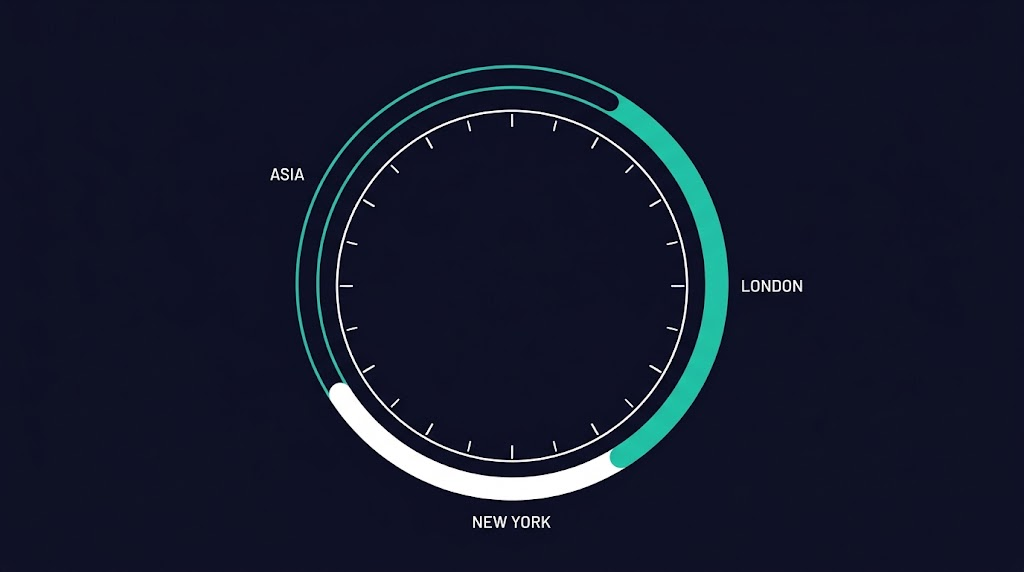
This is where the choice gets personal. First, look at the hours you can actually trade. Then check which markets are busy in that window. The times below use each city’s local time, so they still hold when clocks change for summer.
| Your trading window | What is happening | Markets to watch |
|---|---|---|
| Asian hours | Tokyo, Hong Kong, Singapore and Sydney are open | Yen, Aussie and Kiwi pairs, as well as Asian indices where your platform lists them |
| London morning | London opens at 8 AM UK time, so Europe joins in | Euro and pound pairs, gold and European indices |
| London and New York overlap | Both centres are open for a few hours at once | Major forex pairs, gold, US indices and oil |
| New York afternoon | London has closed, but US markets are still open | US indices, dollar pairs and oil |
For example, a trader in Dubai who is free after work lands right in the London and New York overlap. As a result, almost every major market is busy during her window. On the other hand, a trader in Sydney who trades on her lunch break sits in Asian hours. For her, yen and Aussie pairs make more sense than US indices.
Match the Market to Your Daily Loss Limit
Now add your account rules. Take a $10,000 One Phase account with a 3% daily loss limit, which is $300. The same $300 gives you very different room in each market.
On EURUSD, one standard lot is worth about $10 per pip, so a 30-pip move against you uses the whole $300. Gold works differently. If one lot is 100 ounces, as is common, then a $3 move on one lot costs $300. That is why a smaller size, such as 0.1 lots, is closer to the mark on gold.
Oil follows the same logic, but it moves on its own news calendar. In short, check the contract size in MT5 first, then size each market to your dollar limit. Our max daily loss guide shows how the limit itself is set.
How to Pick Yours in Three Steps
1. Write down the hours you can trade, in your own time zone. Be honest, because tired trading tends to cost more than missed trading.
2. Next, shortlist one or two markets that are busy in that window, using the clock table above.
3. Finally, test your shortlist on a demo account against your daily limit in dollars. Then keep the market that fits both your hours and your limit, even if it is not the one everyone talks about.
FAQs
What is the best market to day trade for beginners?
Major forex pairs suit most beginners. They trade 24 hours on weekdays, so they fit almost any schedule, and you can start small. FXIFY standard accounts also offer 30:1 leverage, so each trade needs less margin.
Should I day trade forex or stocks?
It depends on your hours. Forex trades around the clock on weekdays, while stock CFDs only trade when their exchange is open. In addition, FXIFY standard accounts run forex at 30:1 leverage but stocks at 2:1.
What is the best time to day trade forex?
Many traders focus on the London and New York overlap, because the most major markets are open at once. However, the best time for you is when your chosen pairs are active, and you are alert.
Can I day trade gold on a prop firm account?
Yes. On FXIFY standard accounts, gold trades at 30:1 leverage, and a 50:1 add-on is available for forex and gold. Still, check the contract size first, because each move is worth more per lot than on most forex pairs.
How many markets should a day trader follow?
One or two is enough to start. That way, you learn how each one behaves during your hours, so you can spot normal and unusual moves faster.
The Bottom Line
The best market to day trade is busy when you are free and moves enough for your style. It also fits inside your daily loss limit. So start with your clock, shortlist one or two markets, and size them in dollars. Then, when you are ready, compare the FXIFY programs to find the rules that suit how you trade.