


Why Traders Blow Funded Accounts in the First Five Days
You passed. The email lands, the funded account is live, and for about a day you feel unstoppable. Five days later, the account is gone….
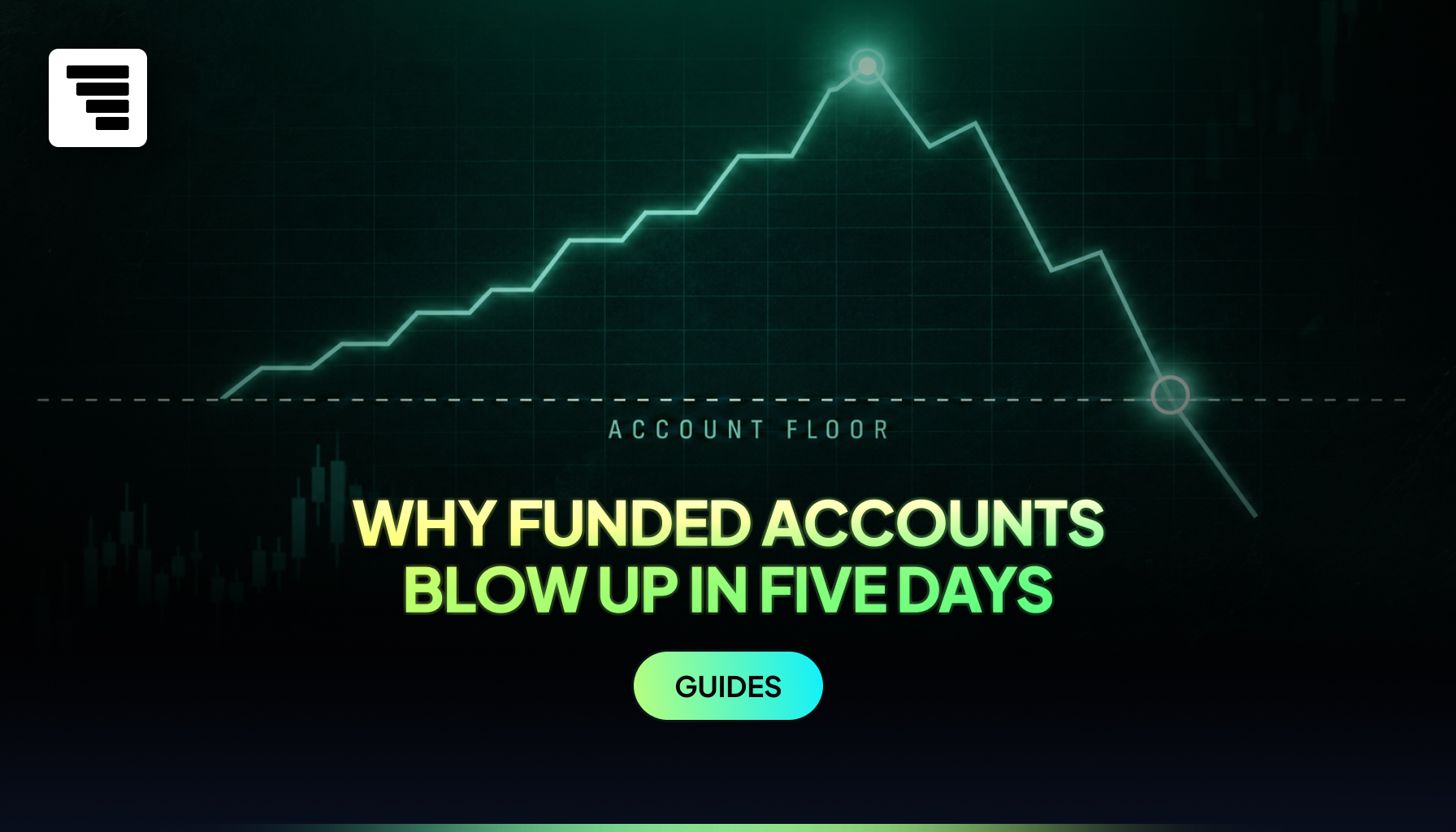
You passed. The email lands, the funded account is live, and for about a day you feel unstoppable. Five days later, the account is gone. If you have been here, you already know the feeling. The strange part is that nothing about your trading actually changed. The rules were the same. The market was the same. What changed was you.
Roughly 40 to 50% of funded accounts are lost within 90 days of funding, and only about 7% of everyone who ever buys a challenge sees a single payout. Those are not numbers about bad traders. They are numbers about good traders who fall into a handful of very human traps the moment real money is on the line. Here are the ones that do the most damage, and why they happen.
Why the First Week Is the Danger Zone
The first five days on a funded account are when the gap between challenge-you and funded-you is widest. In the challenge, the account felt disposable. There was always another attempt. Once funded, the same account suddenly feels precious, or worse, feels like a prize you have to cash in fast. As one trader put it, the mistake is treating a funded account like casino chips instead of business capital. The mechanics of a blow-up are almost always the same: a lot size that is too big or a trade closed at the wrong moment, but the reasons underneath are what actually matter. Fix the mechanics without fixing the reason, and you just blow the next account too.
1. Rushing for the Payout

This is the big one, and it hits from two opposite directions.
If you passed the challenge fast, you carry that same energy into the funded account. Bigger lots. Closing winners early to lock in something real. Reaching for the payout because the account finally means money. The pace that felt bold in the challenge becomes reckless the moment the gains are yours to keep.
If you passed slowly, the pressure is different but just as heavy. You have been at this for weeks, maybe months, with no payday to show for it. Now that you are funded, every day without a withdrawal feels like falling behind. So you force trades that are not there, size up to speed things along, and hand the account back before you ever get paid.
Either way, the payout stops being a result of good trading and becomes the goal you chase directly. That switch breaks accounts. Traders who have lived it describe the spiral the same way: one loss triggers the urge to win it back, that urge triggers a bigger trade, and a bad afternoon turns into dozens of impulsive trades that leave them drained and the account gone.
Picture a day trader who cleared a Two Phase Pro in nine days on a fast run of intraday setups. The funded account goes live, and in the very first session, they open at three times their usual size because the gains are real and they want a payout to match the effort. One ordinary losing trade at that size does what a losing trade should never do on day one. It ends the account.
2. You Did Not Actually Pass It Yourself

A whole market of services will pass a challenge for you. You pay, someone else trades your evaluation, and the funded account lands in your lap. It feels like a shortcut. It is a trap.
The independent numbers on funded trading are already brutal: in the largest study of its kind, covering more than 300,000 accounts, only about 7% of challenge buyers ever received a payout. For traders who bought their pass, the real-world outcome is even worse, because their account was never funded by their skill in the first place. When the funded account arrives, and the trader has to actually trade it themselves, the gap between their real ability and the account they are holding shows up immediately.
You cannot outsource the part that matters. If someone else earned the pass, the funded account is not a reward for your edge. It is a test you have not studied for, and the first week is the exam.
3. You Passed on Luck, Not a Process

Some traders pass the challenge on a good run rather than a repeatable edge. A couple of oversized trades landed. A news spike went the right way. The target got hit, and it felt like skill.
Luck does not carry over. It runs out, usually right when the stakes are highest. A trader who passed on luck walks into the funded account expecting the good run to continue, and when it does not, there is no process underneath to fall back on. The account was built on something that was never going to last, and the funded stage is where that truth arrives.
4. You Are Burnt Out Before You Start

Passing can take a toll that nobody talks about. Weeks of screen time. Multiple evaluations, multiple resets, multiple failed attempts before one finally stuck. By the time the funded account arrives, plenty of traders are running on empty.
Then they do the worst possible thing. They keep going. No break, no reset, straight into trading real capital while mentally exhausted. Tired traders miss setups, break their own rules, and make the small careless mistakes that a rested version of them would never make. The funded account deserved a fresh mind. It got a drained one.
Think of a swing trader who spent two months and five resets grinding through One Phase evaluations before one finally passed. The sensible move is to close the laptop and take a few days. Instead they open the funded account the same afternoon, still wired from the grind, and start managing real capital on no rest. The tired mistakes follow within days.
5. A Normal Losing Streak at the Worst Time

Sometimes nothing goes wrong at all. The trader sizes correctly, follows the plan, respects the rules, and still loses, because a losing streak is a normal part of any strategy. Every edge has drawdown periods. They are not a sign of failure. They are just variance.
The problem is timing. A losing streak that would be survivable over a longer horizon can breach a funded account in its first week, before there is any buffer of gains to absorb it. This one is not a mistake. It is math. But it is why sizing small in the opening days matters so much: it gives a normal losing run the room it needs to pass through without ending the account.
6. The Psychology of Finally Making It

This is the quiet killer, and it wears several faces.
The first is euphoria. Getting funded feels like arriving. The work is done, you made it, and that feeling loosens your grip on the rules you followed so carefully in the challenge. Traders describe it as feeling untouchable right after a win, then throwing that win away on an impulsive trade because they did not want to miss the next move. Over-excitement is where discipline quietly slips.
The second is imposter syndrome. You are good enough to get funded, but part of you still asks why you haven’t made real money yet. That doubt makes you hesitate on good trades and second-guess the process that got you here.
The third, and maybe the most damaging, is over-attachment. You worked so hard for this account that now you are terrified of losing it. So you close winning trades early to secure something. You cut floating positions to mitigate a loss that has not happened. Every exit is a little too soon. Your wins get smaller, your losses stay the same size, and slowly the account bleeds out, not from one big mistake but from a hundred anxious small ones.
Picture a trader on a fresh Two Phase Standard funded account, up a little in week one and terrified of giving it back. Every green trade gets closed early to bank something. Every position that dips gets cut before it can breathe. The wins shrink to nothing, the occasional full loss still lands, and within a week the account has quietly bled below its floor. No single bad trade. Just fear, repeated.
How to Not Be the Statistic
The traders who keep funded accounts are not trading a different market. They are managing themselves differently. A few things separate them.
- Treat the funded account like your only shot. Not because it is, but because that mindset stops you from gambling it.
- Trade the first week at the same size you used to pass, or smaller. Don’t scale up just because the account is real now.
- Let the payout come to you. Chasing it is the fastest way to lose it.
- Rest before you start. A funded account is worth more than the few days you save by skipping the break.
- Pass it yourself, on a process you can repeat, so the account rests on something real.
None of this is about a secret strategy. It is about carrying the same discipline across the line that got you here. If you are still choosing a program, pick one whose rules fit how you actually trade, so you are not fighting the structure on top of everything else. Our guide to trading styles for funded traders can help.
Bottom Line
Funded accounts rarely blow up because a trader forgot how to trade. They blow up because the pressure, the excitement, and the fear of losing something hard-won pull a good trader off their process in the first few days. Recognize the trap you are most likely to fall into, and you are already ahead of most. When you are ready to trade an account the right way, explore FXIFY’s programs.
If any of this hit close to home, that recognition is the useful part. Trading is hard enough without carrying these traps into a live account. If the pressure around trading is affecting you beyond the screen, it is worth talking to someone you trust.