Page background

How US–Iran Tensions Affect Oil, Gold and Forex Markets

When escalation risk rises, monitoring supply disruption probabilities, safe-haven flows, and volatility indicators helps traders feel more confident and in control of market reactions.

Traders react to geopolitical headlines, but understanding that actual market movements depend on changes in future supply, returns, or liquidity helps them feel more prepared and confident in interpreting price movements across oil, gold, and forex markets.

Why Oil Prices React First to US–Iran Escalation

The Strait of Hormuz: The Chokepoint That Moves Markets

Oil responds swiftly to geopolitical escalation due to the supply chain’s identifiable physical vulnerability, specifically the Strait of Hormuz, which is critical for global oil flows and influences market reactions.

According to the U.S. Energy Information Administration (EIA), oil flows through the Strait of Hormuz averaged 20 million barrels per day in 2024. That volume represented approximately 27% of global maritime oil trade and roughly 20% of world petroleum liquids consumption. The EIA describes the strait as one of the world’s most important oil chokepoints, noting that very few alternative routes exist if it is closed.

Saudi Arabia and the UAE hold some bypass pipeline capacity. The EIA estimates that the combined pipeline capacity of Saudi Arabia and the UAE could divert approximately 2.6 million barrels per day away from the strait. That figure is well below average daily Hormuz throughput. A closure would therefore produce a net supply shortfall that existing infrastructure could not offset quickly.

How Escalation Reprices Oil Futures

Futures markets price this risk through what traders call a geopolitical risk premium, which affects specific contracts like WTI and Brent. When the US–Iran escalation increases the perceived probability of strait disruption, buyers of these contracts demand a higher price to accept delivery uncertainty. This dynamic causes the front-month futures to reprice more sharply than longer-dated contracts, helping traders understand potential curve flattening or inversion during escalation.

Recent examples, like US and Israeli strikes on Iranian targets in late February 2026, demonstrate how escalation events lead to market repricing, inspiring traders to anticipate similar reactions in future events.

Iran also produces approximately 3.3 million barrels of oil per day. Any disruption to that output adds a secondary supply channel to the pricing adjustment.

How Gold Absorbs Capital During Geopolitical Risk

Gold as a Safe-Haven Asset: The Core Mechanics

A safe-haven asset retains or increases its value during periods of market stress when most risk assets decline. Gold is the most widely recognised commodity in this category.

The mechanism is capital rotation. When equity markets fall and forward earnings expectations decline, fund managers and institutional investors reduce exposure to growth-sensitive assets. Some of that capital moves into instruments with low or negative correlation to equities under stress. Gold has historically fulfilled this role. It has no counterparty risk. It cannot default. It does not depend on corporate earnings or sovereign solvency. These properties make it a destination for capital preservation during geopolitical escalation.

Why Real Yields Determine Gold’s Strength

The interaction with real yields is relevant here. Real yield is the nominal interest rate on a bond minus the expected inflation rate; it is an inflation-adjusted measure of the return on fixed-income assets. Gold pays no income, so its opportunity cost rises when real yields are high and falls when real yields are low or negative. Geopolitical escalation tends to push inflation expectations higher through energy price pass-through. If nominal interest rates do not rise in response, because central banks hold rates steady or bond markets rally, real yields fall. Lower real yields reduce the opportunity cost of holding gold, making it more attractive relative to fixed-income alternatives.

What the Data Shows

The World Gold Council’s “Gold as a Strategic Asset” report (February 2026 update) notes that gold has historically delivered average returns of approximately 7.5% in the six months following major geopolitical events, citing examples including the Gulf War of 1990 to 1991. Analysts at ING stated in a March 2026 note that a regional spillover or energy supply disruption in the current Iran context would materially boost gold through higher oil prices, increased inflation expectations, and contained real yields.

Following the US and Israeli strikes on Iranian targets in late February 2026, spot gold moved from approximately $5,100 per ounce to above $5,300 in a single session, according to data reported by Investing.com. As of March 2, 2026, spot gold was trading at approximately $5,338 per ounce, according to Fortune. Gold does not always sustain its initial spike in escalation. Pepperstone strategist Michael Brown noted in a March 2026 client note that geopolitical price moves tend to be partially reversed as more rational market assessment replaces the initial reaction.

This is a risk that traders must factor into position management.

How US–Iran Tensions Affect Oil, Gold and Forex provide stability during escalation.

USD: Reserve Currency Demand vs Safe-Haven Demand

Risk-off is a market condition in which investors reduce exposure to higher-volatility assets and seek stability in assets perceived as lower-risk or more liquid, encouraging traders to stay vigilant and strategic amid escalation.

Understanding how US–Iran tensions affect oil, gold and forex markets through risk-off flows requires separating two distinct mechanisms: demand for the US dollar as the world’s reserve currency, and demand for currencies with specific safe-haven characteristics.

The USD plays a structural role in global finance. It is used to price and settle the majority of global commodity trades, including oil. When global financial stress increases, demand for dollar-denominated liquidity tends to rise because institutions need dollars to meet margin calls, settle contracts, and service dollar-denominated debt. This is reserve-currency demand, distinct from safe-haven preference.

Why JPY and CHF Appreciate in Risk-Off Conditions

Research published by the IMF, analysing 11 risk-off episodes between 1992 and 2012, found that the Japanese yen (JPY) and Swiss franc (CHF) tend to appreciate against the USD during risk-off episodes. Many other currencies, including commodity-linked and emerging-market currencies, depreciate against the USD during the same periods.

The IMF’s October 2025 Global Financial Stability Report found that a shock to the VIX, the Chicago Board Options Exchange’s measure of implied equity volatility, is estimated to increase spot market transaction volume in JPY by approximately 40%. That data indicates capital flows into the yen increase measurably when uncertainty rises, consistent with the yen’s role as a safe-haven currency.

Carry Trade Unwind and Currency Flow Mechanics

The CHF benefits from Switzerland’s current account surplus, low domestic inflation, and perceived political neutrality. Both JPY and CHF appreciate during risk-off partly because investors unwind carry trades. A carry trade is a strategy that involves borrowing in a low-interest-rate currency and investing in a higher-yielding one. When risk sentiment deteriorates, carry trades are closed. This means the funding currency, typically JPY or CHF, is repurchased, driving it higher.

The USD’s safe-haven behaviour is conditional. Research published in ScienceDirect (2025) notes that intra-safe-haven currency behaviour varies across different types of crises. When a shock is particularly US-centric or when markets price Federal Reserve rate cuts, the USD can temporarily weaken as JPY and CHF outperform.

Why Volatility Expands Across Commodities and Currency Pairs

How Uncertainty Drives Implied Volatility Higher

Implied volatility is the market’s expectation of future price volatility, derived from option prices. It expands during geopolitical escalation for two reinforcing reasons: uncertainty about outcomes increases, and liquidity in spot and derivatives markets often contracts.

When uncertainty rises, options sellers demand higher premiums to take the risk of being wrong. This raises implied volatility across oil options (observable in the CBOE Crude Oil Volatility Index), gold options, and major currency pair options. Higher implied volatility directly increases the cost of hedging for traders and firms with commodity or currency exposure.

Liquidity Withdrawal and Spread Widening

Liquidity withdrawal amplifies this effect. When large institutional participants, including banks, hedge funds, and trading desks, reduce position sizes in response to uncertain outcomes, the bid-ask spread widens. The bid-ask spread is the difference between the price a buyer is willing to pay and the price a seller is willing to accept. Wider spreads mean each trade costs more to execute. In oil, spreads on physical cargoes can widen significantly as insurers raise war-risk premiums on tankers transiting sensitive routes. Time magazine reported in March 2026 that shipping insurance costs in the Strait of Hormuz had spiked following the escalation.

For retail and professional forex traders, widening during geopolitical shocks is a direct cost of trading. Pairs most exposed to oil-producing economies, such as USD/CAD, USD/NOK, or Middle Eastern currency proxies, experience the greatest volatility. Pairs involving JPY and CHF can experience sharp, rapid movements as large carry trades unwind in short timeframes.

What Traders Should Monitor During US–Iran Escalation

Oil Inventories and Treasury Yields

Oil inventory data: The EIA releases weekly US crude inventory data every Wednesday. A sharp inventory build, such as the 13.4 million-barrel increase reported for the week ending in early February 2026, according to Trading Economics, can suppress oil’s escalation premium by showing that current supply buffers are adequate despite disruption risk. A draw would reinforce the premium.

US Treasury yields: The 10-year US Treasury yield reflects the market’s aggregate view on growth, inflation, and monetary policy. During escalation, if yields fall sharply alongside equity prices, it signals genuine flight-to-safety buying of bonds. If yields rise alongside oil, as can occur when inflation expectations rise faster than growth expectations, real yields compress, supporting gold.

Dollar Index and Volatility Gauges

Dollar Index (DXY): The DXY measures USD performance against a basket of major currencies. A rising DXY during escalation indicates reserve-currency demand is dominant. A falling DXY suggests the shock is being interpreted as negative for the US economy specifically, or that JPY and CHF are absorbing more of the safe-haven flow.

Volatility indices: The VIX measures implied volatility on S&P 500 options. The CBOE Crude Oil Volatility Index (OVX) measures implied volatility on oil futures options. Both expanding simultaneously indicates a broad risk-off move rather than an isolated commodity event.

Official Statements and Diplomatic Signals

Official statements and diplomatic channels: Oil’s geopolitical premium resets quickly when the risk of escalation is revised. A credible diplomatic statement, a ceasefire, or a confirmed resumption of tanker traffic through the Strait of Hormuz can unwind a significant portion of an escalation premium within hours. Traders monitoring oil and related assets need to track official statements from the US State Department, Iran’s Supreme National Security Council, and UN-affiliated bodies as primary inputs, not secondary commentary.

Summary

US–Iran tensions affect oil, gold and forex markets through specific and traceable mechanisms. Oil prices reprice supply risk when Hormuz throughput, which averaged 20 million barrels per day in 2024 according to the EIA, faces disruption. Gold attracts capital rotation as real yields compress and safe-haven demand rises. Forex markets reflect risk-off positioning, with JPY and CHF appreciating, driven by carry unwind and conditional USD demand driven by reserve-currency mechanics. Implied volatility expands and spreads widen across all affected instruments. Traders who understand these transmission mechanisms are better positioned to assess what a headline means for price, how durable that price move is likely to be, and which data points confirm or contradict the initial market reaction.

For traders wanting to understand how structured risk frameworks apply in a funded context, FXIFY’s programme structures can be reviewed at fxify.com/programs/.

Frequently Asked Questions

Does oil always rise during the US–Iran escalation? 

Not always. Oil prices rise when markets increase the probability of a supply disruption. If diplomatic progress is announced simultaneously with an escalation event, or if inventory data shows a significant surplus, the risk premium may not materialise or may be short-lived. The oil price response depends on the credibility and duration of the perceived supply threat, not the headline alone.

Why does gold sometimes fall even during geopolitical escalation? 

Gold can fall during an escalation if higher oil prices drive inflation expectations sharply higher, which in turn causes markets to price in higher interest rates. Rising rate expectations increase real yields, which raise the opportunity cost of holding gold. Additionally, if the USD strengthens sharply due to reserve-currency demand, gold priced in dollars becomes more expensive for international buyers, which can suppress demand. Initial spikes in gold are frequently partially reversed once markets reassess the disruption’s durability.

Is the USD always a safe haven during geopolitical crises? 

No. The USD’s safe-haven behaviour is conditional. Research from ScienceDirect (2025) and the IMF shows that intra-safe-haven currency behaviour varies by crisis type. When a shock is particularly US-centric, or when the Federal Reserve is in a rate-cutting cycle, the JPY and CHF can outperform the USD during the same risk-off episode. The USD functions more reliably as a reserve-currency liquidity instrument than as a pure safe-haven trade.

How quickly do forex markets react to geopolitical escalation?

 Forex markets are open 24 hours on trading days, and major geopolitical events outside regular trading hours are often priced immediately when the next session opens. Price adjustments in the most liquid pairs, including EUR/USD, USD/JPY, and USD/CHF, can occur within minutes of a significant announcement. Thinner liquidity outside regular hours can cause initial moves to overshoot and then partially reverse when larger institutional participants enter the market.

What happens to spreads during geopolitical shocks? 

Bid-ask spreads widen when liquidity providers reduce their exposure to uncertain price outcomes. In oil, physical cargo spreads and tanker insurance costs also rise. In forex, pairs most directly connected to affected economies, such as those involving commodity-exporting currencies, experience the widest spread expansion. Spread widening increases the cost of entering and exiting positions and must be factored into any trade execution decision during periods of geopolitical volatility.

Can the oil risk premium persist for an extended period? 

Yes, but it requires a sustained disruption to physical supply, not just a threat. Historically, escalation premiums that are not validated by actual supply loss tend to erode as markets reassess. If physical Hormuz tanker traffic is genuinely interrupted for an extended period, the premium can persist and deepen. The duration of the premium depends primarily on the length and severity of the actual supply disruption and the speed at which alternative supply sources or strategic reserves are mobilised.

This article is for informational purposes only and does not constitute financial advice. Always verify current programme terms on the FXIFY website before making a decision.

Is Prop Trading Taxable? (2026 Guide for Funded Traders) 

Prop trading payouts are taxable. In virtually every major jurisdiction, money earned from trading a funded account is treated as income by tax authorities. The exact classification – which determines what you report and how – depends on where you live. This guide explains how the IRS, HMRC, CRA, and ATO approach prop trading income, and what that means for you.

Proprietary trading firms provide traders with funded accounts. You trade the firm’s capital, not your own, within defined risk parameters. Before receiving a funded account, you complete an evaluation program by meeting profit targets while staying within drawdown limits. Firms such as FXIFY offer structured evaluation programs – see how it works for details.

Once funded, you receive a performance split – your share of the trading gains generated on the firm’s capital. Performance splits typically range from 50% to 90% of trading gains, depending on the firm and the program. The firm retains the remainder. Your portion is paid out. See FXIFY’spayout structure for specifics.

You earn money by performing a trading service for a firm. That is the distinction tax authorities focus on. It shapes how your income is classified.

Key Terms:  Performance split – your share of trading gains from firm capital. Keeping detailed records of these terms can help you feel more secure and prepared when reporting your income.

Is Prop Trading Taxable?

Quick answer: Yes, prop trading payouts are taxable in most countries, but how you report and classify this income varies. Clarify whether your jurisdiction treats it as self-employment, business, or contractor income to help you understand your specific reporting obligations.

The central question is not just whether prop trading income is taxable, but how it is classified. A clear understanding of this can make you feel more empowered to handle your tax reporting correctly.

Classification varies by country, by the nature of your trading arrangement, and by your individual circumstances. Provide specific examples of tax treatment in different countries to address potential confusion about jurisdiction-specific rules and help traders identify their obligations accurately.

How Tax Authorities Determine Trading Classification

Tax authorities do not automatically classify all trading income the same way. They look at specific factors to decide whether your activity is a business, a profession, or something else.

The most common factors examined include:

•         Frequency – how often you trade and receive payouts

•         Organisation – whether you operate in a systematic, commercial way

•         Profit motive – whether you carry out the activity with the intention of making a profit

•         Dependence – whether trading is your primary or a significant secondary source of income

•         Continuity – whether you trade regularly over time, not just occasionally

Consider a funded trader based in Manchester who receives monthly payouts from a US-based prop firm. Under HMRC’s framework, that trader trades frequently, operates commercially through a funded account program, and earns income from it regularly. HMRC would likely treat those payouts as self-employment income. The trader would need to report via Self Assessment.

Failure to report trading income can result in tax assessments, interest on underpaid tax, and financial penalties. In serious cases, tax authorities may open a formal investigation. The obligation to report applies regardless of whether your prop firm sends you a tax document.

How Prop Trading Is Taxed in Major Countries

United States

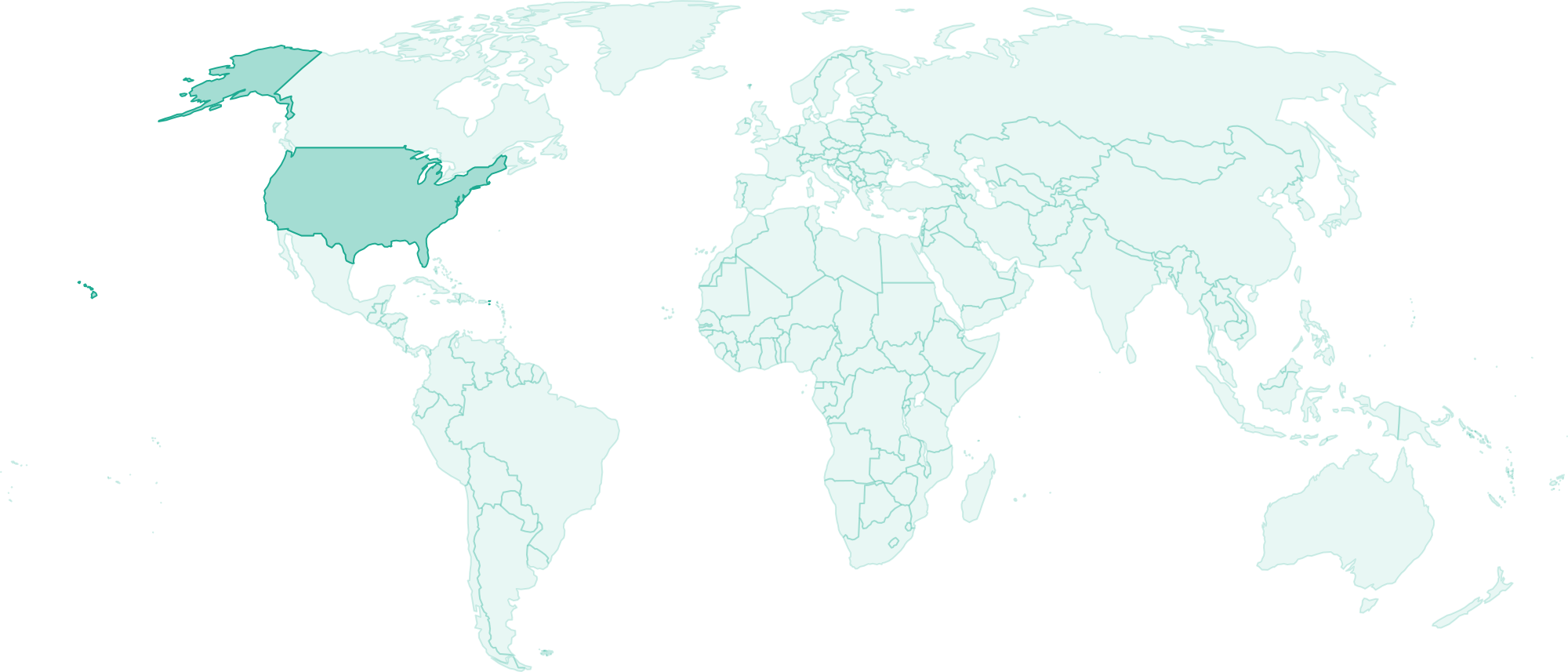
The Internal Revenue Service (IRS) treats income from trading activity as ordinary income. See IRS Topic 429 for its guidance on traders in securities. Prop trading payouts do not qualify as capital gains. Capital gains arise from selling assets you own. A performance split is income earned from a service, not a capital disposal.

Most funded traders in the US report payouts as self-employment or contractor income. You are responsible for reporting this on your annual tax return. Self-employment tax also applies, covering your contributions to Social Security and Medicare programs.

Some high-volume or high-frequency traders may qualify as traders in securities under IRS rules, which unlocks the Section 475(f) mark-to-market election. This is a specific classification with distinct requirements – it does not apply automatically and depends entirely on your individual trading facts. Research this with a US-qualified tax professional if you believe it may apply to you.

United Kingdom

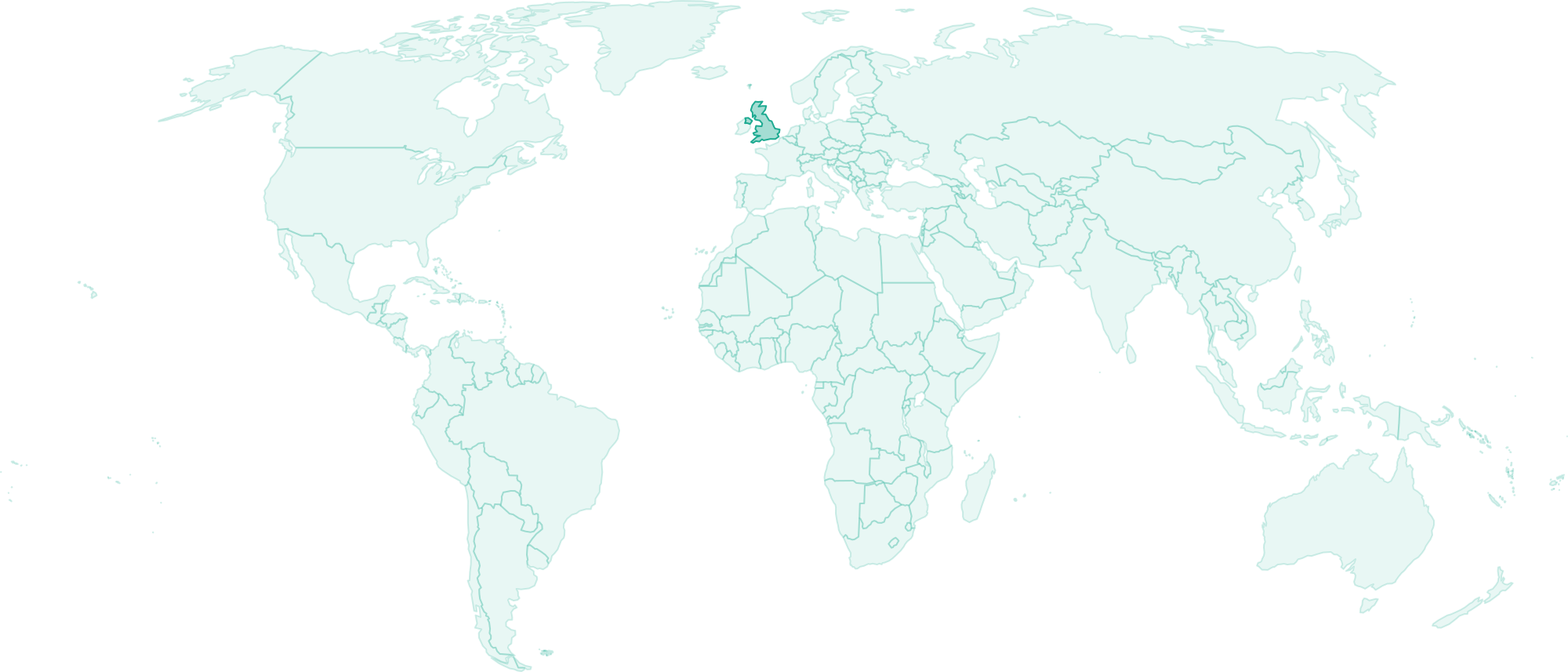
HM Revenue and Customs (HMRC) assesses trading income on a case-by-case basis, using its Business Income Manual (BIM) 56800 guidance on financial trading. The classification depends on the nature of your activity and how you conduct it.

For most funded traders, HMRC treats payouts as self-employment income. You report this through the UK Self Assessment system. If you have not already registered as self-employed, you are required to do so and file an annual Self Assessment tax return.

Being self-employed in the UK also triggers National Insurance obligations. Class 2 and Class 4 National Insurance contributions may apply on trading profits above the relevant thresholds. Many funded traders are unaware of this. Confirm your NI position with a UK-qualified accountant.

Spread betting profits in the UK are exempt from Capital Gains Tax and income tax under current UK tax law. However, this exemption does not apply to prop trading income in the standard funded account model. Do not assume it applies to your situation without taking specific advice.

Canada

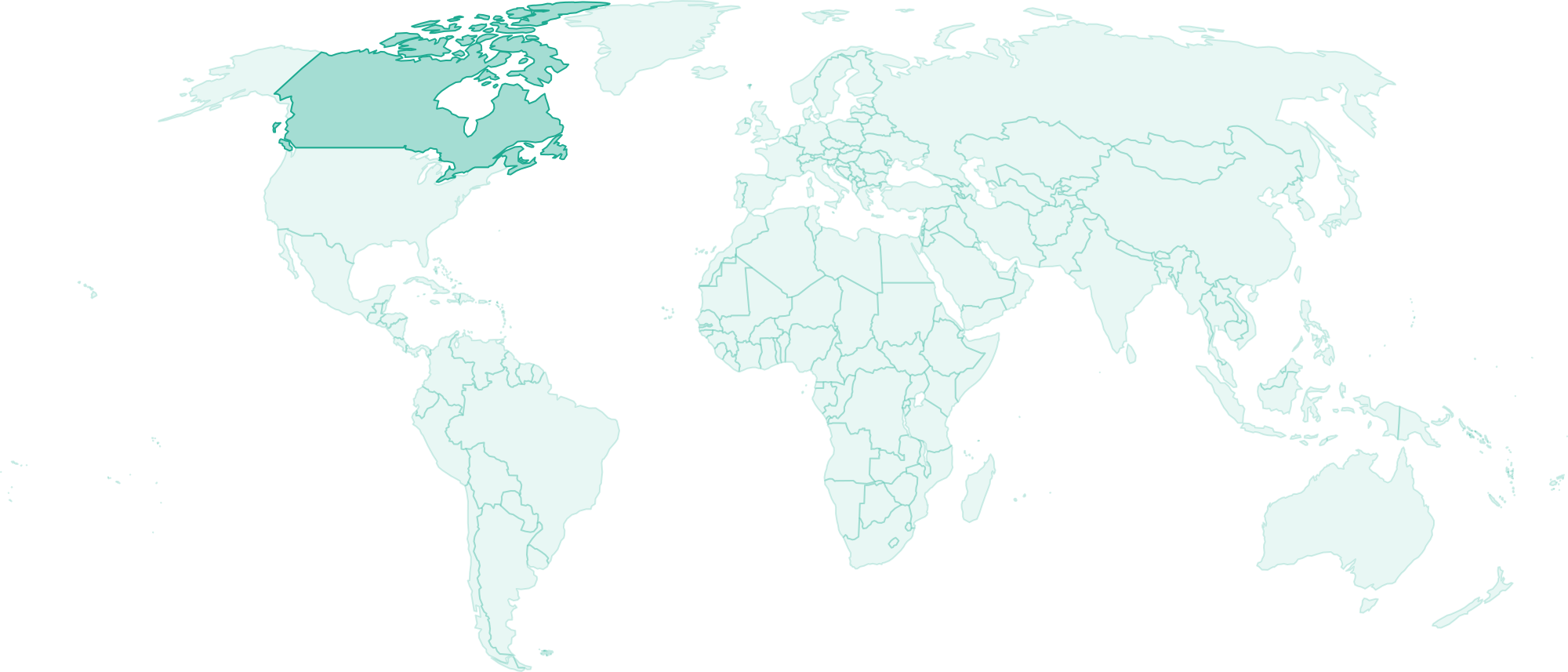
The Canada Revenue Agency (CRA) treats income from active trading as business income where you trade in a business-like way, with a genuine intention to make a profit. See the CRA guidance on business income for details.

Business income is fully taxable in Canada and does not qualify for the lower tax rate applied to capital gains. The CRA treats investing and active trading differently. Capital gains rules may apply to investing. Active trading is treated as a business.

If you receive regular payouts from a prop firm, the CRA is likely to classify you as carrying on a business. Report this income as business income on your T1 General tax return. Business expenses directly related to your trading activity may be deductible, subject to CRA rules.

High-earning Canadian traders should also check whether their business income exceeds the GST/HST registration threshold. If it does, you may need to register for and remit GST/HST. Confirm with a Canadian tax professional.

Australia

Realistic Vector Illustration, great for backgrounds

The Australian Taxation Office (ATO) classifies regular trading activity as a business activity where you operate consistently and with a profit motive. See the ATO guidance on business versus hobby.

The ATO treats prop trading payouts as assessable income – that is, income subject to tax. You include this in your Individual Tax Return (ITR) for the relevant financial year. The frequency, regularity, and commercial nature of your activity determine your classification.

Australian traders classified as carrying on a business may also need to lodge quarterly Business Activity Statements (BAS). This applies if your trading business is registered for GST. Confirm your BAS obligations with a registered Australian tax agent.

Jurisdiction Comparison Table

How tax authorities typically classify prop trading payouts. This is a general guide only – individual circumstances vary.

CountryClassificationReporting MethodKey AuthorityAdditional Note
United StatesSelf-employment/contractor incomeIndividual tax returnIRSSE tax (Social Security & Medicare) may apply
United KingdomSelf-employment/trading incomeSelf Assessment returnHMRCClass 2 & 4 NI may apply
CanadaBusiness incomeT1 General returnCRAGST/HST registration may be required
AustraliaAssessable business incomeIndividual Tax Return (ITR)ATOQuarterly BAS may be required

Always confirm your classification with a qualified tax professional in your country. This table reflects common treatment, not universal rules.

Do Prop Firms Provide Tax Forms?

Whether your prop firm issues tax documentation depends on the firm and the jurisdiction. Practices vary across the industry.

In the United States, firms that pay a contractor USD 600 or more in a tax year are required to issue a Form 1099-NEC under IRS rules. However, this applies primarily to firms with a US presence. Many overseas prop firms do not have US operations and do not issue 1099 forms. Do not wait for a form before reporting. Your obligation to report income exists regardless of whether any documentation arrives. For information on how FXIFY handles payouts, see FXIFY fast payouts.

In other jurisdictions, prop firms do not issue formal tax documentation. You keep your own records and report your income accurately. This is self-reported income.

Ask your prop firm the following questions directly:

•         Do you issue tax documentation for payouts? If so, in what format?

•         Which jurisdictions does your tax reporting cover?

•         Do you report payments to any tax authority on my behalf?

Common Tax Mistakes Prop Traders Make

These errors appear frequently among funded traders. Understanding them helps you avoid costly problems.

Assuming evaluation payouts are not taxable

Some traders believe payouts received during an evaluation phase are not real income. In most cases, they are. If you receive money in exchange for trading activity, tax authorities treat it as income – regardless of the label attached to the program.

Treating payouts as capital gains

Performance splits from prop firms are not capital gains. Capital gains arise from the sale of an asset. A payout from a prop firm is income earned from a service. Applying the wrong classification leads to underpayment of tax.

Failing to record payouts consistently

If you receive payouts across multiple months or from multiple firms, you must track every amount. Every payout is reportable. Incomplete records make accurate reporting difficult and increase your audit risk.

Ignoring income from overseas prop firms

If you are based in the UK and receive payouts from a US-based firm, you must still report that income to HMRC. Most tax systems require you to declare worldwide income. The foreign origin of the payment does not remove your obligation.

Example of Prop Trading Income Reporting

Illustration only. This is not tax advice and does not represent the rules of any specific jurisdiction.

Imagine a funded trader who receives performance-split payouts totalling $24,000 over a tax year, split into twelve monthly payments. During the same year, they spent $800 on a charting software subscription and $400 on a trading data feed. These are costs directly related to their trading activity.

At the end of the year, the trader calculates their taxable income. If their jurisdiction allows business expenses to be deducted from trading income, the calculation might look like this:

ItemAmount (illustrative)
Total payouts received$24,000
Charting software (allowable expense)−$800
Data feed subscription (allowable expense)−$400
Illustrative taxable income$22,800

Expenses that may be deductible – costs you can subtract from your income before tax – include trading software subscriptions, charting platforms, data feeds, trading course fees, and a proportion of home office costs where you trade exclusively from home. What qualifies depends entirely on your jurisdiction and individual circumstances. Consult a tax professional before claiming any deduction.

This is a simplified illustration. Do not use it as the basis for filing your tax return.

Record Keeping for Prop Traders

Accurate records are the foundation of compliant tax reporting. Keep documentation for every payout received and every relevant business expense.

Step 1 – Record every payout. Save payout statements from your prop firm and bank or payment processor transaction records. Screenshots of your dashboard earnings can support formal statements.

Step 2 – Track exchange rates for foreign currency payouts. If you receive payouts in a foreign currency, record the exchange rate on the date of each payment. Use a consistent conversion method throughout the year and document it. Many tax authorities require you to report income in your local currency.

Step 3 – Separate records per firm. If you trade with more than one prop firm, keep separate records for each. Mixing records from different sources without tracking their origin makes accurate reporting harder and raises your audit risk.

Step 4 – Track expenses. Keep invoices and receipts for all business expenses. Use accounting software such as QuickBooks or FreeAgent, or a well-organised spreadsheet. Do not leave this until tax season – missing receipts are difficult to recover.

 Key Takeaways

•         Prop trading is taxable. Whether prop trading is taxable has a clear answer in most jurisdictions: yes. Performance split payouts are income.

•         Classification drives everything. Your income may be treated as self-employment income, contractor income, or business income – the classification determines your reporting obligations and potential deductions.

•         Prop trading payouts are not capital gains. Do not apply capital gains treatment to performance split income.

•         You are responsible for reporting. Whether or not your prop firm sends documentation, you must declare your income.

•         Worldwide income rules apply. If you are a UK or Australian resident trading with a US-based firm, you must still declare those payouts locally.

•         Record keeping protects you. Keep payout statements, expense receipts, and exchange rate records throughout the year – not just at tax time.

•         Seek qualified advice once. Tax law is complex, and individual circumstances differ. Find a tax professional with experience in trading income and consult them before you file.

Frequently Asked Questions

Do prop traders pay taxes on payouts?

Yes. Payouts from prop firms are taxable income in most jurisdictions. The classification – and therefore the rate – depends on your country and your individual circumstances. Report all payouts to your relevant tax authority.

Are prop firm payouts capital gains?

No, in most cases. Capital gains arise from selling an asset you own. A prop trading payout is income earned from a trading service. In most jurisdictions, tax authorities treat it as income rather than a capital gain. Confirm the correct classification with a tax professional.

Do prop firms send tax forms?

It depends on the firm and the country. US-based firms that pay you USD 600 or more in a year are required to issue a Form 1099-NEC under IRS rules. Firms based outside the US do not issue 1099 forms. Maintain your own records and report income regardless of whether you receive any documentation.

How do funded traders report income?

The method depends on your jurisdiction. In the UK, you report via Self Assessment. In the US, you report on your individual tax return. In Canada, you file a T1 General and report business income. In Australia, you file an Individual Tax Return (ITR). Check with a local tax adviser to confirm your specific obligations.

Is prop trading considered self-employment?

In many jurisdictions, yes. Funded traders are treated as independent contractors or self-employed individuals because they provide a trading service in exchange for a share of profits. Being self-employed may mean additional reporting obligations – and in the UK, National Insurance contributions. Confirm with a qualified adviser what applies to you.

Does it matter if the prop firm is based in another country?

Yes. If you are a UK resident receiving payouts from a US-based firm, you must still report that income to HMRC. Most tax systems require you to declare worldwide income. The firm’s location does not reduce your reporting obligations.

Are prop firm challenge fees tax-deductible?

This depends on your jurisdiction and how you are classified. In jurisdictions where your trading is treated as a business, the cost of an evaluation program may be deductible as a business expense. This is not universal. Seek advice from a tax professional familiar with trading income before claiming any deduction.

Best Forex Pairs to Trade

Summary

This guide covers the six factors that determine whether a forex pair is worth trading: volatility, liquidity, technical structure, news sensitivity, session timing, and correlation. Each section uses verified market data to identify the strongest pairs, and the final section shows you how to match a pair to your trading style and available hours, helping you tailor your approach effectively.

Which Currencies Offer the Best Opportunities?

Most traders choose a forex pair because it looks familiar or because someone mentioned it. That is not pair selection. The pair you trade determines your spread cost, your entry quality, how your positions respond to economic data, and whether your strategy has a mathematical chance of working in the hours you trade.

The best forex pairs to trade are not simply the most popular ones. They are the pairs that fit your strategy, your available hours, and your risk approach. This understanding can empower traders to make personalized decisions based on their unique needs.

What Makes a Forex Pair Worth Trading?

Four factors determine whether a pair is practical for active trading.

Liquidity is the volume of active buy and sell orders at any given moment. High liquidity means your order fills at the price you see on screen. Low liquidity means your order may fill at a worse price, which is called slippage. According to the Bank for International Settlements 2025 Triennial Survey, the global forex market averaged $9.6 trillion in daily turnover in April 2025. That volume is concentrated in a small number of pairs, and those pairs carry the tightest spreads available.

Volatility is the extent to which a pair moves in price over a set period, measured in pips. A pip, which stands for percentage in point, is the smallest price increment for most pairs, equal to 0.0001.

Session activity describes when a pair generates its highest volume. Knowing that activity centers on Asian, London, and New York sessions can help traders feel more confident in their trade timing, reducing uncertainty about market behavior.

News sensitivity is the extent to which a pair reacts to scheduled economic data releases. Some pairs move 80 to 150 pips within minutes of a high-impact event. That creates opportunity for certain strategies and serious risk for others.

Six Factors That Determine Which Pair Fits Your Strategy

1. Volatility: Which Pairs Move the Most?

Volatility is measured by the average daily range, which is the typical pip distance between a pair’s daily high and daily low. Check the current ATR (Average True Range) on a daily chart before trading any new pair, as this figure changes with market conditions.

GBPJPY carries an average daily range of approximately 150 pips and reacts simultaneously to UK data, US data, and Bank of Japan policy. Sharp intraday reversals are common. Traders who are not experienced with fast price behaviour are regularly stopped out by normal market noise before the larger move develops.

GBPUSD averages 70 to 120 pips per day in normal market conditions. It is more liquid than GBPJPY, which means intraday moves tend to be smoother.

EURUSD sits in a low-volatility range, with a 10-week average daily movement of 58 pips as of January 2026. Its moves tend to be directional and sustained, which suits trend-following strategies more than breakout approaches seeking fast, large moves.

Before trading any volatile pair, confirm that your stop loss accounts for the pair’s normal daily range. A 20-pip stop on GBPJPY will be triggered by ordinary market movement, not by a losing trade.

2. Liquidity and Spreads: Where Your Cost Is Lowest

The spread is the unavoidable cost you pay on every position you open. For active traders, it compounds significantly across multiple trades per day.

EURUSD accounts for 21.2% of global forex volume with a daily turnover of $2.03 trillion, making it the most traded currency pair in the world. USDJPY is the second-most-traded pair globally, maintaining strong volume across both the Asian and New York sessions. GBPUSD recorded $731 billion in daily turnover, with its highest liquidity concentrated in the London session.

Exotic pairs such as USDTRY and USDZAR carry spreads that can exceed 30 pips and widen further during political events. Most retail traders have no practical reason to include them.

3. Technical Structure: Which Pairs Respect Levels Most Consistently?

EURUSD produces the cleanest technical structure of any major pair. The reason is mechanical: it is the most analyzed pair in the world. When a critical mass of participants act on the same level simultaneously, that level becomes more reliable. No other pair attracts this density of attention.

AUDUSD produces a clean structure with moderate volatility, influenced by Australian commodity exports, global risk sentiment, and Reserve Bank of Australia policy. These are trackable factors that give traders a clear fundamental framework alongside technical analysis.

GBPJPY and EURJPY regularly produce false breaks of technical levels due to high volatility. For traders who are still developing their reading of price action, both pairs carry a significant learning cost.

4. News Sensitivity: Which Pairs Respond Most to Economic Data?

USD pairs react to all major US releases, including Non-Farm Payrolls, the Consumer Price Index,x and Federal Reserve interest rate decisions. GBPUSD and GBPJPY also react to Bank of England rate decisions and UK inflation figures. USDCAD is also sensitive to crude oil prices because Canada is one of the United States’ largest suppliers of crude oil.

USDJPY reacts to US data and Bank of Japan policy. The yen also functions as a safe-haven currency, meaning it tends to strengthen when global investors become risk-averse. This happens through a carry trade unwind: investors who borrowed yen cheaply to invest in higher-yielding assets must buy back yen when conditions deteriorate, strengthening the yen regardless of Japanese economic data. The BIS published a detailed analysis of this mechanism following the sharp yen appreciation of August 2024.

Standard practice is to avoid opening new positions in the 15 minutes before and 5 to 10 minutes after a high-impact release. A free economic calendar is available at Forex Factory.

5. Session Activity: When Are These Pairs Most Active?

The London-New York overlap accounts for only 19% of the trading day but generates 37% of average daily trading volume, making it the single most important window for active traders.

The Asian session, which runs from midnight to 8 am London time, is dominated by yen pairs. USDJPY, AUDJPY, and NZDJPY carry the most volume during this window. The London session, which runs from 8 am to 4 pm London time, accounts for approximately 43% of global trading volume. EURUSD and GBPUSD are most active here, with the London open at 8 am frequently producing the sharpest directional move of the day.

Trading a pair outside its active session produces wider spreads, lower volume,e and less reliable price movement.

6. Correlation: Avoiding Hidden Overexposure

Currency correlation measures how consistently two currencies move in relation to each other. The coefficient runs from negative 100 to positive 100. A reading above positive 80 means two pairs move in the same direction more than 80% of the time.

Forex Pair Correlation Matrix
Daily correlations across major pairs · Hover any cell to read the relationship
Correlation Scale

EURUSD and GBPUSD are strongly positively correlated. Both use USD as the counter currency and involve major European economies. Holding a long EURUSD and a long GBPUSD position simultaneously is not diversification. It is a single directional bet on USD weakness. If the dollar strengthens, both positions lose at the same time.

EURUSD and USDCHF are strongly negatively correlated. A long EURUSD and a long USDCHF will largely cancel each other out. Use Myfxbook’s free correlation tracker to verify current values before holding multiple open positions.

Top Forex Pairs by Category

CategoryRecommended Pairs
Highest Average Daily RangeGBPJPY (~150 pips), GBPUSD (~70 to 120 pips)
Highest Global Daily VolumeEURUSD ($2.03T), USDJPY, GBPUSD ($731B)
Tightest SpreadsEURUSD, USDJPY, GBPUSD
Cleanest Technical StructureEURUSD, AUDUSD
Most News-ReactiveGBPUSD, USDJPY, USDCAD
Best for Asian SessionUSDJPY, AUDJPY, NZDJPY
Best for London/NY OverlapEURUSD, GBPUSD

How to Choose the Right Pair for Your Trading Style

Scalpers who target 5 to 15 pips per trade need spreads as close to zero as possible. EURUSD is the standard choice, with USDJPY as a strong secondary option. Any pair with a spread consistently above 1 pip places a scalping strategy at a cost disadvantage before a single trade is placed.

Day traders who target 30 to 80 pips need a pair that is active during their available hours. Traders in Europe should focus on EURUSD and GBPUSD during the London session. Traders in Asia should focus on USDJPY and AUDJPY during the Tokyo session.

Swing traders who target 100 to 300 pips over multiple days accept the one-time spread cost as minor against the expected move. EURUSD, GBPUSD, and AUDUSD all produce defined directional swings during trending conditions.

Range traders who enter at support and exit at resistance need a pair that consistently respects technical boundaries. EURUSD and USDCHF exhibit clear range behaviour during low-volatility periods. GBPJPY breaks boundaries too frequently for this approach to work systematically.

The Best Forex Pairs Are the Ones That Fit Your Strategy

There is no universally best forex pair. Traders who produce consistent results focus on one or two pairs and develop deep knowledge of how those pairs behave across different conditions. Switching between pairs in search of better results rarely yields better results.

If you are working toward a funded account, the pairs you trade affect your drawdown limits and evaluation targets directly. Review the FXIFY programs to understand how evaluation conditions apply to your approach, and visit the FXIFY FAQs for questions about available instruments.

Frequently Asked Questions

What is the best forex pair for beginners?

EURUSD is the standard starting point. It has the tightest spreads, the deepest liquidity, and the cleanest technical structure of any major pair, with more publicly available research than any other pair.

Which forex pair is the most volatile?

GBPJPY carries an average daily range of approximately 150 pips and is one of the most volatile non-exotic pairs available. GBPUSD averages 70 to 120 pips per day and is the most volatile among the pure major pairs over the long term.

What is the best time of day to trade forex?

The London-New York overlap, which runs from 1 pm to approximately 5 pm London time, generates 37% of average daily trading volume despite covering only 19% of the trading day. It produces the highest liquidity and the most sustained directional moves.

Can I trade multiple forex pairs at the same time?

Yes, but you must account for correlation. Holding long positions on both EURUSD and GBPUSD is not two independent trades. Both pairs are strongly positively correlated, meaning both lose simultaneously if the US dollar strengthens. Verify correlation at Myfxbook before opening multiple positions.

Why does the Japanese yen strengthen during market crises?

The yen is a major funding currency in the carry trade. When market conditions deteriorate, investors who borrowed yen to invest in higher-yielding assets must buy back yen to repay those loans. That buying pressure strengthens the yen regardless of conditions in Japan. The BIS analyzed this mechanism following the sharp yen appreciation of August 2024.

What is the difference between a major pair and a cross pair?

A major pair always includes the US dollar, for example, EURUSD or USDJPY. A cross pair, also called a minor pair, does not include the US dollar, for example, GBPJPY or EURJPY. Cross pairs tend to carry wider spreads and higher volatility than major pairs.

Does FXIFY allow news trading?

FXIFY allows news trading without restriction on all evaluation programs. Visit the FXIFY programs page or the FAQs for the exact conditions on your chosen program.

Are AI and Bots Replacing Retail Traders?

Summary: Algorithms now execute between 60-75% of US equity trades. This article explains the difference between traditional algorithmic trading and AI-based trading, why bots fail during unpredictable market events, and what retail traders need to do to remain relevant in automated markets.

Automated systems now dominate the execution side of financial markets. According to JPMorgan, between 60 and 75% of all US equity trading is carried out by algorithms. In forex markets, the figure is even higher. Finance Magnates estimates that 85% of forex trading volume is now algorithmic.

If you are a retail trader, these numbers matter. They change how the market moves, how liquidity behaves around news events, and why prices sometimes react in ways that feel disconnected from the underlying story.

But the claim that “bots are replacing retail traders” is not accurate, at least not as usually presented. To understand what is really happening, you need to understand what these systems actually are, what they can do, and where they consistently fail.

Algorithmic Trading and AI Trading Are Not the Same Thing

Most articles about “AI bots replacing traders” misuse the term “AI”. The majority of automated trading in markets today is not driven by artificial intelligence. Algorithmic trading systems drive it.

Algorithmic trading means a computer executes trades based on a fixed set of rules written by a human. The rules do not change unless a programmer changes them. If the price crosses a moving average, the system buys. If volatility reaches a certain level, the system exits. The machine follows the instructions. It does not learn, adapt, or decide.

AI-based trading differs from traditional algorithms because true AI systems, using machine learning and reinforcement learning, can adapt to new market conditions by detecting patterns that the programmer did not explicitly define. They update their behaviour as new data arrives, which can help traders understand how AI might respond differently during unpredictable events. According to EBC Financial Group, the key distinction is that AI can pick up patterns humans did not specify. Still, this flexibility introduces additional model risk and depends heavily on the quality of input data.

The distinction matters because the limitations of each type are different. A traditional algorithmic system fails when the market moves outside the rules it was written for, such as during sudden crises. An AI system can also fail when it encounters conditions that were not represented in the data it learned from, like during unprecedented market shocks. Both can fail, especially in extreme events, but they do so in different ways. Understanding these limitations helps traders prepare for unexpected market moves.

When the 2010 Flash Crash occurred on May 6, the event was driven by traditional high-frequency trading algorithms, not by AI. A large automated sell order from Waddell & Reed Financial, worth approximately $4.1 billion in E-Mini S&P futures contracts, triggered a cascade of algorithmic responses. High-frequency trading systems repeatedly bought and resold contracts among themselves, creating what the SEC described as a “hot potato” volume effect. In 14 seconds, those systems traded over 27,000 contracts, representing 49%of total volume at that time. The Dow Jones fell nearly 1,000 points before partially recovering. The SEC and CFTC later confirmed that high-frequency algorithms exacerbated the decline. Human intervention, including the manual suspension of E-Mini trading, helped halt the collapse.

How Much of the Market Is Now Automated and What That Means for Your Trades

Algorithmic trading has grown steadily since the early 2000s. According to QuantifiedStrategies.com, algos now account for approximately 60% to 75% of trading volume across US equity markets, European financial markets, and major Asian capital markets. In US forex markets, the proportion is higher still.

The global algorithmic trading market was valued at $21.06 billion in 2024 and is projected to reach $42.99 billion by 2030, according to Grand View Research. A separate report from the AI trading software market suggests that the segment alone could grow from $11.5 billion in 2024 to $75.5 billion by 2034.

For retail traders, what matters is not the market size figure. What matters is the practical effect on price behaviour.

Algorithms make markets more efficient during normal conditions. They narrow bid-ask spreads and provide liquidity. But they can also amplify price moves during abnormal conditions, because many systems react to the same data at the same time. The IMF cautioned in 2024 that widespread AI trading can increase volatility when multiple models respond identically to the same market event. The 2010 Flash Crash illustrated exactly this feedback dynamic.

Retail traders who do not understand this will misread price action. Recognising that algorithms cause short-term distortions can give traders a practical edge and boost their confidence in managing risks.

Where Algorithmic Systems Fail and Why Human Judgement Still Has Value

Algorithmic systems have three persistent failure modes that retail traders can understand and use.

Overfitting. A system trained on historical data will often perform well on that data but fail in live markets when conditions change. This is called overfitting. The algorithm learned the past too precisely and cannot adapt to a new regime. This is why many retail algo traders report strong backtests but poor live performance.

Regime blindness. Algorithms do not know when the rules have changed. Human traders can recognise regime shifts by monitoring macro developments or observing price reactions, which can make traders feel more capable and in control.

Feedback cascades. When many algorithms respond to the same signal, their effects can be self-reinforcing, causing sharp moves. Recognising this pattern can help traders avoid being caught in the whipsaw, fostering a sense of strategic control.

The Eurekahedge AI Hedge Fund Index, which tracks funds using AI-based strategies, returned approximately 9.8% annualised from December 2009 to July 2024, compared to 13.7% for the S&P 500 over the same period. This is not evidence that AI is worthless. It is evidence that AI is a tool, not a guaranteed edge. The best outcomes come from combining it with human judgment.

How Retail Traders Can Work Alongside Algorithmic Systems Rather Than Against Them

The practical question is not whether algorithms are replacing retail traders. The question is whether retail traders are adjusting their approach to account for algorithmic market behaviour.

Several adjustments are directly actionable.

Trade away from the noise window. Algorithms react fastest in the first minutes after a news release. Spreads widen, liquidity thins, and prices can move sharply in both directions before settling. Trading 5 to 15 minutes after a release, once algorithmic positioning has stabilised, often produces cleaner entries.

Recognise liquidity sweeps for what they are. Many short-term price spikes below support or above resistance are algorithmic stop hunts. The algorithm pushes price to a level where retail stop-loss orders are clustered, triggers those orders to generate liquidity, then reverses. Traders who understand this pattern can use the sweep as an entry signal rather than exiting at exactly the point the algorithm wants them to.

Use algorithmic tools for execution, not for decisions. Platforms such as MetaTrader 5, TradingView with alerts, and QuantConnect allow retail traders to automate strategy execution without requiring any coding beyond basic scripting. The decision of what to trade, when to trade, and what size remains with the human. The algorithm handles the mechanical part without hesitation or deviation from the rules.

According to a 2023 eToro Global Trading Study, 45% of retail traders already use some form of automated strategy. This figure will rise. The traders who remain relevant are those who use automation to execute disciplined strategies faster and more consistently, while keeping the macro and contextual judgment for themselves.

Human Trader vs Algorithmic System: A Direct Comparison

The competition is not zero-sum. The comparison below shows where each has a structural advantage.

Human Trader EdgeAlgorithmic System Edge
Reads market context during news eventsExecutes orders in milliseconds
Identifies regime changes before data confirms themRuns 24 hours a day without fatigue
Adapts strategy when macro conditions shiftProcesses thousands of instruments simultaneously
Overrides a position when logic no longer appliesMaintains consistent position sizing with no emotion
Recognises when a breakout is a trap, not a signalApplies stop-loss rules with exact precision every time

The most effective approach in current markets combines both columns. You provide the strategy and the contextual judgement. Automation provides consistent execution. 

What This Means If You Are Trading with a Prop Firm

Proprietary trading firms evaluate traders on disciplined risk management and consistent performance, not on whether they trade manually or use automation. FXIFY’s evaluation programs permit automated trading strategies, provided they meet the programme rules.

Regardless of the programme you choose, the evaluation tests your ability to manage drawdown and protect capital. An algorithm that performs well in backtesting but breaches a daily loss limit in live conditions will still fail the evaluation. Human oversight of the automated system is not optional. Full programme details are available at fxify.com/how-it-works.

Frequently Asked Questions

Are AI trading bots and algorithmic trading bots the same thing?

No. Algorithmic trading uses fixed rules written by a programmer. The system follows those rules and does not change unless reprogrammed. AI-based trading uses machine learning to detect patterns without explicit instructions and to update its behaviour as new data arrives. Most automated trading in financial markets today is algorithmic, not AI.

What percentage of trading is now algorithmic?

According to JPMorgan, between 60%  and 73% of US equity trading is algorithmic. In forex markets, Finance Magnates estimates the figure at approximately 85%. The exact number varies by market and time period.

Why did the 2010 Flash Crash happen?

The SEC and CFTC concluded that a large automated sell order of 75,000 E-Mini S&P futures contracts triggered a cascade of high-frequency trading activity. Algorithms began passing the contracts back and forth rapidly, draining liquidity. The Dow Jones fell nearly 1,000 points in under 30 minutes before recovering when E-Mini trading was manually suspended. High-frequency algorithms exacerbated the decline. Human intervention was required to stop it.

Can retail traders use algorithmic systems effectively?

Yes. Platforms such as MetaTrader 5 and TradingView allow retail traders to automate strategy execution without advanced programming knowledge. The advantage is consistent execution without emotional deviation. The risk is that a poorly designed algorithm can breach risk parameters faster than a human trader who monitors positions manually. Human oversight remains necessary.

Does FXIFY allow automated trading strategies in its evaluations?

FXIFY permits automated and algorithmic trading strategies across its evaluation programmes, subject to programme rules. FXIFY also allows news trading without restriction. Full details of each programme are available at fxify.com/programs.

Do algorithmic trading systems always outperform human traders?

No. The Eurekahedge AI Hedge Fund Index returned approximately 9.8% annualised from 2009 to 2024, compared to 13.7% for the S&P 500 over the same period. Algorithms can outperform in specific conditions but fail during regime changes and unpredictable events. Performance depends on how the system is designed, how well it is monitored, and whether it is adjusted when market conditions change.

Top 5 Prop Firms in the UK (2026)

The UK has one of the largest retail trading communities in Europe. Thousands of traders now use prop firms to access large amounts of capital without using their own money.

The problem is simple: prop firms look similar on the surface, but the differences between them are large. Capital limits vary significantly between firms. The lowest starting ceiling in this comparison is $100,000 and the highest is $400,000. That means one firm offers four times more starting capital than another from day one. Some firms pay out on demand. Others make you wait 30 days. Trading restrictions depend on the program type, the instrument, and whether a news event is scheduled.

This article compares five firms that accept UK traders: FXIFY, FTMO, FundedNext, FundingPips, and The5ers. Every fact comes from published program data. The comparison covers six areas:

  • Maximum starting capital
  • First payout eligibility
  • Ongoing payout frequency
  • Profit split percentage
  • Trading rules covering news events, weekends, and Expert Advisors
  • Platforms and pricing models

One important point before reading further: a high profit split means very little if the capital limit is low, the first payout takes 30 days, or your trading strategy breaks the firm’s rules. All six areas matter together.

What to Check Before Choosing a Prop Firm

Most traders look at profit split first. This is the wrong place to start.

Profit split only matters after two things have happened: you have received capital to trade, and you have received a payout. Before either of those things happens, three questions decide whether a firm is right for you:

  • How much capital can you access from day one?
  • When is the first payout available, and is the timing fixed or flexible?
  • Do the firm’s trading rules allow your strategy, your instruments, and your approach to news events?

Getting clear answers to these three questions will save you from paying an evaluation fee for a program that does not suit how you trade.

1. FXIFY

The highest starting capital in this comparison, with first payout available on demand.

Starting Capital

FXIFY funds accounts from $5,000 up to $400,000. That is the highest direct starting capital among the five firms in this comparison. FundingPips starts at $100,000. FTMO and FundedNext cap at $200,000. The5ers reaches $250,000 through staged growth.

At FXIFY, a trader can access $400,000 from a single account on day one of their funded stage. No staging. No waiting to unlock more capital. The full amount is available as soon as you pass your evaluation.

Five Programs Built for Five Types of Trader

Most prop firms offer one or two account structures. FXIFY offers five, each designed for a specific trading profile. You can compare all of them on the FXIFY Programs page.

The One Phase is for traders who want the fastest route to a funded account. One evaluation. One profit target. Pass it and you are funded. No second stage, no extended waiting period.

The Two Phase Standard uses a trailing drawdown and is built for traders with consistent discipline. Phase 1 requires a 10% profit target. Phase 2 requires 5%. Two Phase Classic uses a static drawdown instead, giving traders a fixed risk boundary that does not move as the account grows.

The Three Phase offers the lowest assessment fees and the lowest profit targets in the evaluation range. Each phase requires only 5%. Three stages, lower cost, same funded account at the end.

The Lightning Challenge is FXIFY’s fastest evaluation. A 5% profit target, completed within 7 calendar days with a minimum of 5 trading days. Account sizes go up to $100,000. This program is built for traders who know their edge and want to prove it quickly.

The Instant Funding program removes the evaluation entirely. No targets. No phases. You purchase the account and begin trading funded capital on day one. Account sizes go up to $100,000. This is designed for professional traders with a proven, stable strategy who do not need a warm-up period.

The purchase fee is fully reimbursed with your first payout on request for all One Phase, Two Phase, and Three Phase plans.

First Payout

On the One Phase, Two Phase Standard, and Three Phase programs, the first payout is available on demand.

After you pass the evaluation and close your first profitable live trade, you can request a withdrawal immediately. There is no requirement to wait 14 days before submitting your first payout request.

This on-demand structure applies only to the first payout after funding.

After the initial withdrawal, payouts follow the selected cycle:

  • Monthly by default
  • Bi-weekly if the payout add-on is purchased

This means traders do not need to wait 14 days for their first payout, but subsequent withdrawals follow the chosen schedule.

Minimum Trading Days

Minimum trading days apply only during the evaluation phases.

  • One Phase, Two Phase Standard, and Three Phase: 5 minimum trading days per phase
  • Two Phase Classic: 4 minimum trading days per phase

There are no minimum trading day requirements once the account reaches the funded stage.

Instant Accounts:

  • Instant Standard: no minimum trading days
  • Instant Lite: 5 minimum trading days

Profit Split Up to 90%

FXIFY funded traders earn up to 90% performance split on their trading gains. The performance split add-on is available at checkout and can be applied to any evaluation program. Instant Funding accounts offer up to 90% from day one.

Platforms, Pricing and Instruments

FXIFY supports MT4, MT5, DXtrade, and TradingView. That is four platforms, the widest selection in this comparison. The5ers and FundingPips each support two platforms. FTMO and FundedNext support four but do not include TradingView.

Two pricing models are available. RAW pricing offers spreads from 0.0 on major FX pairs and gold, with a $6 per lot commission on FX, metals, indices, and commodities. Stocks on RAW are charged at 0.35% round trip. All-In pricing includes everything inside the spread with zero separate commission on FX, metals, indices, and commodities. Traders choose the model that fits their cost structure at checkout.

Over 100 instruments are available across forex, metals, indices, stocks, and commodities. Standard leverage is 30:1, with an upgrade to 50:1 available at checkout.

Trading Rules: What Is Permitted and What Is Not

For One Phase, Two Phase Standard, Two Phase Classic, and Three Phase accounts:

News trading is allowed without restriction. Expert Advisors are allowed. Copy trading is permitted between your own FXIFY accounts and from FXIFY accounts to other accounts, provided you supply FXIFY with the master account statement.

For the Lightning Challenge:

A stop loss is required on every trade. The first and second trades placed without a stop loss result in automatic position closure. The third violation is a permanent hard breach. News trading is restricted 5 minutes before and 5 minutes after any high-impact event. Holding through the news is allowed, but opening, closing, or placing any orders including stop loss and take profit orders within that 10-minute window is restricted. Any profit made within this window is not counted.

For Instant Funding accounts:

News trading is restricted 5 minutes before and 5 minutes after high-impact events. The same 10-minute window rule applies and any profit within it is not counted. Weekend holding is not allowed. Open positions are automatically closed before the market closes on Friday. Expert Advisors, bots, and copy trading are prohibited and can result in account termination.

2. FTMO

A structured evaluation model with a fixed 14-day payout cycle.

Starting Capital

Each FTMO account is capped at $200,000. That is the maximum size of a single account. The total capital allocation across all of your accounts combined is limited to $400,000 per trader or per strategy at any one time. This means you can hold, for example, two $200,000 accounts or four $100,000 accounts, but you cannot exceed $400,000 in total across all accounts running the same strategy. A single account never exceeds $200,000.

First Payout and Payout Cycle

Payouts are processed every 14 days. Processing time after a request is approximately 8 hours. There are no withdrawal fees. There is no on-demand option. If your account produces profit before the 14-day period ends, you wait until the cycle completes before requesting a payout.

Profit Split

The standard split is 80%. The 1-Step model offers 90%. FTMO’s scaling plan increases the account balance by 25% every four months when conditions are met, with potential growth up to $2 million.

Platforms and Pricing

FTMO supports MT4, MT5, cTrader, and DXtrade. 93 instruments are available covering forex, indices, commodities, metals, cryptocurrencies, and stocks. FTMO uses a commission-based pricing model with raw spreads. Leverage goes up to 1:100 on standard accounts.

Trading Rules — Standard Account

Weekend holding is not permitted on Standard funded accounts. Positions must be closed before the market closes for the weekend. News trading is restricted during high-impact events in the funded stage: new positions cannot be opened or closed within 2 minutes of a major news event.

Trading Rules — Swing Account

FTMO offers a separate Swing Account that removes both the weekend holding restriction and the news trading restriction entirely. This is an important option for traders whose strategy requires holding positions over weekends or trading around scheduled news events. The Swing Account has lower maximum leverage of 1:30 on forex.

Expert Advisors

EAs and algorithmic trading are permitted. However, widely used third-party EAs shared across many accounts can result in FTMO refusing to issue a funded account, due to maximum capital allocation rules across their trader base. Custom or personalised EAs do not carry this risk.

3. FundedNext

No consistency rule. Three account model types available.

Starting Capital

FundedNext funds accounts up to $200,000. Three program structures are available: Stellar 1-Step, Stellar 2-Step, and Stellar Instant.

First Payout and Payout Cycle

Payout timing depends on the selected account model.

Stellar 1-Step: first payout is available after 5 business days, and subsequent payouts can be requested every 5 days. Stellar 2-Step and Stellar Lite: first payout is available after 21 days, followed by bi-weekly payouts. Stellar Instant: on-demand payout is available once the account has grown by 5%.

The minimum withdrawal is $250 for most account sizes and $500 for the $100,000 account. Withdrawals are processed within 24 hours. A processing fee of up to 3.5% applies to all withdrawals.

Profit Split

Stellar 1-Step accounts start at 90% and can reach 95% with an add-on. Stellar 2-Step and Lite start at 80% and can scale to 90%. Stellar Instant starts at 80%.

Platforms and Pricing

FundedNext supports MT4, MT5, cTrader, and Match Trader. 78 instruments are available covering forex, crypto, indices, and commodities. Raw spreads are provided across accounts.

What Makes FundedNext Different

FundedNext does not apply a consistency rule during evaluation. Most prop firms require that no single trading day produce more than a set percentage of your total evaluation profit. Traders who generate large gains on specific sessions rather than spreading results evenly are often affected by this rule. FundedNext removes it during the evaluation stage, making the program accessible to a wider range of trading styles.

Trading Rules

News trading is allowed across all account types. However, in funded accounts, profits from trades opened or closed within 5 minutes before or after a high-impact news event count at only 40% of their actual value. The remaining 60% is not counted toward your withdrawable profit. Losses from those trades still apply in full.

EAs are allowed only on MT4 and MT5. They are not permitted on cTrader or Match Trader. EAs must be customised to your own trading style. Identical trades across multiple accounts and off-the-shelf EAs are not allowed.

Funded accounts apply a 5% daily drawdown limit and a 10% maximum total drawdown. A 40% consistency rule applies in funded accounts: no single day’s profit can exceed 40% of the total profits in that account.

4. FundingPips

Four payout cycle options. Terms vary significantly between models.

Starting Capital

FundingPips shows account tiers up to $100,000 in its published data. This is the lowest starting ceiling among the five firms compared here. Through the scaling program, capital can grow up to $2 million based on consistent performance.

First Payout and Payout Cycle

FundingPips offers four payout structures. Which one applies depends on the model you select:

Tuesday payouts (weekly): available after 5 trading days, with a 60% profit split. Bi-weekly payouts: 80% profit split. Monthly payouts: 100% profit split. On-demand payouts: available once you achieve a 45% consistency score, meaning no single day’s profit can exceed 45% of your total withdrawable amount.

The minimum withdrawal is 1% of your original account balance. A $10 processing fee applies to each withdrawal. Processing takes within 24 hours after approval.

Profit Split

Splits range from 60% to 100%, depending on the selected payout cycle. The Zero (Instant Funding) account offers up to 95% with a 15% consistency requirement.

Platforms and Pricing

FundingPips supports MT5, Match Trader, and cTrader. Note: cTrader costs an extra $20 to access. MT4 is not available on FundingPips. 48 instruments are available covering forex, metals, indices, cryptocurrencies, and energies. Individual stock CFDs are not available. A $2 commission per round lot applies to forex, metals, and energies. Indices and some other instruments are commission-free.

Trading Rules

During evaluation, there are no restrictions on news events or weekend holding.

In Master (funded) accounts, you cannot open new positions within 3 minutes before or after a high-impact news event. Profits from trades opened or closed within 5 minutes of a major news event will not count, unless the trade was opened at least 5 hours before the event.

In the Zero (Instant Funding) account, no news trading or weekend holding is permitted at any stage.

EAs are allowed only as trade management or risk management tools. EAs built for strategy execution, speed, or arbitrage are not permitted and will result in account termination. HFT, arbitrage, hedging, gap trading, and tick scalping are all prohibited across all account types.

5. The5ers

A staged growth model where capital increases as you hit performance targets.

Starting Capital

The5ers lists account tiers up to $250,000. Capital does not arrive as a single amount. It increases progressively as traders hit defined performance targets in each stage, with the potential to scale to $2 million.

First Payout and Payout Cycle

The first withdrawal is available 14 days after the funded account is activated. After that, payouts are processed bi-weekly. The minimum withdrawal is $150, which applies across all programs.

Withdrawals can be made via bank transfer (3% fee), Rise or crypto (2% fee), or Hub Credits for purchasing new challenges (0% fee). Processing takes up to 7 business days after a request is submitted.

Profit Split

The split depends on which program you choose. Bootcamp and Hyper Growth start at 50% and scale to 100%. High Stakes starts at 80% and also scales to 100%. The 50% starting split in some programs is the lowest in this comparison.

Platforms and Pricing

The5ers supports MT5 and cTrader. Approximately 40 instruments are available covering forex majors, minors, and exotics, metals including gold and silver, major indices, energies, and cryptocurrencies. This is the smallest instrument selection in this comparison.

Pricing uses raw spreads with commissions on forex and gold, and spread-based pricing with no commission on indices, crypto, and commodities. Commission is $4 per standard lot on forex.

Trading Rules

Overnight and weekend holding is permitted across all programs. Weekend holding on indices incurs a swap fee.

News trading rules differ by program. Bootcamp and Hyper Growth allow news trading. High Stakes restricts it.

The Bootcamp program requires a stop-loss order on every open position. Per-position risk is capped at 2% of the account balance. Repeated violations can result in account termination.

EAs are supported on both MT5 and cTrader. Traders may copy their own trades across their own accounts without breaking any rules.

Starting Capital Compared

FirmMaximum Starting CapitalNotes
FXIFY$400,000Highest single-account ceiling in this comparison
The5ers$250,000Capital increases through staged performance targets
FTMO$200,000The maximum total allocation across all accounts is $400,000 per trader or strategy.
FundedNext$200,000Available across Stellar 1-Step, 2-Step, and Instant models
FundingPips$100,000Lowest starting ceiling; scales to $2M through Hot Seat program

First Payout Compared

FirmFirst Payout TimingOngoing Cycle
FXIFYOn-demand inside evaluation accountsbi-weekly, or monthly, depending on account type
FTMOAfter the 14-day cycle completes14-day fixed
FundedNext (2-Step)After 21 daysBi-weekly
FundingPipsDepends on the model selectedWeekly, bi-weekly, or monthly, depending on the model selected. 
The5ers14 days after funded account activationBi-weekly fixed

Trading Rules Compared

FirmNews TradingWeekend HoldingExpert Advisors
FXIFY (Evaluation)PermittedPermittedPermitted
FXIFY (Instant Funding)Restricted around high-impact eventsConditions applyPermitted
FTMORestricted in funded stageNot permitted on Standard accountsThird-party EAs not permitted
FundedNextRestricted in funded and instant stagesNot specified in the reviewed dataAvailable via add-on
FundingPipsNo new positions within 3 minutes of the event. Profits within 5 minutes do not countPermitted except on the Zero accountTrade and risk management EAs only
The5ersRestricted in some programsPermitted, swap applies on weekend indicesPermitted on MT5 and cTrader

Summary

Each firm in this comparison suits a different type of trader.

FTMO offers a consistent, rules-based structure with a fixed 14-day payout cycle. It works well for traders who want a predictable process. It is not suitable for traders who rely on Expert Advisors or trade during news events.

FundedNext removes the consistency rule, which is a real advantage for traders whose results are uneven across days but profitable across the month. Restrictions still apply in funded accounts, so the full terms are worth reading before selecting a model.

FundingPips has the most payout cycle options in this group, including an on-demand model. The capital ceiling of $100,000 is the lowest here, and the better conditions are tied to additional requirements that vary between models.

The5ers is built for traders who prefer gradual, structured progression over immediate access to large capital. The starting profit split in some programs is 50%, the lowest in this comparison, and the bi-weekly fixed payout schedule means earnings come in more slowly in the early stages.

FXIFY leads this comparison on three specific measures: the highest starting capital at $400,000, on-demand first-payout availability within evaluation programs, and the widest platform access with two pricing models. For UK traders who want the largest possible capital from the start, the flexibility to withdraw earnings without waiting for a fixed cycle, and trading conditions that accommodate news events and Expert Advisors inside evaluation accounts, FXIFY provides the strongest combination of the five firms reviewed here.

All information in this article comes from published program data. Traders should confirm current terms directly with each firm before opening an account, as conditions can change at any time.