





How Funded Traders Build Conviction Without Overtrading
Two traders. Same program. Same account size. Same trading day. Trader A places twelve trades. Three met the criteria they wrote before the trading day….

Two traders. Same program. Same account size. Same trading day.
Trader A places twelve trades. Three met the criteria they wrote before the trading day. Nine did not. Four of the nine were losses. The daily loss limit took four unplanned hits.
Trader B places three trades. All three met the criteria written before the trading day. One was a loss. Two were profitable. The daily loss limit absorbed one planned loss, and the trading day ended with progress toward the profit target.
The difference is not talent. It is not experience. It is whether the trades placed during the trading day matched the criteria written before it.
That is the only definition of conviction that matters in funded trading. It is also the only definition of overtrading.
Key Terms
| Term | What it means |
| Entry criteria | The specific written conditions that must be present before a trade is placed. A price level, a structure, a signal. Defined before the trading day begins, not during it |
| Overtrading | A trade is placed when the entry criteria written before the trading day are not met. Not defined by trade frequency. Defined by whether the criteria were met |
| Daily loss limit | A rule capping how much an account can lose in one trading day. Calculated from the previous day’s closing balance at 5 PM EST |
| Daily loss limit threshold | The daily loss limit is expressed in dollars for today. Calculated from yesterday’s 5 PM EST closing balance multiplied by the daily loss limit percentage. Reaching it means a breach. It is not a budget to spend |
What Overtrading Actually Costs in a Funded Account
In retail trading, overtrading is a pattern you can recover from. One bad trading day does not end anything. Tomorrow, the account is still there.
In funded trading, the daily loss limit changes this.
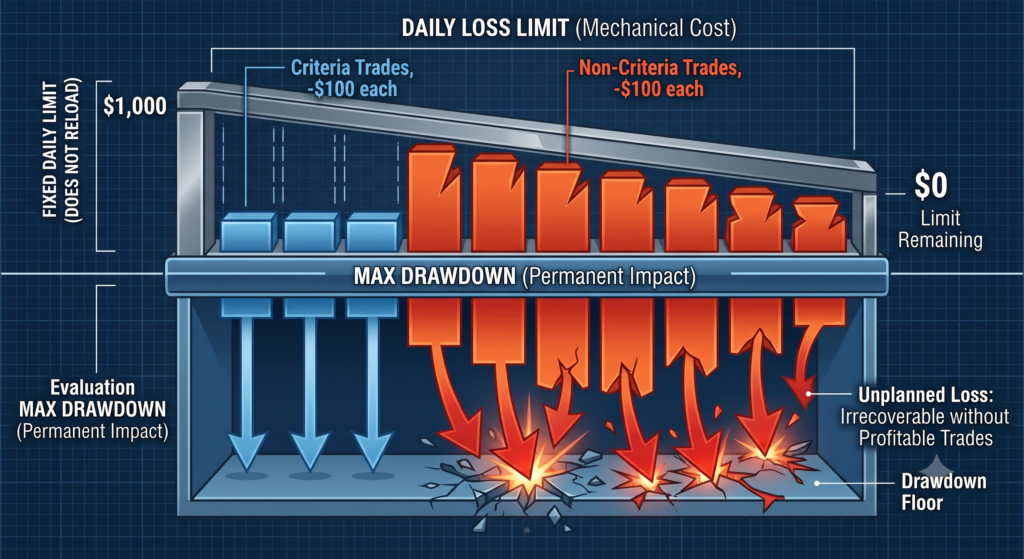
Every trade, whether it meets criteria or not, carries risk against the daily loss limit. The daily loss limit threshold is a fixed dollar amount. It does not reload within the trading day. A carefully planned entry and a boring trade count equally against it.
On a $25,000 account with a 4% daily loss limit, the hard threshold for the day is $1,000. A trader risking $100 per trade has ten losing trades before the trading day ends. If three of those ten were genuine criteria trades and seven were not, seven trades consumed $700 of the daily loss limit without a written reason behind them.
700 dollars of the daily loss limit is used for unplanned trades. That is not a personality flaw. That is a mechanical cost.
It affects more than the trading day. Every losing trade on a non-criteria entry also consumes maximum drawdown room. That room cannot be recovered without profitable trades. A non-criteria losing trade reduces both the daily loss limit remaining and the maximum drawdown room. Both take a profitable trade to recover.
In programs with a consistency rule, overtrading compounds the problem further. Non-criteria losses reduce the total profit figure. On a funded account where total profit is still positive but smaller than those losses, a strong day becomes a larger percentage of the total. The consistency rule threshold is easier to reach when previous trading days have been reduced by non-criteria losses.
What the Funded Structure Rewards
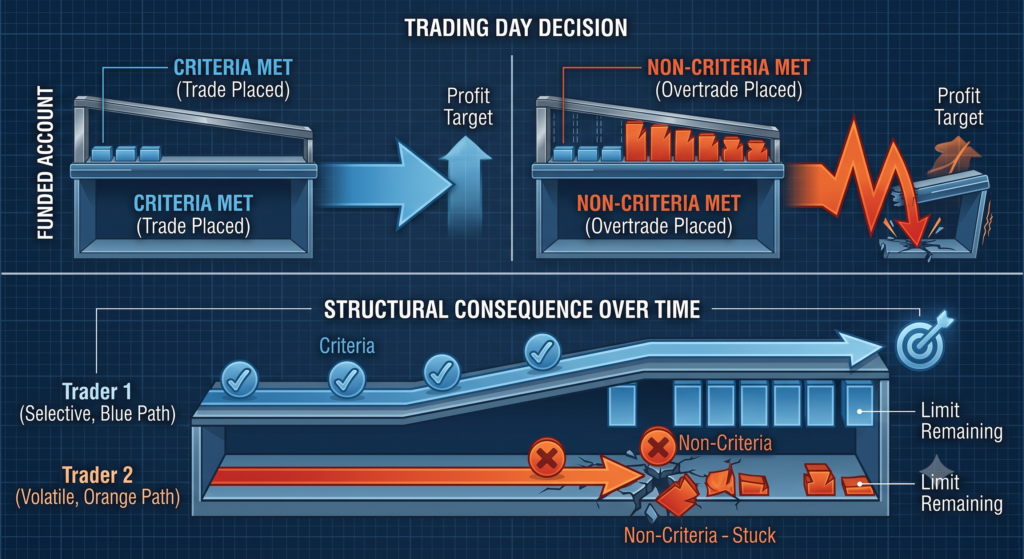
The funded structure does not reward frequency. It rewards selectivity.
On any trading day when the entry criteria are not met and no trade is placed, the daily loss limit is fully preserved. The drawdown floor does not move. The evaluation progress does not change. The next trading day starts in the same room as the one before.
On every trading day when a non-criteria trade is placed and loses, the reverse is true. The daily loss limit has been partially consumed. The drawdown floor has moved closer. The profit target is slightly further away.
The funded structure calculates outcomes against rules. The daily loss limit does not distinguish between a criteria trade and a non-criteria trade. A losing non-criteria trade reduces the daily loss limit by exactly as much as a losing criteria trade. But one has a written reason behind it, and one does not.
Over many trading days, the trader who only places criteria trades preserves more of the daily loss limit, more drawdown room, and a more direct path to the profit target than the trader who places criteria trades plus non-criteria trades.
The Zero-Trade Day
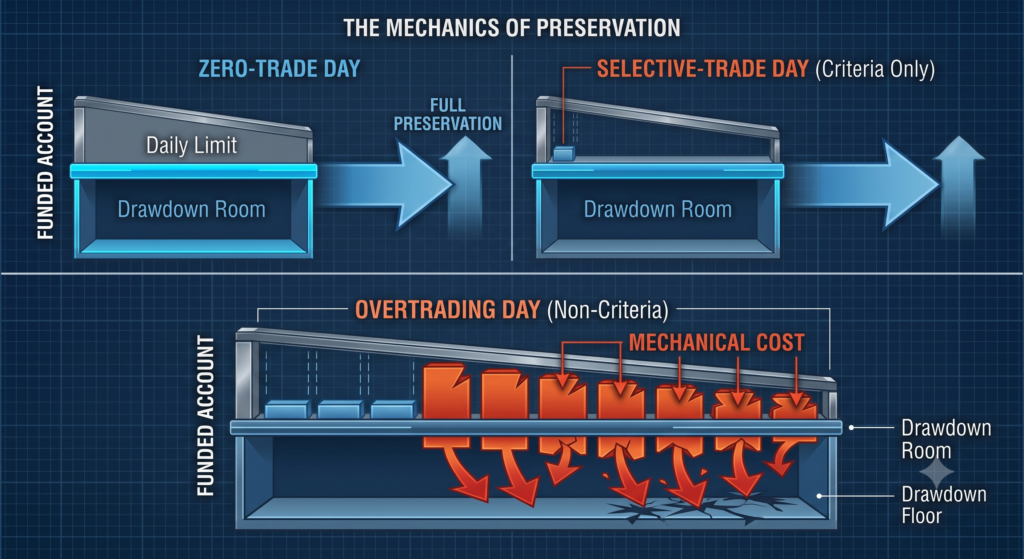
A day with zero trades on a funded account costs nothing.
The daily loss limit is fully preserved. The drawdown floor does not move. The profit target distance is unchanged. The evaluation is in exactly the same position as the day before.
Zero is not a failed trading day. Zero is a trading day where the entry criteria were not met, and the trader chose not to place a trade.
This is the most useful mechanical truth of the funded structure. A day without a single trade is often a better outcome than a day with twelve trades, only two of which meet the criteria. The twelve-trade day has ten opportunities to consume the daily loss limit without a written reason. The zero-trade day has none.
Most traders do not find this intuitive. But on a funded account with a daily loss limit, a zero-trade day and a criteria-only day are the two best outcomes available. Both preserve the full daily loss limit. Both preserve the drawdown room. Both preserve the path to the target.
How to Define Entry Criteria Before the Session
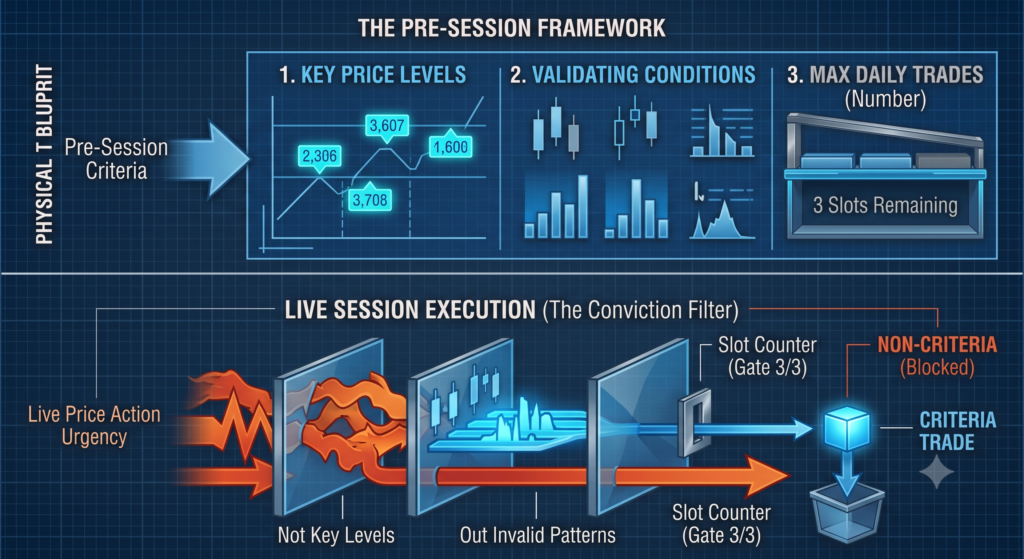
Entry criteria are written before the trading day. Not during it.
During the trading day, the price is moving. There is urgency. A setup that is close to the criteria written before the trading day can appear to meet them. The moment of checking whether something meets the criteria is not the right moment to define them.
Before the trading day begins, nothing is open. No position is at risk. No price is moving on the screen. This is when the criteria are clear.
Three things belong in the pre-trading-day criteria:
What price levels matter today? Specific levels where the trade reason exists. Not “I will trade if it looks bullish.” The specific price at which the structure, level, or signal that defines the entry will be present. This is a number, not a feeling.
What conditions must be present at that level? The specific signal is required alongside the price level. This might be a candle pattern, a volume event, or a moving average position. Whatever the entry reason is, it must be defined in advance. A price level alone is not criteria. The criteria are the combination of the level and the condition that validates it.
The maximum number of trades for the trading day. A number. Not a principle. How many trades, at most, will be placed today? Three. Five. One. This number prevents a situation in which criteria are defined, but the trading day still produces 12 trades because “each one looked different.”
If a trade appears during the trading day and meets all three (correct price level, condition present, maximum not yet reached), it is a criteria trade.
If any one of the three is absent, it is not.
This is the full definition of conviction in funded trading. Not a feeling. A trade that meets all three criteria written before the trading day began. For more on what the pre-session preparation framework looks like in practice, see The Psychology of Pre-Session Preparation in Trading.
Big Moments Reveal Everything
The trading day that tests a funded trader is not the quiet one. It is the day price is moving, the account is flat, and a setup appears that almost looks like the one defined before the trading day.
That is the moment. Not “does this feel right.” The question is simpler and more mechanical. Does this setup meet the criteria written before the trading day?
If yes: take it. That is conviction by the only definition that matters here. If no: do not take it. That is the full answer to overtrading.
Big moments reveal whether the criteria were written clearly enough, held to precisely enough, and whether the zero-trade outcome was accepted as genuinely neutral. Not a failure. Not a missed opportunity. A preserved daily loss limit and a preserved path to the target.
Explore FXIFY’s programs to see the structure within which your entry criteria will operate.
FAQs
What is the difference between conviction and overtrading in a funded account?
Conviction is placing a trade that meets all three criteria written before the trading day: the correct price level, the required condition at that level, and within the maximum trade count for the day. Overtrading is placing a trade when any one of those three criteria is absent. The distinction is not about how many trades are placed. It is about whether each trade had written criteria behind it before the trading day began.
Is a zero-trade day acceptable on an FXIFY evaluation?
Yes. A zero-trade day on any FXIFY evaluation preserves the full daily loss limit, does not move the drawdown floor, and leaves the evaluation in exactly the same position as the day before. There is no rule across FXIFY’s standard programs that requires a minimum number of trades per day. The minimum trading days requirement means the evaluation cannot be completed in fewer days than the program specifies, but there is no obligation to trade on every day.
Does FXIFY limit the number of trades I can place in a trading day?
No FXIFY standard program caps the number of trades per trading day. The daily loss limit is the practical ceiling. Once the level is reached, the trading day ends. How quickly the daily loss limit is consumed depends on position sizing and the number of trades placed. Setting a personal maximum trade count in pre-trading-day criteria is a trader’s choice, not an FXIFY rule.
How does overtrading affect the consistency rule on Two Phase Classic?
Two Phase Classic carries a 25% consistency rule on the funded account. The rule means the single highest daily profit cannot exceed 25% of the total profit. Non-criteria losses across trading days reduce the total profit figure. On a funded account where total profit is smaller than those losses, a strong day is a larger percentage of the reduced total. A trader who has had several days of non-criteria losses may find that a strong winning day triggers a recalculation, even at modest profit levels. Fewer non-criteria losses keep the total profit figure higher and the consistency threshold further away.
How is the entry criteria different from a trading strategy?
A trading strategy describes how a trader approaches the market overall. Entry criteria are the specific written conditions for a specific trading day. Before each trading day, the trader identifies which price levels are relevant today, what signal is required at those levels, and how many trades will be placed at most. The criteria change from trading day to trading day based on what the market has set up. The strategy behind them may stay consistent. Entry criteria are the trading-day-specific application of that strategy written down before the day begins.