





Why Drawdown Rules Matter When Choosing a Prop Firm
I was up on the day. Comfortably up, the kind of up where you start doing the math on the payout in your head. Two…

I was up on the day. Comfortably up, the kind of up where you start doing the math on the payout in your head. Two losing trades later, nothing wild, just an ordinary bad hour, and the dashboard flagged a breach I never saw coming.
I sat there rereading the rules page as it had betrayed me. It hadn’t. I’d skimmed it once when I opened the account and never looked at it again. The floor was never where I thought it was. I just never checked.
That’s not bad luck. That’s not knowing what you were actually being measured against until the day it mattered.
Here’s what actually reading it looks like.
Key terms
| Term | What it means |
| Drawdown | The drop from an account’s highest point to its current point. |
| Max drawdown | The overall loss limit for the life of the account. Static or trailing, depending on the program. |
| Daily loss limit | The maximum loss allowed in a single trading day. Calculated from the previous day’s closing balance at 5 PM EST. |
| Static drawdown | A drawdown floor fixed at the starting balance. Never moves. |
| Trailing drawdown | A drawdown floor that follows the account’s highest closed trading balance upward. Open positions don’t move it until they’re closed. |
| Lock | The point where a trailing floor permanently stops moving and behaves like static, once profit reaches the account’s drawdown percentage or a payout is processed. |
First: what “drawdown” actually means
Every prop firm enforces a maximum drawdown. Cross it, and the account is over, regardless of how much profit you’d made getting there.
Simple so far. What actually decides whether you survive a normal losing week is three things every firm defines differently:
- What it’s measured from. Starting balance? Your highest-ever balance? Live equity, including trades still open?
- When it’s checked. In real time, tick by tick? Or only at the end of day?
- Whether it ever stops moving. Some structures trail forever. Others trail up to a point, then lock permanently, which changes your risk picture depending on which side of that lock you’re on.
If you can’t answer all three for the firm you’re evaluating with, you don’t actually know your risk. You’re guessing.
The three drawdown structures, defined properly
Static drawdown
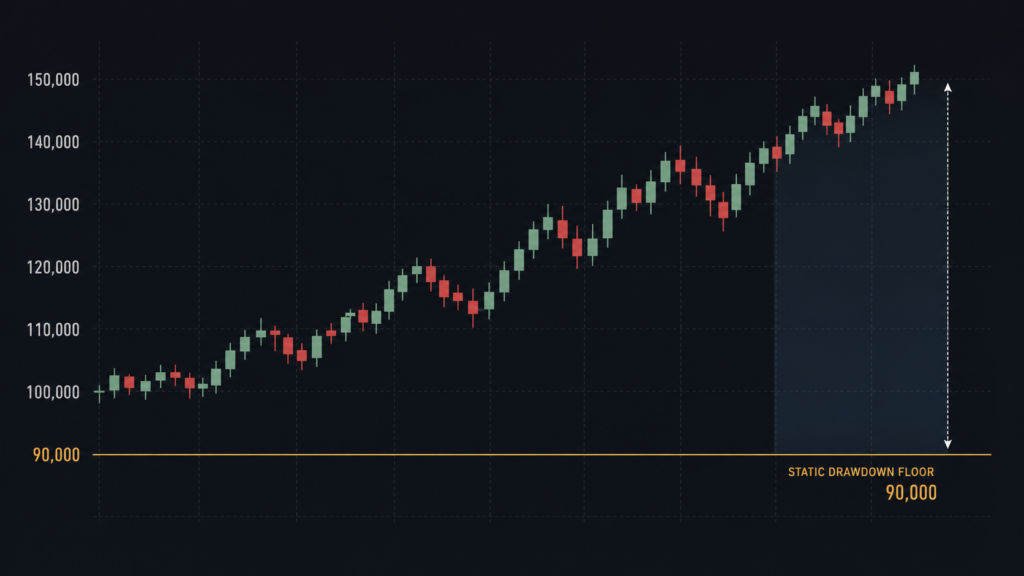
The floor is set once, from your starting balance, and it never moves. On a $100,000 account with a 10% static max drawdown, the floor sits at $90,000, whether your balance is $95,000 or $150,000. As you bank profit, the distance between your equity and that floor grows, which means your real cushion against a bad week gets bigger the more you make.
Trailing drawdown.
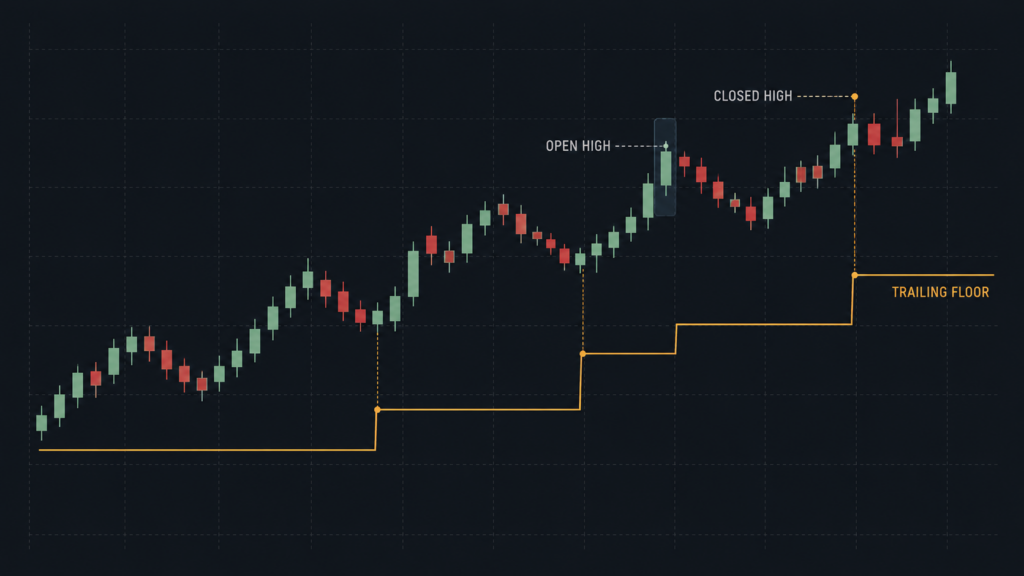
The floor follows your highest-ever closed trading balance upward, not live equity. An open position running in your favor doesn’t raise the floor until you actually close it. Every new closed high drags the floor up with it. This means a winning trade doesn’t tighten your cushion the moment it’s open, only once it’s booked and becomes the new high.
Trailing-until-locked.
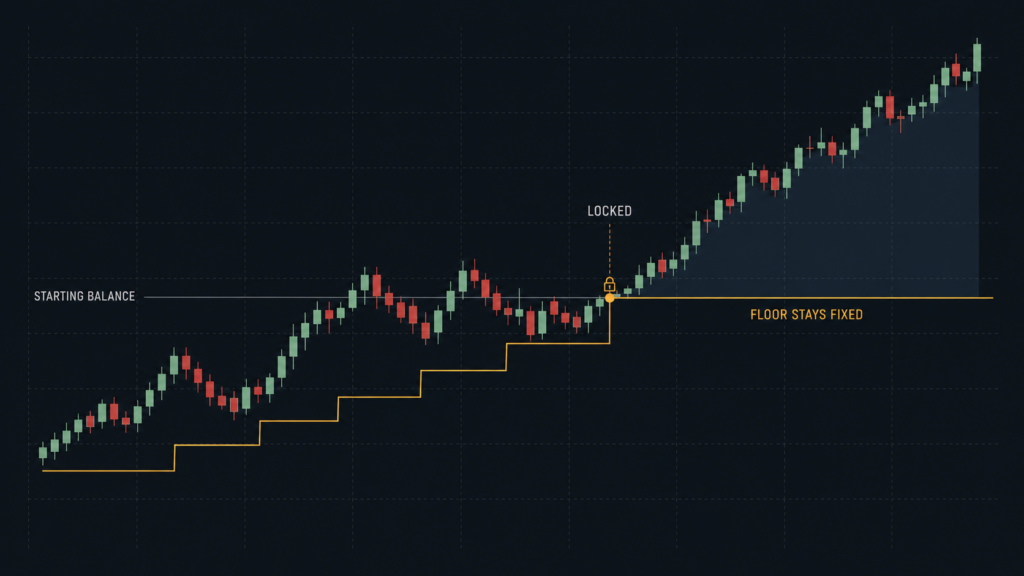
This is the structure behind FXIFY’s trailing accounts, not every FXIFY account. The floor trails your highest closed balance until your profit reaches the account’s drawdown percentage, at which point the floor stops moving permanently and locks at your starting balance. It also locks the moment a payout is processed. From that point on, no matter how high the account climbs, your only max-drawdown risk is falling all the way back to where you started.
Here’s what matters when you’re picking an FXIFY program: drawdown types aren’t the same across the board. One Phase, Two Phase Standard, and Lightning run trailing drawdown. Two Phase Classic, Two Phase Pro, and Three Phase Challenge use static drawdown. Two accounts on the same firm, same broker, same platform, can have completely different drawdown behavior depending on which program you bought, which is exactly the kind of detail that gets skipped when someone assumes “FXIFY’s drawdown” is one fixed thing. “Choosing a prop firm” isn’t just picking a company. It’s picking a specific rule set, and at most firms, including this one, that rule set changes program to program, not just firm to firm.
| Program | Drawdown type | Daily limit | Max drawdown |
| One Phase | Trailing | 3% | 6% |
| Two Phase Standard | Trailing | 4% | 10% |
| Two Phase Classic | Static | 4% | 10% |
| Two Phase Pro | Static | 4% | 8% |
| Three Phase Challenge | Static | 5% | 5% |
| Instant funding | Trailing | 8% | 8% |
| Lightning | Trailing | 3% | 4% |
Two more mechanics that matter before you size a trade: the daily loss limit resets off the previous day’s 5 PM EST closing balance, and either rule breaches on real-time equity crossing the line, not on where the trade eventually settles. A price spike that dips below the level and recovers in the same second still counts.
Inside a single program family, the drawdown mechanic can change entirely depending on which named variant you pick. Two Phase Classic, Two Phase Standard, and Two Phase Pro all sit under “Two Phase” at checkout, and each carries a different drawdown setup: 10% static, 10% trailing, and 8% static, respectively. Same family name, three different rule sets. That’s one more reason “what’s FXIFY’s drawdown” is the wrong question. The right one is “what’s this specific variant’s drawdown,” checked against the exact one you selected, not the family name it sits under.
The numbers, worked through
Take a $100,000 Two Phase Standard account: trailing drawdown, 4% daily limit, 10% max drawdown. All three trades below are closed positions, since that’s what actually moves the trailing floor.
Trade one: closed up $2,000; balance now $102,000. The max-drawdown floor trails up with it.
Day two: a rough day, down $3,000, balance now $99,000. The max-drawdown floor doesn’t move on this, because it only trails balance highs, not lows. Separately, the daily loss limit doesn’t trip either. That day’s limit was $4,080 (4% of the $102,000 prior close), and a $3,000 loss stays under it.
Day three: another push, this time up to $110,000, a 10% gain from the starting balance. At that point, per FXIFY’s rule, profits have reached the drawdown percentage, and the max-drawdown floor locks permanently at $100,000. From here, the account could run to $150,000, and the only way to breach max drawdown is a full retracement back to the original $100,000. The daily loss limit still applies every day, but the “moving floor” problem is gone for good.
Now put the same trader on a Two Phase Classic account instead: static, not trailing, same $100,000 size, same 10% max drawdown. The floor sits at $90,000 from day one and never moves, whether the balance is $95,000 or $150,000. No lock event needed, because there was never anything trailing to begin with.
Same trader, same trades, two different risk pictures. The difference isn’t FXIFY versus some other firm. It’s one FXIFY program versus another.
Why this should shape which program you pick, not just how you trade
Profit targets get all the attention because they’re the number on the homepage. Drawdown structure is the number that decides whether you’re still in the game long enough to hit that target.
- If you hold trades overnight or swing over several days, neither static nor trailing max drawdown punishes you directly for that, since both only ever react to closed balance, never an open position. What you actually need to watch while a trade’s still open is the daily loss limit, which is checked against real-time equity regardless of which program you’re on. That’s the number that can catch you overnight. Max drawdown won’t.
- If you tend to have a strong edge but occasional rough weeks, the static programs (Two Phase Classic, Two Phase Pro, Three Phase Challenge) protect banked profit from day one. The floor never moves regardless of how the account performs, so a bad week never costs you room you’d already earned.
- If your risk per trade is already small and tightly controlled, trailing costs you less either way, because your highest-closed-balance moments and your worst-case moments are both closer to your last balance. The floor has less distance to move.
None of this is about which program is “better.” It’s about which drawdown mechanic matches how you actually trade, and the table above is what that decision should actually be made against, not a guess about what “FXIFY’s drawdown” does in general.
Before you buy your next evaluation
Ask the rules page four questions, in this order:
- Is the max drawdown static or trailing?
- If trailing, does it lock at some point, and at what threshold?
- Is it measured on closed balance or live equity, including open trades?
- When exactly is it checked: in real time, or only at a daily reset?
If you can’t find a straight answer to all four before you pay for a challenge, that’s information too.
Bottom line: drawdown isn’t a footnote next to the profit target. It’s the rule that decides whether you’re still in the account long enough to reach it. Know exactly which structure you’re trading against before you risk a single dollar on it.
Explore FXIFY’s evaluation programs to find the drawdown structure that actually fits how you trade.