


Bobby’s Effective Leverage Formula: Written Down
FXIFY co-founder Bobby joined a panel Q&A at Online Trading Expo 2026. The session covered trading strategies, risk management, and the business dynamics of prop…
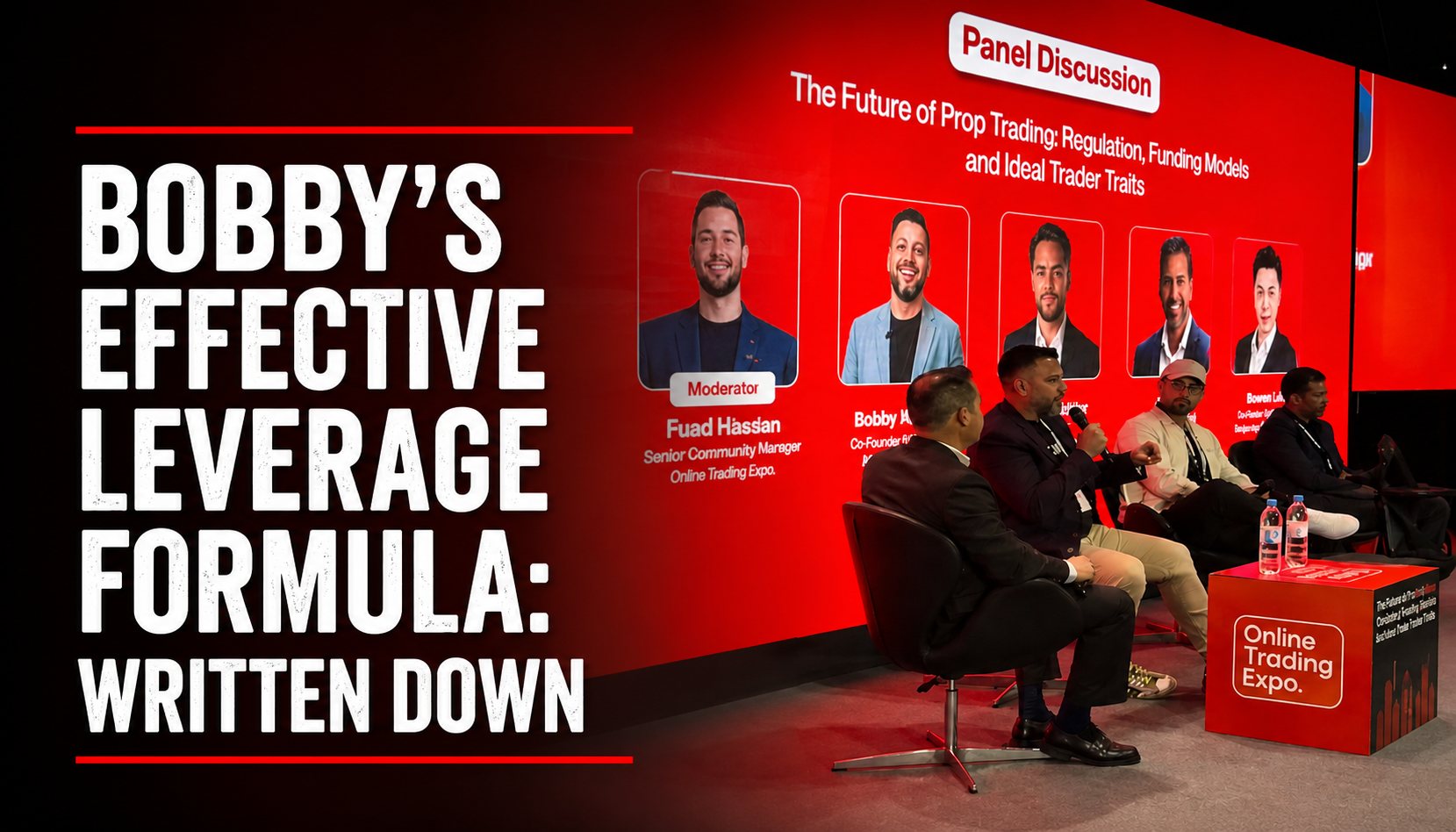
FXIFY co-founder Bobby joined a panel Q&A at Online Trading Expo 2026. The session covered trading strategies, risk management, and the business dynamics of prop firms. Three questions came from the floor.
One of the answers introduced a concept that Bobby says drives most prop trading mistakes. In his words, nobody in the industry talks about it.
Here it is written down.
The Formula
Effective leverage = total position value ÷ account balance
Two numbers. One calculation. This is the number that actually determines your risk. Not the leverage your broker advertises.
Bobby’s Example From the Panel
Account size: $10,000
Position: 2 mini lots of EURUSD
Position value: $20,000 (used as the illustration figure)
$20,000 ÷ $10,000 = 2:1 effective leverage
A 1% move in EURUSD will move your account by 2%.
That is the number that matters. Not the 100:1 or 200:1 your broker advertises. That is the position you chose to carry.
The broker’s leverage sets the ceiling. The trader’s position size sets the actual risk. Every time.
Why This Is the Number That Gets Traders
Many traders think about leverage the way a broker markets it. A firm offers 100:1. That sounds like a room. It sounds like an opportunity. What it actually means is that you can take positions far larger than your balance. And many traders do so without realizing how exposed they are.
The effective leverage calculation removes the marketing from the equation.
If your account is $10,000 and your position value is $50,000, your effective leverage is 5:1. A 1% move against you costs 5% of your account. In an evaluation program with a 5% daily loss limit, that is the entire day gone in a single ordinary market move.
Bobby’s example from the panel was gold. In his words, XAUUSD has been moving 1% almost every day in the current market. Not as a tail-risk event, but as a normal Tuesday. A trader running 5:1 effective leverage on gold is one standard trading day away from ending their evaluation. Not because the market did something unusual. Because the position size was too large for the account.
This is what Bobby said drives him to talk about this:
“Nobody ever talks about this. I don’t care how much leverage a brokerage gives you. It is the position size that you’re taking compared to your balance.”
How to Run the Check Before Every Trade
Before every entry, answer one question: What is my effective leverage on this position?
Step 1. Calculate your total position value.
Forex (standard lot): 100,000 × current price. For a mini lot (0.1 lot), divide by 10.
Gold (standard lot): 100 troy oz × current gold price. For a micro lot (0.01 lot), that is 1 troy oz × current price.
Step 2. Divide by your current account balance.
Step 3. Your effective leverage ratio tells you directly. 2:1 means a 1% market move costs 2% of your account. 5:1 means 5% per 1% move.
Step 4. Compare that number to your daily loss limit. If a 1% move would consume most or all of your daily limit, the position is too large.
Thirty seconds. Before every trade.
What Else Bobby Covered on the Panel
The Q&A went beyond effective leverage. Two other questions came up.
On whether prop firms fund their best traders beyond the standard programs.
Someone asked why prop firms do not simply give more capital to consistently profitable traders. Bobby’s answer: They do, but it does not happen publicly. FXIFY identifies traders who demonstrate strong risk management and longevity across their funded accounts. Where appropriate, the firm introduces them to hedge funds and funds of funds that are actively looking for specific strategies and approaches.
There is no policy on the website. It happens through relationships on the brokerage side. The trader’s data speaks first. If the institutional partner is interested, the introduction follows.
On how traders actually behave over time.
Someone asked how many traders buy once and leave versus those who return. Bobby’s answer: The typical lifetime value of a prop trader is three to five challenges. Some move between firms, chasing discount codes when a deal arrives elsewhere. The pattern is similar to that of the broader retail FX and CFD market, where client redeposit rates typically fall between 1 and 5, depending on retention.
The point behind both answers is the same: the traders who build something in this space are the ones who approach it with the right framework. The ones who apply the effective leverage calculation before every trade. The ones whose data tells a story worth sharing with an institutional partner.
Why FXIFY Is Built This Way
Bobby said it clearly on the panel. FXIFY deliberately offers lower maximum leverage than most prop firms. He knows that is not the headline traders want to see. Many traders look at headline leverage first and move on if the number is not big enough.
That is a feature, not a problem.
FXIFY is not trying to attract traders who need 500:1 to make their strategy work. The firm is built for traders who understand that effective leverage, the ratio between what they put on and what they have, is the leverage number that actually matters. Lower maximum leverage encourages that thinking. It reduces the ceiling on recklessness before the trader gets a chance to test it.
And for the traders who do get it right, who trade consistently, who manage their effective leverage correctly across multiple funded accounts, who build a track record that holds up, FXIFY’s position as a broker-backed firm with institutional relationships means there is a real next step available. Not just another evaluation. Something beyond it.
That is the intention behind how we build this firm. Not to process challenges at scale. To find the traders worth finding and give them something real to work toward.
Explore FXIFY’s programs and see where the framework takes you.