



Trading Burnout Recovery: Signs, Causes, and What to Do
It is Thursday afternoon. The setup you have traded a hundred times prints on the chart. You look at it. You do not click. The…
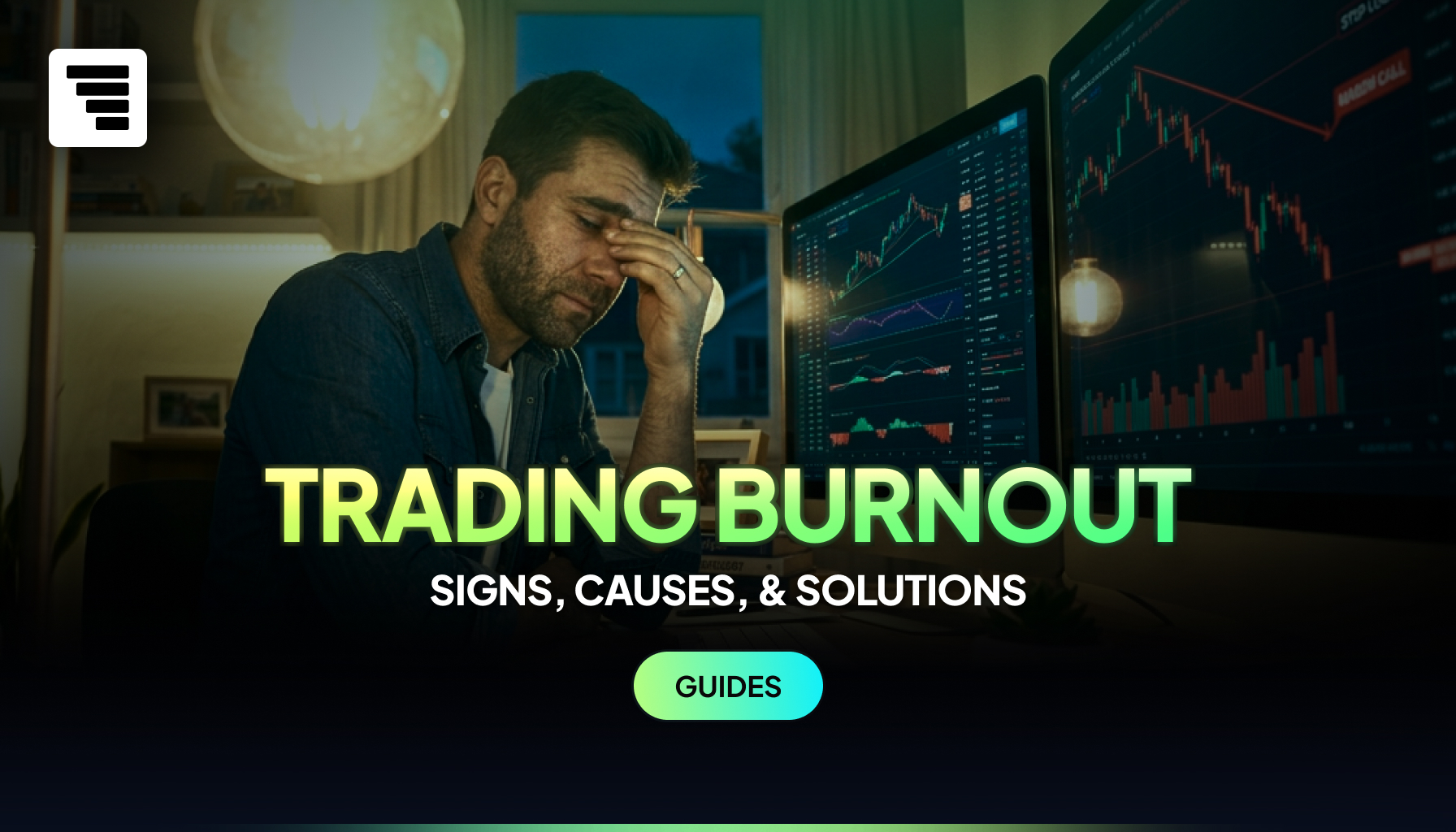
It is Thursday afternoon. The setup you have traded a hundred times prints on the chart. You look at it. You do not click. The candle closes, and the move runs without you.
You were not confused about the trade. You just could not do it.
Trading burnout recovery starts with one check, because the same week can have three different causes, and each one needs something different.
How to Tell Burnout From a Bad Week
Ask yourself whether you still believe in your plan.
If you believe it and you are running it, and the money is still going the wrong way, you are having a bad week. Bad weeks pass on their own. Nothing below will help, and changing your rules now will cost you.
If you have stopped believing it, that is a different problem. It usually follows a run of losses, or a rule you broke that happened to win. Written rules bring you back. Start with Risk Management Rules That Outlive Motivation.
If you still believe your plan and cannot bring yourself to run it, keep reading. That is the one this article is about.
Key Terms
| Term | What it means |
| Entry criteria | The conditions you write down before the trading day. A trade either meets them or it does not |
| Execution score | One word per trade. Did the entry meet your written criteria, yes or no. It ignores the money |
| Decision load | The number of choices a trading day asks of you. Pairs, timeframes, setups, and screen hours all add to it. Most of those choices never become trades |
| Daily loss limit | The most you can lose in one trading day. Calculated from the previous day’s closing balance at 5 PM EST. A breach triggers when live equity falls below the breach level |
| Loss allowance and breach level | Two different numbers. On a $100,000 account with a 3% daily loss limit, the loss allowance is $3,000, and the breach level is $97,000 |
| Drawdown floor | The level at which the account breaches. A static floor sits at your starting balance for the life of the account. A trailing floor rises as the account grows. The trail is a fixed percentage, so the dollar distance grows with the balance. It updates at server reset, based on the highest balance reached that trading day, whether trades are open or closed |
Trading Burnout Recovery, Step by Step
Trading more will not fix this. That is the first thing to accept, because it is the opposite of what most traders do.
Step 1: Stop Trading and Set a Return Date
Two to five trading days. Choose the return date now, before you close the platform.
The end date is what stops a break from turning into avoidance. Close the platform properly. Not to a background tab you check between other things.
This is the step most traders skip, and the rest don’t work without it.
Step 2: Backtest for 30 Minutes Each Day During the Break
This will seem to contradict the step above. It does not. Stopping trading does not mean zero chart time.
Open a backtesting tool each day. TradingView’s replay function works, or any historical data source you have. Pick a recent week you did not trade. Scroll forward bar by bar. Mark every instance where your written entry criteria appear. Do not place any real positions. No money moves. No results get recorded.
Thirty minutes. That is all.
Here is why this works when live trading does not: what empties you out during burnout is not reading charts. It is reading charts while managing positions, live results, and the pressure of an open account. Backtesting removes all three. You are using the analytical part of your mind without loading the emotional part. You are staying in contact with your setup pattern without any of the weight that comes with live execution.
After two to five days of this, you will notice something. You start to remember why you built the rules. You start seeing the setup as a pattern, not a decision. The reconnection is quiet, and it is real.
When you return to live trading, carry this forward. Thirty minutes of backtesting before your first chart of the day, every trading day. It becomes a warm-up: the same way a musician runs scales before performing, or an athlete warms up before a game. You arrive at the live session with your eye already calibrated and your decision load already started in a controlled environment. No other burnout article will tell you this. It comes from trading experience, not from theory.
Step 3: Find What Is Draining You
Write down what wore you out. Not the trades. The hours, the sleep, the size of the account, the money, the run of results, whatever is happening away from the charts.
Most of the time it is not one thing on the chart. It is the weight of everything at once.
If the cause is outside trading, no trading rule reaches it. Better to know that now than after another month.
Step 4: Come Back Small
One pair. One setup. One time window. The smallest position size you use.
Cut the number of decisions, not just the risk. A trading day with six pairs and four timeframes is hundreds of small choices, and almost none of them become trades. That is the part that empties you out.
Small size does something else. When a loss costs little, the urge to win it back right away is weaker.
Step 5: Set a Stop Time for the Charts
Pick the hour and hold it, whether you are up or down.
You do not recover while the platform is open. A trading day with an end is one you can repeat. A trading day that runs until you fall asleep is not.
Before you open, write down three numbers: your daily loss limit for the trading day, the gap between your balance and your drawdown floor, and what is on the economic calendar. Those three set the edges of the trading day before the first chart appears. More on this in The Psychology of Pre-Session Preparation in Trading.
Step 6: Score Your Rules, Not Your Money
One word per trade. Did it meet your written conditions, yes or no?
Judge the week on that alone. Money will do what it does, and during a bad stretch it tells you almost nothing about how you are trading.
Some trading days the conditions will not appear, and you will take nothing. That is a correct outcome, and it costs nothing. See How Funded Traders Build Conviction Without Overtrading.
When most of your answers are yes for two weeks, add things back. One pair, or one setup, or size. One at a time.
Signs of Trading Burnout
Looking back, it rarely arrives in one week. It builds.
You take entries that miss a condition by a little. At first you notice. Later you do not, and you only find them when you go back through the log.
You move a stop after the trade is open, not because the first one was wrong, but to put off the loss. The first time it bothers you. After a few weeks, it stops bothering you.
You watch valid setups go by. Not weak ones. Skipping a weak setup leaves you fine. This is the trade you called correctly, running without you, while you sit there wondering why you have rules at all.
Your worst entries land on Thursday and Friday, week after week. Your capacity is running out before the week does.
None of these mean much on their own. Together, and worsening over several weeks, they are worth taking seriously.
What Causes Trading Burnout Away From the Charts
Some traders rest, cut size, follow the plan, and feel exactly the same. If that is you, the load is coming from somewhere your routine does not reach. Four places to look.
- The Money
If the capital in play is money you actually need, that pressure sits behind every click. No written rule removes it. Trading an amount you can afford to lose changes more than any process fix.
- The Fit
Count the hours your approach needs. Compare that with the hours you really have. If the gap is wide, the approach is the problem, not you. A slower method on a higher timeframe asks less of you each week.
- The Break Was Too Short
Days are not always enough. Some traders need weeks. The market will still be there.
- Overtrading.
Decision load is cumulative. A trading day with six pairs, four timeframes, and twelve potential setups does not feel like overtrading while it is happening. But each choice, even the ones you decline, uses the same cognitive resource as the ones you take. A trader placing twenty trades a week carries more daily load than one placing five, even if both accounts are moving by the same dollar amount. If your approach is structured but your volume is high, the exhaustion may not be about losses. It may be about the sheer number of decisions the day asks of you. Reduce the pairs and the timeframes before you reduce the plan.
- Life Outside Trading
If it has reached your sleep, your mood, and parts of your life that have nothing to do with charts, it is bigger than a trading problem. Talk to someone you trust, or to a professional. No article about entry rules will reach that.
There is one more answer, and it is the one nobody wants to read. Some people find that trading, or trading at this size, or trading at this pace, does not suit them. That is a real finding, not a failure.
Five Things That Are Not Burnout
- Feeling Nothing After a Win or a Loss
That is usually experience. Results have become information, which is where steady traders end up. Check whether you are still engaged, not whether you are still excited. Calmly reviewing your trades is fine. Flat and no longer opening your review is a different matter.
- Doubting Your Plan After a Losing Run
Losses make every entry feel uncertain. You hesitate, then you start ignoring conditions, and results get worse. Your belief took the damage. The plan is fine.
- Dropping Your Plan After a Rule Break Paid
You skipped a condition: the trade won, and now the rules look like wasted effort. That is one lucky outcome, teaching you the wrong lesson.
- Trading Less During a Low-Opportunity Market
When the market is ranging, slow, or not producing your setup, taking fewer trades is the plan working. It can feel like burnout: sitting at the charts, nothing printing, watching other instruments move. But if your entry criteria are not appearing, not trading is correct. The question to ask is whether your setup has genuinely stopped printing or whether you have stopped looking for it. Check a recent session in replay. If the setup is printing and you are not taking it, that is burnout. If it genuinely is not printing, that is selectivity.
- Sizing Down After a Drawdown
Choosing to trade smaller after the account takes losses is a risk management decision, not burnout. Burnout is when you are unable to execute a trade you want to take. Sizing down deliberately is control, not avoidance. The distinction is whether the smaller size is a choice or the only position you can bring yourself to place.
Bottom Line
Ask one question. Do you still believe your plan?
Believing it, running it, and losing anyway is a bad week. Not believing it is bad trading. Believing it and being unable to run it is burnout.
For that last one, stop for a few days with a date to come back. Find what is draining you. Return on one pair, one setup, smallest size. Set the hour the charts go off. Score whether you followed your rules.
If none of that moves it, the cause is probably not on the chart.
Explore FXIFY’s programs and start your next evaluation with the right structure in place.
Trading Burnout FAQs
How do I know if it is burnout or just a bad week?
Ask whether you still believe your plan. In a bad week, you believe it, you run it, and the market does not pay. That passes. In burnout, you still believe it but cannot bring yourself to execute it. Burnout also builds over weeks and carries across a weekend. A bad week does not.
Do I need to stop trading to recover?
Take a short break, and set the return date before you close the platform. Two to five trading days is enough for most traders. Trading through it usually makes it worse. When you come back, reduce your exposure before you reduce what you expect from yourself.
Is it burnout if I stopped following my plan?
Usually not. Dropping a plan after a losing run is damaged belief. Dropping it after a rule-break win is one lucky outcome that teaches the wrong lesson. Both are bad trading, and both are corrected by returning to written entry rules. In burnout, the belief in the plan remains.
Is feeling nothing after a win or a loss a sign of burnout?
Usually the opposite. Flat reactions are common once results become information rather than events. The thing to watch is engagement. Calm and still reviewing your trades are good signs. Flat and no longer reviewing anything is worth attention.
What if I have rested, cut my size, and still feel the same?
Then look outside the routine. Check whether the money in play is money you need. Check whether your method demands more hours than you have. Check whether the break was long enough. If it has affected your sleep and mood outside the charts, speak to someone you trust or a professional.