

What Happens After You Pass Your Prop Firm Evaluation
Passing the evaluation is the qualification step. It is not the end goal. Meeting the profit target and staying within the drawdown rules proves you…
Passing the evaluation is the qualification step. It is not the end goal.
Meeting the profit target and staying within the drawdown rules proves you can perform under specific conditions once. The funded account proves you can do it consistently over time. The two are different things, and most traders who lose funded accounts discover that difference too late.
Here is what actually changes when you pass.
How the Funded Account Is Issued
After completing the evaluation, the prop firm reviews your account activity and verifies that all program rules were followed.
Once approved, you receive access to a funded account with capital under the firm’s defined trading framework. At FXIFY, funded accounts operate in conditions that mirror live markets. Account credentials are issued via email or through your trader dashboard. Most funded accounts are activated within a few business days of evaluation completion.
The core rules from the evaluation carry forward into the funded account. A breach of a funded account permanently closes it. There is no recovery period.
What Changes When You Become Funded
The goal changes.
During the evaluation, the goal is to reach a target. On the funded account, the goal shifts to protecting a floor and generating consistent returns over time.
This changes how position sizing should work. An evaluation trader who hits the target quickly and moves on is finished with that account. A funded trader who takes an outsized loss early in the cycle faces a much harder path to the first payout.
The funded account rewards consistency. It does not reward speed.
Performance Split and Payouts
A performance split is the percentage of trading gains that the trader receives. The remaining percentage stays with the firm. At FXIFY, the performance split is clearly stated before the evaluation begins.
Payout eligibility
Profit alone does not qualify a trader for a payout. Most programs require:
- A minimum number of trading days have been completed
- A minimum profit threshold reached
- Full compliance with all account rules throughout the period
Every requirement must be met before a payout request can be submitted.
First payout vs ongoing payout cycles
The first payout often has its own set of eligibility requirements before a request can be submitted. Many programs also offer First Payout On Demand, allowing eligible traders to request their first payout as soon as the required conditions have been met, rather than waiting for the standard payout schedule.
Once your first payout has been completed, you’ll typically move to the program’s regular payout cycle, such as bi-weekly or monthly, depending on the firm’s rules.
Racing to hit a profit target as quickly as possible often means missing the minimum trading-day requirements. The result is a target hit on paper but not paid out until the day count is also met.
Drawdown and Risk Rules After Funding
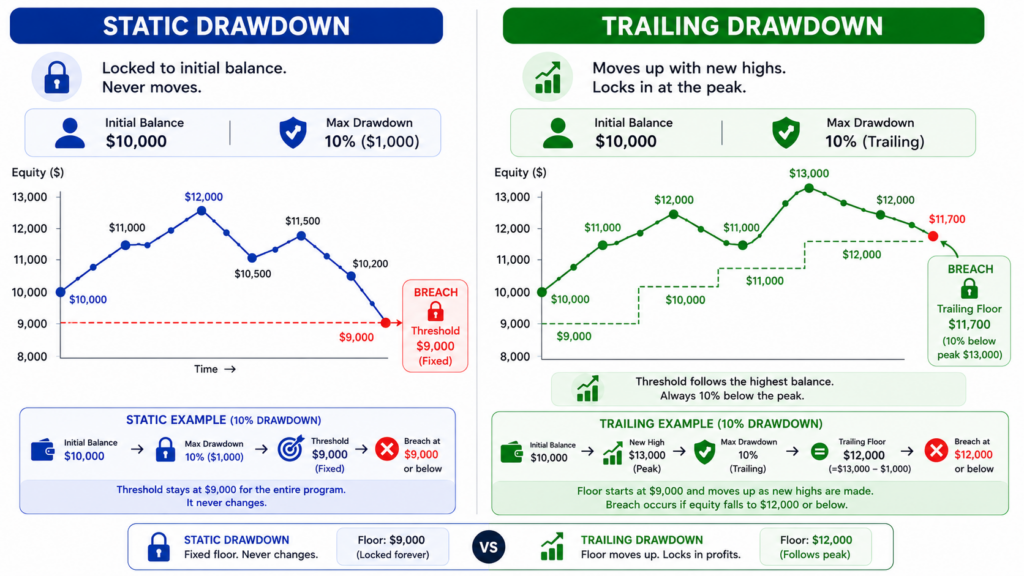
A breach permanently closes the account.
FXIFY programs use two drawdown structures: static and trailing. Knowing which structure applies to your account before placing the first funded trade is not optional.
Static Drawdown
Static drawdown is fixed to the starting balance for the lifetime of the account. It does not move as the account grows.
On the Three Phase Challenge, the maximum drawdown is 5% of the starting balance. On Two Phase Classic, it is 10%. On Two Phase Pro, it is 8%.
Example: Two Phase Classic ($10,000 account, 10% static maximum drawdown):
| Event | Balance | Floor |
| Account opens | $10,000 | $9,000 |
| Account grows to $12,000 | $12,000 | $9,000 |
| Account grows to $15,000 | $15,000 | $9,000 |
The floor stays at $9,000 regardless of how the account grows. The room between equity and floor increases as the account grows.
Trailing Drawdown
Trailing drawdown moves upward as the account reaches new closed balance highs. This is the balance after trades are closed. Not floating equity on open positions. An open trade pushing equity higher does not move the trailing floor. Only a closed balance at a new high moves it.
The trail distance in dollars is fixed at the starting balance multiplied by the drawdown percentage.
Example: One Phase ($10,000 account, 6% trailing maximum drawdown):
Trail distance = $10,000 × 6% = $600 (fixed)
| Highest closed balance | Floor |
| $10,000 (start) | $9,400 |
| $11,000 | $10,400 |
| $12,000 | $11,400 |
| $13,000 | $12,400 |
The floor rises with each new closed balance high. The trailing distance ($600) stays fixed. As the account grows, the floor follows.
If equity falls to the trailing floor, the account breaches.
Trailing drawdown requires tighter position sizing than static drawdown. The higher the account grows, the higher the floor sits. This leaves less room for a drawdown before a breach.
How Withdrawals Affect Your Drawdown
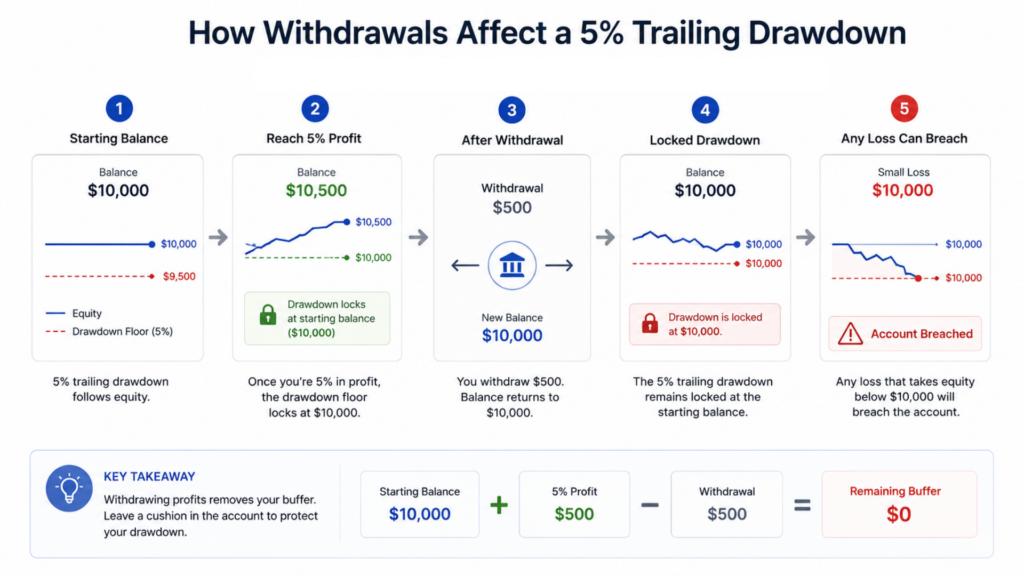
This is one of the most important mechanics to understand before making the first withdrawal.
On trailing drawdown programs, withdrawing profits reduces the account balance. The trailing distance remains fixed. What changes is where the current balance sits relative to the floor.
The general principle is this: after a withdrawal, the gap between your account balance and the drawdown floor is smaller than before the withdrawal. Traders who withdraw the full available profit and immediately resume normal position sizing are trading with less room than they may realise.
A practical approach used by many funded traders is to leave a buffer in the account after withdrawals rather than withdrawing every available dollar.
Position sizing should always account for the worst-case daily move, not the average expected move.
What Most Traders Get Wrong After Passing
Overtrading
Some traders start placing trades without written criteria because they feel pressure to produce results quickly. More trades do not produce more profit. They generate more exposure than the daily loss limit allows.
Increasing position size too quickly
A few profitable trading days often lead traders to significantly increase their position size. One oversized losing trade can remove weeks of gains. Position sizing should scale with track record and drawdown room, not with short-term confidence.
Misunderstanding payout timing
Many traders expect a payout immediately after the evaluation. Payouts require a minimum number of trading days, a minimum profit, and full compliance with all rules. Missing any one of these delays the payout regardless of how much profit the account has generated.
Ignoring the drawdown floor after withdrawals
On trailing drawdown programs, withdrawing profit and continuing to trade at the same position size reduces the available buffer. Traders should recalculate their drawdown room after every withdrawal before sizing the next trade.
How Behaviour Changes After Funding
Two patterns appear in traders who lose funded accounts quickly.
The first is excessive caution. The trader avoids valid setups because the fear of losing the account overrides the pre-written criteria. The result is missed entries, flat sessions, and a profit target that drifts further away.
The second is oversizing. The trader takes larger positions after early gains, treating the funded account as a vehicle for maximum short-term extraction rather than a long-term operation.
Both patterns have the same mechanical outcome. The drawdown floor is approached faster than necessary.
The traders who retain funded accounts longest trade the same way after funding as they did in the final stages of their evaluation. Consistent position sizing. Written entry criteria. Pre-calculated daily loss limit threshold before the first trade.
For the pre-session framework that makes this consistent, see The Psychology of Pre-Session Preparation in Trading.
Bottom Line
Passing the evaluation sets the criteria. The funded account is where those criteria apply permanently.
The first funded trade is not a reward. It is the start of a different kind of test. The rules are the same. The consequences of breaking them are not.
Run the pre-session check. Calculate the daily loss limit threshold before every trading day. Know your drawdown floor. Size positions against the worst-case move.
Explore FXIFY’s programs and learn the account rules before you place your first trade.
FAQs
Do you get paid immediately after passing the evaluation?
No. Passing the evaluation qualifies you for a funded account; it doesn’t make you immediately eligible for a payout. Before requesting a payout, you’ll need to meet your program’s eligibility requirements, such as the minimum trading days, minimum profit threshold, and full compliance with the trading rules.
FXIFY offers a First Payout On Demand feature, allowing eligible traders to request their first payout as soon as all requirements have been met, rather than waiting for the standard payout schedule.
What is a funded account?
A funded account gives you access to capital under the prop firm’s defined trading framework. You trade under the firm’s rules and receive a performance split, which is a percentage of the profits you generate. A breach of the drawdown limit or a rule violation will permanently close the account.
How do payouts work on FXIFY?
Payouts are processed when a trader meets the eligibility conditions for a given cycle. These include minimum trading days, minimum profit, and drawdown compliance throughout the period. Once eligible, traders submit a payout request and receive their performance split. Cycle timing and conditions vary by program. Always verify current terms at fxify.com/fast-payouts.
Can you lose your funded account?
Yes. Breaching the drawdown limit, violating account rules, or failing to meet minimum activity requirements permanently closes the account. A common cause is withdrawing all available profit and then continuing to trade without recalculating the remaining drawdown room. Understanding your drawdown structure and the effect of withdrawals before placing any trade is essential.
What happens after your first payout?
After your first payout, trading continues under the same FXIFY account rules, and you’ll move to your program’s standard payout schedule for future requests. Once a payout request is submitted, your account may be placed into read-only mode while the request is being reviewed. After the payout has been processed, trading can resume as normal. By continuing to trade consistently and follow the account rules, you can build a strong payout history over time.
Do the same rules from the evaluation apply after funding?
Core rules carry forward, including drawdown limits and trading restrictions. Some programs adjust specific parameters at the funded step. Review your funded account terms carefully before you begin trading. Do not assume the funded account is identical to the evaluation without verifying the specific conditions for your program.