


Trading After a Big Loss: How to Reset Without Making It Worse
You just took a big loss. The chart is still open, but you’re already thinking about the next trade. Right now is the highest-risk moment…
You just took a big loss. The chart is still open, but you’re already thinking about the next trade.
Right now is the highest-risk moment of your trading day. Not because of what just happened, but what you’re about to do next. Most accounts don’t get blown by a single bad trade, but by the trade that comes right after it.
What you do in the next five minutes will either contain the loss or compound it. There are four responses traders make at this moment. Three make it worse. Let’s explore what each one does to the account and what the fourth looks like.
Key Terms
| Term | What it means |
| Tilt | Making decisions driven by emotional response to recent losses rather than a normal strategy. Often expressed through oversized positions, low-quality setups, or rapid-fire trades. |
| Revenge trade | A trade taken specifically to recover a recent loss, usually outside the trader’s normal setup criteria. |
| Position sizing | The dollar amount risked on a single trade. Usually expressed as a percentage of account equity. |
| Clean reset | Returning to the trader’s normal setup criteria and position size after a loss. Treating the loss as a lesson from the past rather than something to recover from. |
What’s in this guide
- Why is the moment after a big loss the highest-risk moment of the day
- The four responses traders make after a big loss
- What each response does to the account
- What the clean reset actually looks like
Why the Moment After a Big Loss Is the Highest-Risk Moment of the Day
When you take a major hit, your account dynamics change instantly as the loss flattens your capital cushion. On a $100,000 account, a $1,500 hit means you are suddenly operating much closer to your daily loss limit and maximum drawdown boundary. Any additional loss in that same session hits harder.
Your judgment is also at its weakest right now. You haven’t evaluated the next setup against your normal criteria. You’re still processing the latest loss. This mix of compressed buffer and compromised evaluation is exactly why traders fail prop firm challenges. It is not a single bad trade that kills an account, but a bad trade followed by a worse response.
The Four Responses Traders Make After a Big Loss
1. The Tilt-Trade (Trying to Immediately Win Back the Loss)
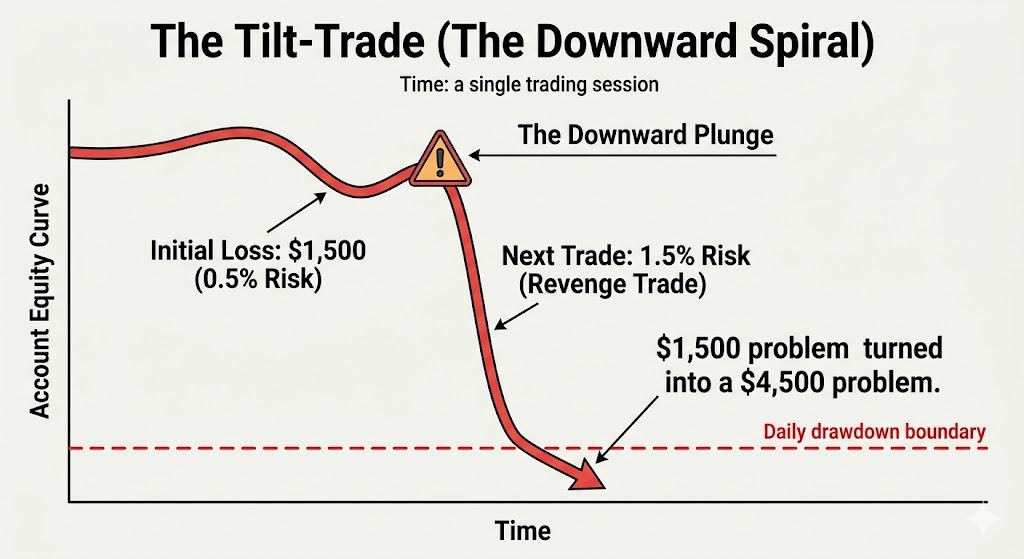
What it looks like: You took a $1,500 loss at 0.5% risk, with forty minutes left in the session. You size the next trade at 1.5% to make it back before the close. Maybe you take two or three quick trades in a row.
What it does to the account: If that next trade loses at 1.5% risk, you’re now $4,500 down in the session. The buffer that was tight after the first loss is gone. One more loss and you’re looking at a breach. You turned a $1,500 problem into a $4,500 problem in forty minutes.
Why it fails mechanically: The math doesn’t support recovering a loss in a single trade unless the position size is dangerous. Recovery to normal size takes multiple sessions. Trying to do it in one trade means taking outsized risk on your worst judgment of the day.
2. The Freeze (Stepping Back, Missing Valid Setups)
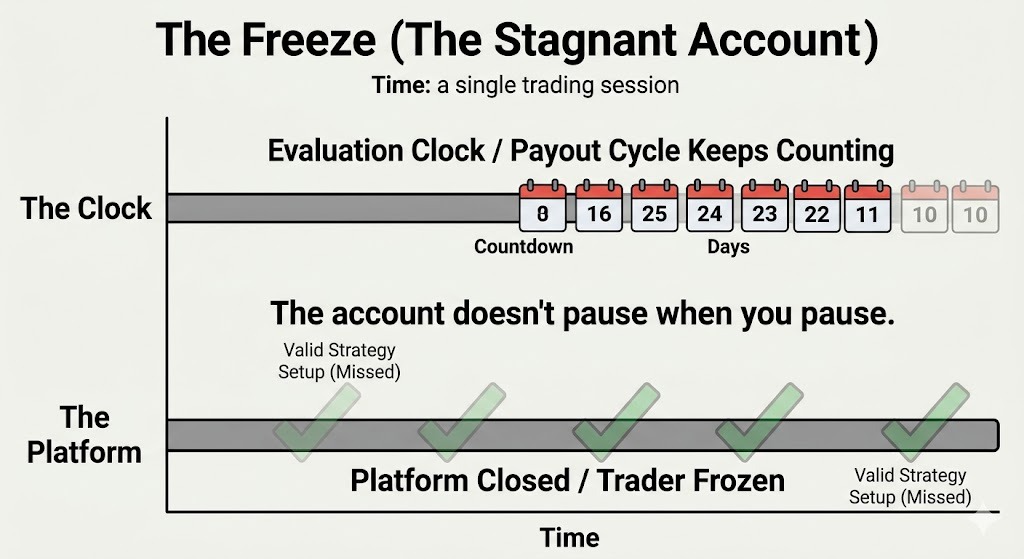
What it looks like: You close the platform. You don’t trade for the rest of the day or the rest of the week. Setups appear that you would normally take, and you skip them.
What it does to the account: On a funded account, missed valid setups mean falling behind payout cycle requirements. On a challenge, missed setups mean running out of evaluation time without enough trades. The account doesn’t pause when you pause.
Why it fails mechanically: The drawdown limits stay in place while you’re frozen. The payout cycle keeps counting. The evaluation clock keeps running. The freeze feels like avoiding risk. It converts one bad trade into a structural setback.
3. The Forced Setup (Taking a Trade That Wouldn’t Normally Pass)
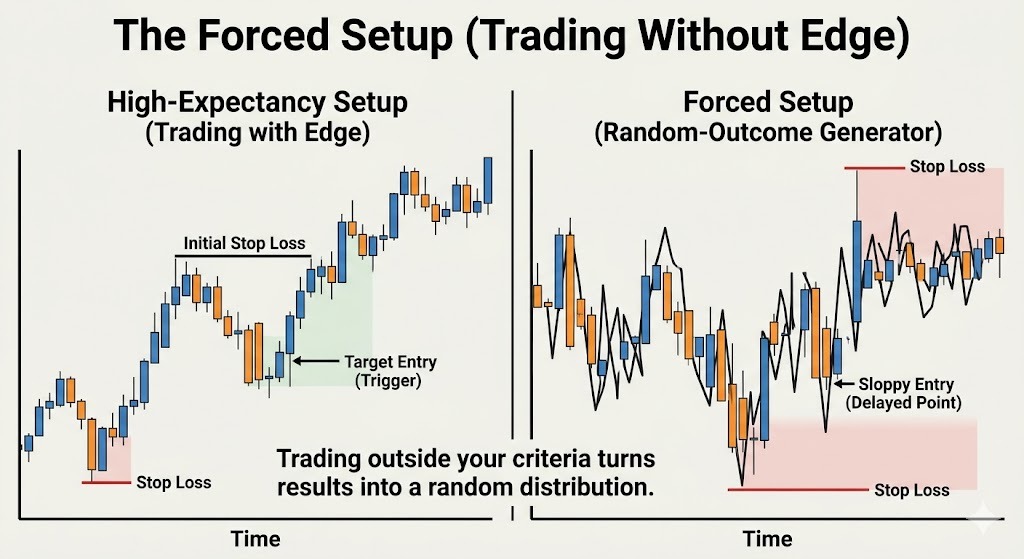
What it looks like: You’re not trying to revenge trade. You just feel the need to be in the market. You take a setup that wouldn’t normally pass your criteria: a wider stop, a lower-quality structure, a pair you don’t usually trade. It doesn’t feel like tilt. It is.
What it does to the account: Low-quality entries have worse expectancy than your normal setups. Your edge lives in your criteria. Trading outside those criteria is trading without edge. The capital at risk might match a normal trade, but the probability of it working is lower.
Why it fails mechanically: Edge is your only long-term advantage. Trading outside your criteria turns the account into a random-outcome generator. Over enough trades outside your setup, results converge to a random distribution, and that random distribution loses to the spread and slippage every time. It’s one of the clearest patterns in how marginal trading erodes funded account performance across a payout cycle: it’s not one forced trade; it’s the habit.
4. The Clean Reset (Trading the Next Setup Like the Loss Never Happened)
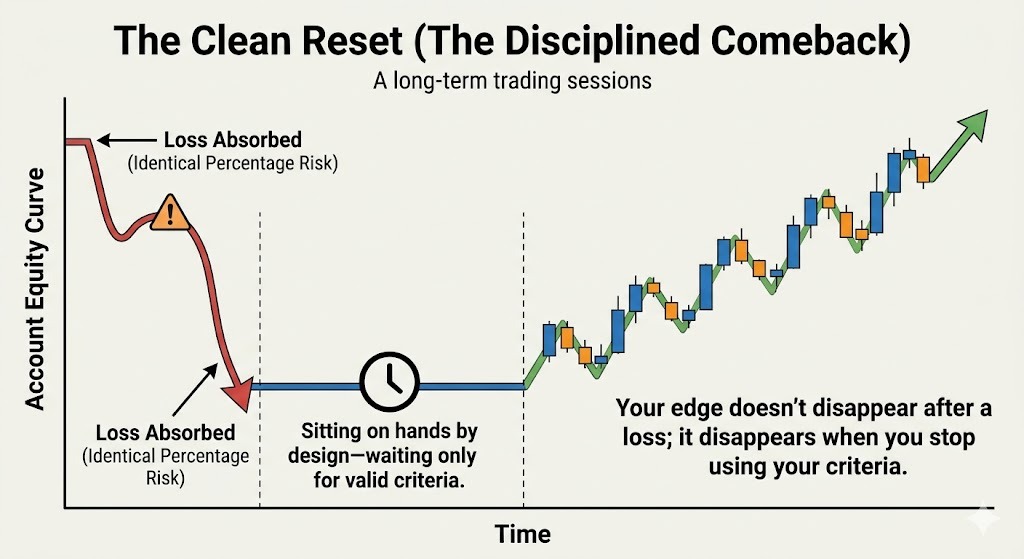
What it looks like: You close the chart with the loss on it. You check your normal setup criteria. You wait. When a setup appears that meets those criteria, you size it the same way you sized trades before the loss. You take it and manage it like any other trade.
What it does to the account: The loss is in the past. The account is smaller, the buffer tighter. But you’re running the same strategy with the same edge. Over enough trades, the strategy’s expectancy reasserts itself.
Why it works mechanically: Your edge doesn’t disappear after a loss. It disappears when you stop using your criteria. The clean reset is the only response that maintains those criteria. The clean reset is sitting on your hands by design, and most don’t.
What the Clean Reset Actually Looks Like
- Close the chart that has the loss on it. Switch to a different pair or close the platform for an hour. The visual of the losing trade interferes with the evaluation of the next setup.
- Write down what counts as your next valid setup. Specific criteria: pair, structure, entry trigger, stop, target. Write it down. If your criteria have shifted since before the loss, you’re not ready to trade.
- Don’t change your size. Same percentage risk as before the loss. Sizing down because the account is smaller and sizing up to recover faster are the same mistake. Both are responses to the loss. Neither is part of your strategy.
- Don’t trade for the rest of the session if no valid setup appears. Missing a session is normal. Having time left in the session is not a reason to trade.
- Treat the loss as already accounted for in your monthly distribution. Big losses are part of any strategy’s expected range. They don’t need to be recovered. They need to be absorbed. The next trade is not a recovery trade.
FAQs
- What should I do immediately after a big trading loss?
Close the chart showing the loss. Write down the specific criteria your next setup needs to meet. If nothing in the current session meets them, don’t trade. The immediate action is to stop before you act, not to act to fix what happened.
- Should I reduce position size after a big loss?
No. Sizing down is a reaction to the loss, not to your strategy. Your normal size is calibrated to your account and criteria. Drop it only if account rules require it at a specific drawdown threshold, not as a response to a single trade.
- Is it normal to want to win back a loss immediately?
Yes. The urge to recover is a normal response to losing. What matters is whether you treat it as a signal to act or a signal to wait. Recognizing the urge and not trading on it is the mechanism of the clean reset.
- How long should I wait before trading again after a big loss?
Long enough to write your next valid setup criteria without the loss influencing them. For most traders, that’s at least an hour, often the rest of the session. The test isn’t timed. It’s whether your criteria have stayed intact.
- What’s the difference between a clean reset and just stopping for the day?
Stopping for the day is the freeze: you disengaged because of the loss. The clean reset means staying engaged with your criteria and stopping only when nothing valid appears. The outcome can look the same. The mechanics are different.
- Does tilt always lead to more losses?
Not on every trade. But the risk profile is consistently worse: larger size, lower setup quality, worse expected outcome. One tilt-trade that wins is still a tilt-trade. Over enough of them, results are predictably worse.
- How do I know if I’m trading on tilt?
Check your position size against your normal size. If it’s larger, you’re on tilt. Check the setup against your criteria. If it doesn’t meet them, you’re forcing. The simplest test: if the loss hadn’t happened, would you take this trade at this size? If the honest answer is no, stop.
Bottom Line
The trade after a big loss is the highest-risk trade of the day. The buffer is compressed, the judgment is compromised, and three of the four responses traders make add to the damage. The tilt-trade risks a breach. The freeze costs progress. The forced setup trades away your edge. Only a clean reset keeps the account intact and the strategy working.
Close the chart on the loss. Write down your next valid setup criteria. Wait for a setup that meets them. Same size as before the loss. The loss is already in the past; the next trade has nothing to recover.
Execution conditions matter on every trade, including the next one after a big loss. FXIFY is broker-backed by FXIFY Markets, an established broker operating since 2010, with direct liquidity provider relationships and control over how orders are routed, rather than running on a third-party retail broker’s feed.
Explore FXIFY’s programs to find the rule set that matches how you trade.