

Weekly Market Analysis: What’s Moving the Markets This Week (1–5 September)
September opens with more clarity than most months. Fed Chair Kevin Warsh spoke at Jackson Hole on Friday. Core PCE landed on Tuesday. The Q2…

September opens with more clarity than most months. Fed Chair Kevin Warsh spoke at Jackson Hole on Friday. Core PCE landed on Tuesday. The Q2 GDP second estimate was confirmed on Wednesday. All three pointed in the same direction.
The data and the speech both point toward further tightening rather than an extended pause.
Here is what happened, what it means, and what this week decides before the September 16 FOMC meeting.
What Warsh Said at Jackson Hole
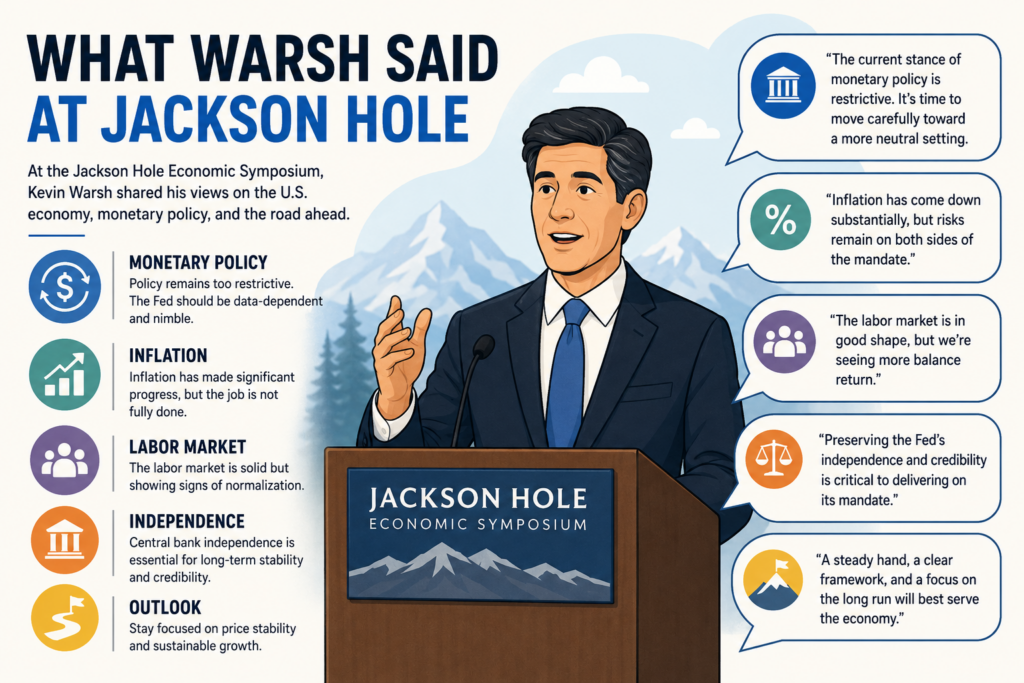
On Friday 28 August, Warsh delivered his first major address as Fed Chair. The headline across major financial outlets was consistent: inflation is still too high and the Fed may need to raise rates.
The specific language that moved markets came from two passages. First, Warsh said he would be “hard pressed to describe broad financial conditions as restrictive,” pointing to investment in equipment and intangibles running approximately 9% higher year-on-year, S&P 500 corporate profits up more than 20%, and credit spreads near historic lows. That framing directly challenged the assumption that current policy is doing enough. Second, he set out his standard for when the hiking cycle ends: “We must be confident that underlying inflation is moving to our objective clearly and at sufficient speed. Otherwise, we have work to do.”
Markets read that framing as pointing toward further tightening rather than an extended pause.
Warsh also used the speech to formalise his doctrine on forward guidance, laying out his guiding principles as a stated framework for the first time. The key points: judge trends, not isolated data points; short-term interest rates are the predominant tool; unconventional measures such as asset purchases should be used sparingly, if at all; and money supply growth matters as a signal.
The market reaction was immediate. Treasury yields rose sharply. The Dollar strengthened across major pairs. September hike expectations, which had fallen to 31.6% before the speech, jumped to approximately 55-60% on Friday afternoon per CME FedWatch, then climbed further to 66.1% by Monday morning per CNBC citing CME Group data. Fortune described the new message as having “immediately triggered a jump in expectations for a near-term rate increase.”
The question Warsh did not answer: whether September is the meeting where the Fed acts. The August CPI lands on 11 September and August NFP lands this Thursday. Both arrive before the September 16 decision. Warsh has been explicit that he will not pre-commit. Thursday’s jobs report is the next major data point before the September 16 decision and will be closely watched for signals on labour market direction.
What the Data Said Last Week
Core PCE July: in line, but still running hot
The Federal Reserve’s preferred inflation measure came in exactly as forecast on Tuesday. Core PCE rose 0.2% month-on-month in July and 3.3% year-on-year, unchanged from June’s annual rate. Headline PCE also rose 0.2% for the month and 3.7% year-on-year.
The in-line result did not change the trajectory but did confirm that inflation is not accelerating. Real consumer spending was essentially flat in July, rising less than 0.1% after adjusting for inflation, a sharp deceleration from June’s 0.4% real gain. Personal income rose 0.4% and disposable income rose 0.5%, both faster than June. The saving rate held at 3.0%, near a four-year low.
The BEA simultaneously released the second estimate for Q2 GDP, which confirmed growth at an annualised rate of 1.5%, unchanged from the advance estimate but with a meaningful revision inside the numbers. The Q2 PCE price index was revised up to 5.3% from 5.1%, and the core PCE price index for Q2 was revised up to 3.6% from 3.4%. That upward revision to the price data, even in a GDP estimate that held the headline unchanged, added to the inflation concern heading into Warsh’s Friday speech.
What it means: Core PCE at 3.3% is 1.3 percentage points above the Fed’s 2% target and has been above target for more than five years, with the most recent reading covering July 2026 marking the 64th consecutive month above the 2% threshold. The in-line result keeps the pressure on without giving the doves a clear reason to push back against the hawkish tone from Jackson Hole.
This Week’s Events
The week starts quietly with US markets closed Monday for Labor Day, before building toward the most closely watched labour market reading ahead of the September 16 FOMC meeting.
Tuesday, 1 September — ISM Manufacturing PMI (USD) | 2:00 PM GMT

The first major data release of September covers the health of the US manufacturing sector in August. The report lands at 10:00 AM ET, the first business day the US market is open this week.
July’s ISM Manufacturing PMI came in at 55.6, the highest reading since May 2022 and the seventh consecutive month of expansion. That acceleration from June’s 53.3 was one of the stronger manufacturing readings of the current cycle. The 50-point mark divides expansion from contraction. A sustained reading above 54 is consistent with an economy that can absorb further tightening.
What traders are watching:
Above 54 — Bullish USD. Confirms manufacturing momentum is holding. Adds to the case that the economy can handle a September hike.
Below 50 — Bearish USD. A contraction signal after seven consecutive months of expansion would be a significant shift in the data and would ease September hike expectations.
Wednesday, 3 September — ISM Services PMI (USD) | 2:00 PM GMT
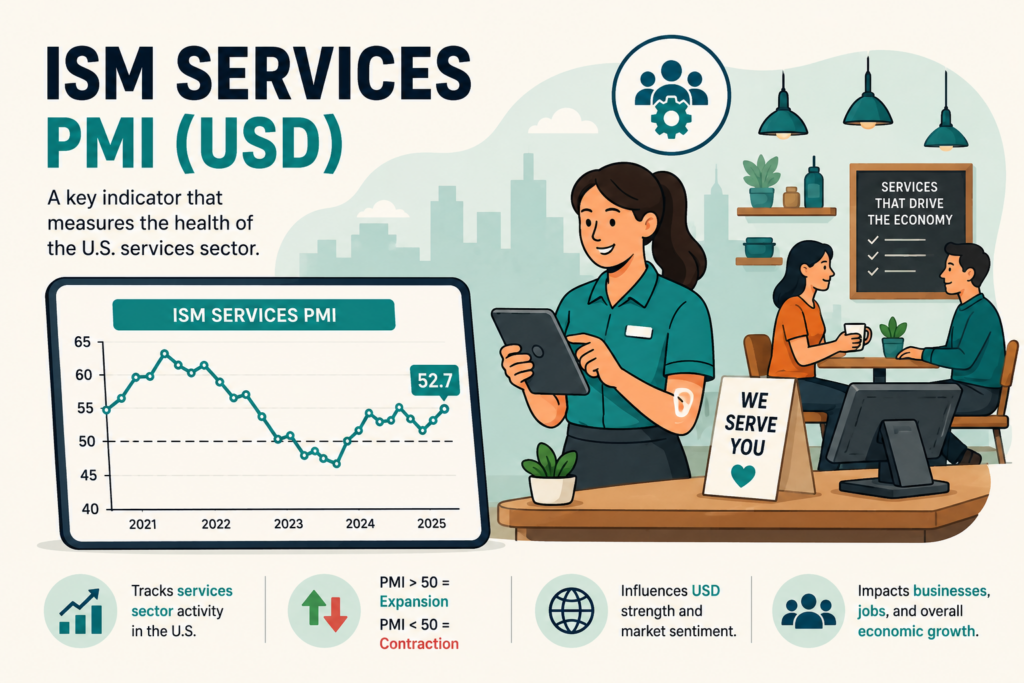
The services sector covers roughly 80% of the US economy. A reading above 50 signals expansion. The report lands at 10:00 AM ET on Wednesday.
July’s ISM Services PMI has not yet been confirmed at time of writing. The sector has been in expansion for over 12 consecutive months. Given that real consumer spending was essentially flat in July, Wednesday’s services reading will show whether the softness in the spending data has begun to feed through to business activity.
What traders are watching:
Above 55 — Bullish USD. Consistent with a healthy services economy and reduces the urgency for the Fed to pause.
Below 50 — Bearish USD. A contraction in services would be the clearest signal yet that tighter policy is weighing on the largest part of the economy.
Thursday, 4 September — Non-Farm Payrolls and Unemployment Rate (USD) | 12:30 PM GMT
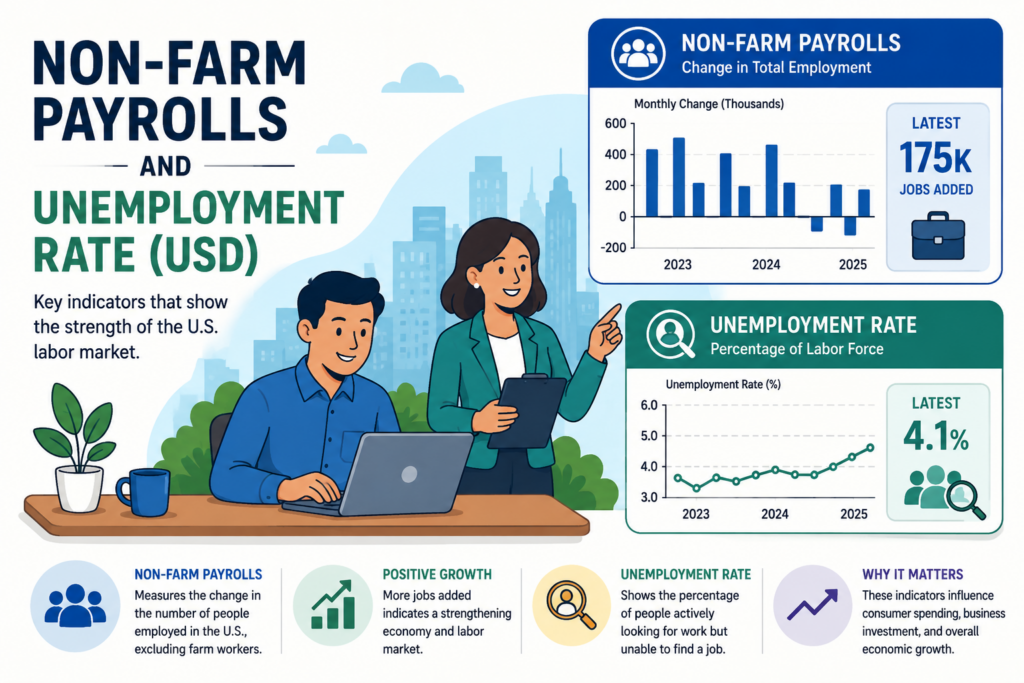
The August employment situation report lands at 8:30 AM ET Thursday, the last major labour market data point before the September 16 FOMC meeting.
The context makes this report carry unusual weight. July NFP came in at -23,000, the first negative print of the current tightening cycle. June was revised down to +20,000 from +57,000. May was revised down to +63,000 from +129,000. The combined May and June revision subtracted 103,000 jobs from previously reported figures. Temporary layoffs surged to 921,000 in July, a level that has historically been an early signal of broader labour market deterioration.
The consensus forecast for August is 55,000 jobs added, with the unemployment rate expected to hold at 4.1% and average hourly earnings growth slowing to 3.0% year-on-year from 3.2% in July. FinancialJuice’s NFP preview, published Monday 1 September, sets the forecast range at -25,000 to +102,000, an unusually wide band that reflects genuine uncertainty about whether July’s negative print was a temporary distortion or the start of a trend.
Warsh’s Jackson Hole speech introduced a specific test: the Fed needs to be “confident that underlying inflation is moving to our objective clearly and at sufficient speed.” A weak August NFP would raise the question of whether the economy is already slowing without any additional policy tightening, which would complicate the case for hiking at a meeting just 12 days away. A strong rebound above 100,000 would validate the hawks and would likely push September hike probability above 70%, building on the 66.1% already priced by CME FedWatch as of Monday morning.
Average hourly earnings carry additional weight this month. Wage growth slowed from 3.5% to 3.2% in July. A further deceleration toward 3.0% would reduce the wage-inflation channel concern. An acceleration back above 3.5% would add to the case for tightening.
What traders are watching:
Strong rebound above 100,000 — Bullish USD. Confirms labour market strength and validates the case for a September hike. September hike expectations rise sharply. Dollar strengthens.
Weak print or second consecutive negative — Bearish USD. Signals the labour market is deteriorating and reduces the case for an imminent hike. September hold expectations build and the Dollar weakens.
The September 16 Picture
After Warsh’s speech, the September 16 FOMC decision sits in a genuinely uncertain zone. The Fed’s own preferred inflation measure is running at 3.3% year-on-year. The chair has publicly said financial conditions do not look restrictive. Three FOMC members voted to hike in July. The minutes showed broader sympathy for the hawkish case beyond those three.
Set against that: the labour market has printed two consecutive months of very weak data. Real consumer spending was flat in July. Retail sales fell 0.6% in July. Consumer confidence fell to 51.0 in the preliminary August University of Michigan reading.
Thursday’s NFP is the data point that decides which of those two pictures the committee weighs more heavily on September 16. The FOMC will also have August CPI on 11 September before making its decision. But NFP lands first. And in a meeting where Warsh has stated the Fed is watching trends rather than isolated prints, two consecutive negative payroll months would meet his own stated test of a trend rather than an isolated data point.
Calendar Snapshot
| Date | Event | Currency | Time (GMT) |
|---|---|---|---|
| Tue 1 Sep | ISM Manufacturing PMI | USD | 2:00 PM |
| Wed 3 Sep | ISM Services PMI | USD | 2:00 PM |
| Thu 4 Sep | Non-Farm Payrolls | USD | 12:30 PM |
| Thu 4 Sep | Unemployment Rate | USD | 12:30 PM |
| Thu 4 Sep | Average Hourly Earnings | USD | 12:30 PM |
A Quick Note on Risk
Economic data releases can cause sharp, fast moves in the market. Price can spike in both directions before settling. This week the primary risk window is Thursday at 12:30 PM GMT when the August employment situation report lands. With the September 16 FOMC meeting 12 days away, any significant surprise in either direction is likely to generate an outsized market reaction. Make sure you understand how your FXIFY account drawdown rules work before you trade around major news events. For more on how funded traders approach volatile sessions, see our guides on trading styles for funded traders and how news events affect prop traders.